Results by title
15 books match the query 'Insects'
Acoustic Communication in Insects and Anurans
Common Problems and Diverse SolutionsH. Carl Gerhardt and Franz Huber
University of Chicago Press, 2002
H. Carl Gerhardt and Franz Huber address these questions among many others, drawing on research from bioacoustics, behavior, neurobiology, and evolutionary biology to present the first integrated approach to the study of acoustic communication in insects and anurans. They highlight both the common solutions that these very different groups have evolved to shared challenges, such as small size, ectothermy (cold-bloodedness), and noisy environments, as well as the divergences that reflect the many differences in evolutionary history between the groups. Throughout the book Gerhardt and Huber also provide helpful suggestions for future research.
Architecture by Birds and Insects
A Natural ArtPaintings by Peggy Macnamara
University of Chicago Press, 2008
A visual celebration of these natural feats of engineering and ingenuity, Architecture by Birds and Insects allows readers a peek inside a wide range of nests, offering a rare opportunity to get a sense of the materials and methods used to build them. Here, we see the kinds of places where nests are built—for instance, the house wren has been known to occupy cow skulls, flower pots, tin cans, and the pockets of hanging laundry, while the uglynest caterpillar prefers rose bushes and cherry trees. Inspired by the vast nest collection at the Field Museum, which features specimens gathered throughout North and South America, Peggy Macnamara’s paintings are enhanced by text written by museum curators. This narrative provides a foundation in natural history for each painting, as well as fascinating anecdotes about the nests and their builders.
Like so many natural treasures, nests are easy to ignore. But Macnamara’s gorgeous paintings will undoubtedly change that. Architecture by Birds and Insects at last gives the tiniest engineers their rightful moment in the spotlight, and in so doing increases awareness and encourages the protection of birds, insects, and their habitats. Readers will never look at a Frank Gehry design, or a treetop nest, the same way again.
Common Insects of Texas and Surrounding States
A Field GuideBy John Abbott and Kendra Abbott
University of Texas Press, 2020
Thanks to its size and geographic position, Texas is home to nearly 30,000 species of insects, likely making its insect population the most diverse in the nation. Ranging from eastern and western to temperate and tropical species, this vast array of insects can be difficult to identify. In Common Insects of Texas and Surrounding States, John and Kendra Abbott have created the state's most comprehensive field guide to help readers recognize and understand these fascinating creatures.
Containing 1,300 species and more than 2,700 photographs, this guide offers a wealth of information about the characteristics and behaviors of Texas's insects. Each chapter introduces an order with a discussion of general natural history and a description of other qualities helpful in distinguishing its various species, while every species' entry provides a state map showing where it is most likely to be found, a key displaying its seasonal distribution, information about its habitat, and corresponding photos. Featuring colored tabs for quick reference, a glossary, and information about other arthropods, this guide is the perfect companion for anyone wanting to identify and learn more about the many insects of Texas.
Illinois Insects and Spiders
Paintings by Peggy Macnamara
University of Chicago Press, 2005
Marrying art and entomology, Illinois Insects and Spiders is a unique introduction to local biodiversity. Artist Peggy Macnamara celebrates the state's burgeoning insect and spider populations with twenty-seven color plates of beautiful renderings of numerous species, organized both taxonomically and thematically. The insects on each plate are depicted true to scale in relation to one another and are displayed approximately ten times larger than life size. Accompanying each plate are lively captions-written by Field Museum curators and collection managers-that identify the species and reveal their interesting behaviors and unique habitats.
Illinois Insects and Spiders encourages readers to explore the biodiversity at their feet-in the shiny beetles on the ground-and in the air-in the glint of a lightning bug in summer. More than a traditional field guide, Illinois Insects and Spiders is the rare book that combines lush artwork with the science of natural history, bringing both closer to the general reader.
In a Desert Garden
Love and Death among the InsectsJohn Alcock
University of Arizona Press, 1999
As Alcock studies the plants in his yard, he shares thoughts on planting, weeding, and pruning that any gardener will appreciate. And when commenting on the mating rituals of spiders and beetles or marveling at the camouflage of grasshoppers and caterpillars, he uses humor and insight to detail the lives of the insects that live in his patch of desert. Celebrating the virtues of even aphids and mosquitoes, Alcock draws the reader into the intricacies of desert life to reveal the complex interactions found in this unique ecosystem. In a Desert Garden combines meticulous science with contemplations of nature and reminds us that a world of wonder lies just outside our own doors.
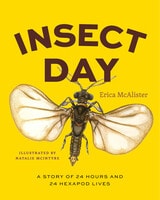
Insect Day
A Story of 24 Hours and 24 Hexapod LivesErica McAlister
University of Chicago Press, 2026
An hourly guide that follows twenty-four insects as they find food, mates, and safety from predators.
In this short book, celebrated scientist and award-winning author Erica McAlister leads readers on a worldwide field trip in search of insects. Each chapter of Insect Day introduces a single insect during a single hour, highlighting how twenty-four different species spend their time.
Early in our day, we meet a cold Arctic bumblebee, basking among poppy flower petals to warm itself. Even when the world around her is very cold, she keeps remarkably warm simply by vibrating. Near midday, there is enough sunlight for the blue-winged helicopter, a damselfly, to navigate the forests for her prey. When our insect spots a spider web, she looks for its creator—one vicious hunter eyeing up another. The giant damselfly reverses away from the web and then launches into an attack, grabbing onto the spider with her forelegs. If successful (many spiders are dropped), she perches while feasting. And then, like the most fastidious of diners, she cleans off any gossamer threads with a good preen. In the dark, the dung beetle also looks to the sky, using the Milky Way to orient itself as it rolls a ball of dung—a future home for its offspring. And, as our day closes, a tiger moth escapes bat hunters by fighting sound with sound—jamming bats’ sonar with ultrasonic clicking noises.
For each chapter, artist Natalie McIntyre has depicted these insects in stunning illustrations, blending traditional scientific drawing methods with fine art techniques. Working together to narrate and illustrate these unique moments in time, McAlister and McIntyre have created an engaging read that is a perfect way to spend an hour or two—and a true gift for readers, amateur naturalists, and all insect lovers.
Insect Media
An Archaeology of Animals and TechnologyJussi Parikka
University of Minnesota Press, 2010
Through close engagement with the pioneering work of insect ethologists, including Jakob von Uexküll and Karl von Frisch, posthumanist philosophers, media theorists, and contemporary filmmakers and artists, Parikka develops an insect theory of media, one that conceptualizes modern media as more than the products of individual human actors, social interests, or technological determinants. They are, rather, profoundly nonhuman phenomena that both draw on and mimic the alien lifeworlds of insects.
Insect Poetics
Eric C. Brown
University of Minnesota Press, 2006
In Insect Poetics, the first book to comprehensively explore the cultural and textual meanings of bugs, editor Eric Brown argues that insects are humanity’s “other.” In order to be experienced, the insect world must be mediated by art or technology (as in the case of an ant farm or Kafka’s Metamorphoses) while humans observe, detached and fascinated.
In eighteen original essays, this book illuminates the ways in which our human intellectual and cultural models have been influenced by the natural history of insects. Through critical readings contributors address such topics as performing insects in Shakespeare’s Coriolanus, the cockroach in the contemporary American novel, the butterfly’s “voyage out” in Virginia Woolf, and images of insect eating in literature and popular culture. In surprising ways, contributors tease out the particularities of insects as cultural signifiers and propose ways of thinking about “insectivity,” suggesting fertile cross-pollinations between entomology and the arts, between insects and the humanities.
Contributors: May Berenbaum, Yves Cambefort, Marion W. Copeland, Nicky Coutts, Bertrand Gervais, Sarah Gordon, Cristopher Hollingsworth, Heather Johnson, Richard J. Leskosky, Tony McGowan, Erika Mae Olbricht, Marc Olivier, Roy Rosenstein, Rachel Sarsfield, Charlotte Sleigh, Andre Stipanovic.
Eric C. Brown is assistant professor of English at the University of Maine at Farmington. He has written previously about insects and eschatology in Edmund Spenser’s Muiopotmos.
Insects of the Great Lakes Region
Gary A. Dunn
University of Michigan Press, 1996
The insects are the world's most amazing animals and comprise over eighty-five percent of the known animal species. Insects of the Great Lakes Region is the first comprehensive guide to document the rich and diverse insect fauna of the Great Lakes region. In Insects of the Great Lakes Region, educators, insect enthusiasts, and the general public will find high-quality, well-presented, easy-to-understand information with over 250 illustrations of the insects found in yards, gardens, fields, and forests. Among the topics discussed are the geological, biological, and entomological history of the Great Lakes region, the distributional patterns of insects in the Great Lakes region, and insect classification and identification. Appendixes guide the reader to entomological organizations, entomological periodicals, public insect collections, regulations on collecting insects from public lands in the Great Lakes region, as well as rare, threatened, and endangered insects. This guide shows the amateur entomologist everything he needs to know, from where to collect milkweed bugs to how often to feed his pet tarantula.
Gary Dunn is Executive Director and Editor, Young Entomologists' Society, Inc., International Headquarters, Lansing, Michigan.
Ninety-nine Gnats, Nits, and Nibblers
May R. Berenbaum
University of Illinois Press, 1989
Why the "Jesus bug" can walk on water
How the katydid’s nighttime noise inspired romantic poetry
The trapping prowess of the hungry antlion
That disgusting thing chiggers do to eat your skin
A witty and educational guide that’s as accessible as the container of flour you should have closed more tightly, Ninety-nine Gnats, Nits, and Nibblers is the fascinating story of our million closest neighbors.
Ninety-nine More Maggots, Mites, and Munchers
May R. Berenbaum
University of Illinois Press, 1993
Why the rove beetle gives mind-altering drugs to ants
How the snail-killing fly enjoys its escargot
Why Piophila casei doesn’t care when you eat its larvae
What strange fate awaits a honey ant worker engorged with nectar
As lively as a fly in the buttermilk, Ninety-nine More Maggots, Mites, and Munchers is a who’s who and what’s THAT? guide to Lilliputian life-forms both familiar and obscure.
Planet of the Bugs
Evolution and the Rise of InsectsScott Richard Shaw
University of Chicago Press, 2014
Leaving no stone unturned, Shaw explores how evolutionary innovations such as small body size, wings, metamorphosis, and parasitic behavior have enabled insects to disperse widely, occupy increasingly narrow niches, and survive global catastrophes in their rise to dominance. Through buggy tales by turns bizarre and comical—from caddisflies that construct portable houses or weave silken aquatic nets to trap floating debris, to parasitic wasp larvae that develop in the blood of host insects and, by storing waste products in their rear ends, are able to postpone defecation until after they emerge—he not only unearths how changes in our planet’s geology, flora, and fauna contributed to insects’ success, but also how, in return, insects came to shape terrestrial ecosystems and amplify biodiversity. Indeed, in his visits to hyperdiverse rain forests to highlight the current insect extinction crisis, Shaw reaffirms just how crucial these tiny beings are to planetary health and human survival.
In this age of honeybee die-offs and bedbugs hitching rides in the spines of library books, Planet of the Bugs charms with humor, affection, and insight into the world’s six-legged creatures, revealing an essential importance that resonates across time and space.
Poetics of the Hive
Insect Metaphor in LiteratureCristopher Hollingsworth
University of Iowa Press, 2001
The Art of Migration
Birds, Insects, and the Changing Seasons in ChicagolandPaintings by Peggy Macnamara
University of Chicago Press, 2013
As the only artist in residence at the Field Museum, Peggy Macnamara has a unique vantage point for studying these patterns and capturing their distinctive traits. Her magnificent watercolor illustrations capture flocks, movement, and species-specific details. The illustrations are accompanied by text from museum staff and include details such as natural histories, notable features for identification, behavior, and how species have adapted to environmental changes. The book follows a gentle seasonal sequence and includes chapters on studying migration, artist’s notes on illustrating wildlife, and tips on the best ways to watch for birds and insects in the Chicago area.
A perfect balance of science and art, The Art of Migration will prompt us to marvel anew at the remarkable spectacle going on around us.
The Butterflies of Iowa
Dennis W. Schlicht
University of Iowa Press, 2007