Results by title
8 books match the query 'Institution'
Carnegie Maya II
Carnegie Institution of Washington <i>Current Reports</i>, 1952-1957John M. Weeks
University Press of Colorado, 2009
The final CIW field project took place in July of 1950, in the Maya region of Mayapán, where extensive and detailed investigations were conducted for five years. To ensure the rapid dissemination of the results of the Mayapán Project, two series of papers described the work being undertaken and reported the preliminary findings. These were volumes 50 through 57 of the Year Books and numbers 1 through 41 of the Current Reports. A total of forty one Current Reports were published by the Carnegie Institution of Washington from 1952 to 1957. All forty one of these are reproduced in The Carnegie Maya II, accompanied by an introduction by John Weeks, a forward by Marilyn Masson, and a summary table of data compiled by Marilyn Masson regarding artifacts unearthed at Mayapán.
Purchase of the print book comes with free individual access to the Adobe Digital Editions Carnegie Maya Series Ebook, which contains the complete set of The Carnegie Maya, The Carnegie Maya II, The Carnegie Maya III and The Carnegie Maya IV, thus making hundreds of documents from the Carnegie Institution's Maya program available in one source.
Carnegie Maya
The Carnegie Institution of Washington Maya Research Program, 1913-1957John M. Weeks
University Press of Colorado, 2006
The Carnegie Institution of Washington sponsored archaeological, ethnographic, linguistic, and historical investigations in the Maya region of southern Mexico and northern Central America between 1914 and 1957. The institution led the field during that time, with financial support and other resources no university could match.
Dispersed and out-of-print for fifty years, more than 350 reports from the Maya program are now available in this single volume. Reports from the institution's annual Year Books and other materials collected here tell the history of Maya research through firsthand accounts by participating scholars and reveal the progression of Mesoamerican archaeology from avocational interest to scholarly pursuit. Thematic and regional organization of the reports permits readers to monitor development of research concepts. Appendixes list all Carnegie Maya publications, Carnegie personnel, and the archival holdings of Carnegie-derived material at Harvard University, Tulane University, and the University of Chicago.
Purchase of the print book comes with free individual access to the Adobe Digital Editions Carnegie Maya Series Ebook, which contains the complete set of The Carnegie Maya, The Carnegie Maya II, The Carnegie Maya III and The Carnegie Maya IV, thus making hundreds of documents from the Carnegie Institution's Maya program available in one source.
Institution and Passivity
Course Notes from the Collège de France (1954-1955)Maurice Merleau-Ponty
Northwestern University Press, 2010
Institution and Passivity is based on course notes for classes taught at the Bibliothèque Nationale de Paris. Philosophically, this collection connects the issue of passive constitution of meaning with the dimension of history, furthering discussions and completing arguments started in The Visible and the Invisible and Signs (both published by Northwestern). Leonard Lawlor and Heath Massey’s translation makes available to an English-speaking readership a critical transitional text in the history of phenomenology.

New Zealand Film and Television
Institution, Industry and Cultural ChangeTrisha Dunleavy and Hester Joyce
Intellect Books, 2011
Despite challenges arising from a limited population and the difficulty of obtaining adequate funding, both the film and television industries of New Zealand have been the source of significant achievements and profound cultural influence. Charting their emergence and subsequent development through five decades, New Zealand Film and Television looks at these two increasingly vibrant cultural and creative industries. While there is a growing body of academic work on film and television in New Zealand, relatively little exists that examines the specific cultural concerns, local industries, institutions, and policies involved, which this book addresses in full.
Pictures from an Institution
A ComedyRandall Jarrell
University of Chicago Press, 1952
A finalist for the National Book Award, this classic novel of midcentury campus life is demonically funny and brutally cutting
Beneath the unassuming surface of a progressive women’s college lurks a world of intellectual pride and pomposity awaiting devastation by the pens of two brilliant and appalling wits. Randall Jarrell’s classic novel was originally published to overwhelming critical acclaim in 1954, forging a new standard for campus satire—and instantly yielding comparisons to Dorothy Parker’s razor-sharp barbs. Like his fictional nemesis, Jarrell cuts through the earnest conversations at Benton College—mischievously, but with mischief nowhere more wicked than when crusading against the vitriolic heroine herself.
“A most literate account of a group of most literate people by a writer of power. . . . A delight of true understanding.”—Wallace Stevens
“I’m greatly impressed by the real fun, the incisive satire, the closeness of observation, and in the end by a kind of sympathy and human warmth. It’s a remarkable book.”—Robert Penn Warren
“Move over Dorothy Parker. Pictures . . . is less a novel than a series of poisonous portraits, set pieces, and endlessly quotable put-downs. Read it less for plot than sharp satire, Jarrell’s forte.”—Mary Welp
“One of the wittiest books of modern times.”—New York Times
“[T]he father of the modern campus novel, and the wittiest of them all. Extraordinary to think that ‘political correctness’ was so deliciously dissected 50 years ago.”—Noel Malcolm, Sunday Telegraph
“A sustained exhibition of wit in the great tradition. . . . Immensely and very devastatingly shrewd.”—Edmund Fuller, Saturday Review
“[A] work of fiction, and a dizzying and brilliant work of social and literary criticism. Not only ‘a unique and serious joke-book,’ as Lowell called it, but also a meditation made up of epigrams.”—Michael Wood
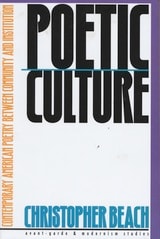
Poetic Culture
Contemporary American Poetry between Community and InstitutionChristopher Beach
Northwestern University Press, 1999
The Carnegie Maya III
Carnegie Institution of Washington Notes on Middle American Archaeology and Ethnology, 1940-1957John M. Weeks
University Press of Colorado, 2011
The series began in 1940 as an outlet for information that may have been considered too unimportant, brief, or restricted to be submitted for formal publication. However, these notes are often of great interest to the specialists for whom they are designed and to whom their distribution is restricted. The majority of the essays-most of which are on the Maya-are on archaeological subjects, epigraphy, ethnohistory and ethnography, and linguistics. As few original copies of the Notes series are known to exist in U.S. and Canadian libraries, the book will make these essays easily accessible to students, academics, and researchers in the field.
Purchase of the print book comes with free individual access to the Adobe Digital Editions Carnegie Maya Series Ebook, which contains the complete set of The Carnegie Maya, The Carnegie Maya II, The Carnegie Maya III and The Carnegie Maya IV, thus making hundreds of documents from the Carnegie Institution's Maya program available in one source.
The Carnegie Maya IV
Carnegie Institution of Washington Theoretical Approaches to Problems, 1941-1947John M. Weeks
University Press of Colorado, 2012
Only a few sets of these three contributions to the Theoretical Approaches to Problems series are known to have survived, making The Carnegie Maya IV an essential reference and research resource.
The corresponding ebook, for individual download, contains the complete set of The Carnegie Maya, The Carnegie Maya II, The Carnegie Maya III and The Carnegie Maya IV, thus making hundreds of documents from the Carnegie Institution's Maya program available in one source.