Results by title
7 books match the query 'Institution Building'
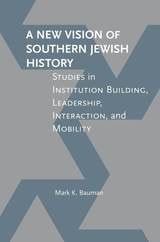
A New Vision of Southern Jewish History
Studies in Institution Building, Leadership, Interaction, and MobilityMark K. Bauman, Foreword by Ronald H. Bayor
University of Alabama Press, 2019
Essays from a prolific career that challenge and overturn traditional narratives of southern Jewish history
Mark K. Bauman, one of the foremost scholars of southern Jewish history working today, has spent much of his career, as he puts it, “rewriting southern Jewish history” in ways that its earliest historians could not have envisioned or anticipated, and doing so by specifically targeting themes and trends that might not have been readily apparent to those scholars. A New Vision of Southern Jewish History: Studies in Institution Building, Leadership, Interaction, and Mobility features essays collected from over a forty-year career, including a never-before-published article.
The prevailing narrative in southern Jewish history tends to emphasize the role of immigrant Jews as merchants in small southern towns and their subsequent struggles and successes in making a place for themselves in the fabric of those communities. Bauman offers assessments that go far beyond these simplified frameworks and draws upon varieties of subject matter, time periods, locations, tools, and perspectives over three decades of writing and scholarship.
A New Vision of Southern Jewish History contains Bauman’s studies of Jewish urbanization, acculturation and migration, intra- and inter-group relations, economics and business, government, civic affairs, transnational diplomacy, social services, and gender—all complicating traditional notions of southern Jewish identity. Drawing on role theory as informed by sociology, psychology, demographics, and the nature and dynamics of leadership, Bauman traverses a broad swath—often urban—of the southern landscape, from Savannah, Charleston, and Baltimore through Atlanta, New Orleans, Galveston, and beyond the country to Europe and Israel.
Bauman’s retrospective volume gives readers the opportunity to review a lifetime of work in a single publication as well as peruse newly penned introductions to his essays. The book also features an “Additional Readings” section designed to update the historiography in the essays.
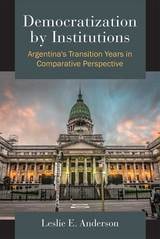
Democratization by Institutions
Argentina's Transition Years in Comparative PerspectiveLeslie E. Anderson
University of Michigan Press, 2016
In this pioneering study of democratization in Argentina, Leslie Anderson challenges Robert Putnam’s thesis that democracy requires high levels of social capital. She demonstrates in Democratization by Institutions that formal institutions (e.g., the executive, the legislature, the courts) can serve not only as operational parts within democracy but as the driving force toward democracy.
As Anderson astutely observes, the American founders debated the merits of the institutions they were creating. Examining how, and how well, Argentina’s American-style institutional structure functions, she considers the advantages and risks of the separation of powers, checks and balances, legislative policymaking, and strong presidential power. During the democratic transition, the Argentinian state has used institutions to address immediate policy challenges in ways responsive to citizens and thereby to provide a supportive environment in which social capital can develop.
By highlighting the role that institutions can play in leading a nation out of authoritarianism, even when social capital is low, Anderson begins a new conversation about the possibilities of democratization. Democratization by Institutions has much to say not only to Latin Americanists and scholars of democratization but also to those interested in the U.S. constitutional structure and its application in other parts of the world.
Institution Building in Urban Education
Morris Janowitz
Russell Sage Foundation, 1968

Making Institutions Work in Peru
Democracy, Development and Inequality Since 1980Edited by John Crabtree
University of London Press, 2006
Contributors include Paulo Drino (University of Manchester), Cynthia Sanborn (Centro de Investigaciones, Universidad del Pacifico, Lima), Carlos Monge (Participacion Ciudadana, Lima), Fernando Rospigliosi (Instituto de Estudios Peruanos, Lima), Pedro Franck (Departamento de Economia, Universidad Catolica, Lima), Fernando Eguren (Centro Peruano de Ciencias Sociales, Lima), Rosemary Thorp (Queen Elizabeth House/St Antony's College, Oxford), Eduardo Dargent (University of Texas,Austin), Coletta Youngers (Washington Office on Latin America,Washington D.C.), Francisco Durand (University of Texas, San Antonio), Jose Tavara (Departamento de Economia, Universidad Catolica, Lima, and OSIPTEL), and Richard Webb (Instituto Cuanto and Central Bank of Peru).
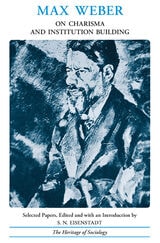
On Charisma and Institution Building
Selected WritingsMax Weber
University of Chicago Press, 1968
Max Weber on Charisma and Institution Building is a volume in "The Heritage of Sociology," a series edited by Morris Janowitz. Other volumes deal with the writings of George Herbert Mead, William F. Ogburn, Louis Wirth, W. I. Thomas, Robert E. Park, and the Scottish Moralists—Adam Smith, David Hume, Adam Ferguson, and others.
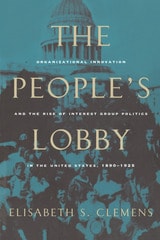
The People's Lobby
Organizational Innovation and the Rise of Interest Group Politics in the United States, 1890-1925Elisabeth S. Clemens
University of Chicago Press, 1997
Clemens sheds new light on how farmers, workers, and women invented strategies to circumvent the parties. Voters learned to monitor legislative processes, to hold their representatives accountable at the polls, and to institutionalize their ongoing participation in shaping policy. Closely analyzing the organizational politics in three states—California, Washington, and Wisconsin—she demonstrates how the political opportunity structure of federalism allowed regional innovations to exert leverage on national political institutions.
An authoritative statement on the changes in American politics during the Progressive Era, this book will interest political scientists, sociologists, and American historians.
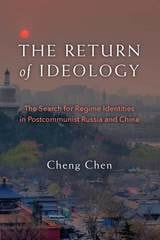
The Return of Ideology
The Search for Regime Identities in Postcommunist Russia and ChinaCheng Chen
University of Michigan Press, 2016
As a nation makes the transition from communism to democracy or another form of authoritarianism, its regime must construct not only new political institutions, but also a new political ideology that can guide policy and provide a sense of mission. The new ideology is crucial for legitimacy at home and abroad, as well as the regime’s long-term viability. In The Return of Ideology, Cheng Chen compares post-communist regimes, with a focus on Russia under Putin and post-Deng China, investigating the factors that affect the success of an ideology-building project and identifies the implications for international affairs.
Successful ideology-building requires two necessary—but not sufficient—conditions. The regime must establish a coherent ideological repertoire that takes into account the nation’s ideological heritage and fresh surges of nationalism. Also, the regime must attract and maintain a strong commitment to the emerging ideology among the political elite.
Drawing on rich primary sources, including interviews, surveys, political speeches, writings of political leaders, and a variety of publications, Chen identifies the major obstacles to ideology-building in modern Russia and China and assesses their respective long-term prospects. Whereas creating a new regime ideology has been a protracted and difficult process in China, it has been even more so in Russia. The ability to forge an ideology is not merely a domestic concern for these two nations, but a matter of international import as these two great powers move to assert and extend their influence in the world.