Results by title
17 books match the query 'Instruction'
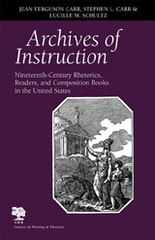
Archives of Instruction
Nineteenth-Century Rhetorics, Readers, and Composition Books in the United StatesJean Ferguson Carr, Stephen L. Carr, and Lucille M. Schultz
Southern Illinois University Press, 2005
Both a historical recovery and a critical rethinking of the functions and practices of textbooks, Archives of Instruction: Nineteenth-Century Rhetorics, Readers, and Composition Books in the United States argues for an alternative understanding of our rhetorical traditions. The authors describe how the pervasive influence of nineteenth-century literacy textbooks demonstrate the early emergence of substantive instruction in reading and writing. Tracing the histories of widespread educational practices, the authors treat the textbooks as an important means of cultural formation that restores a sense of their distinguished and unique contributions.
At the beginning of the nineteenth century, few people in the United States had access to significant school education or to the materials of instruction. By century’s end, education was a mass—though not universal—experience, and literacy textbooks were ubiquitous artifacts, used both in home and in school by a growing number of learners from diverse backgrounds. Many of the books have been forgotten, their contributions slighted or dismissed, or they are remembered through a haze of nostalgia as tokens of an idyllic form of schooling. Archives of Instruction suggests strategies for re-reading the texts and details the watersheds in the genre, providing a new perspective on the material conditions of schooling, book publication, and emerging practices of literacy instruction. The volume includes a substantial bibliography of primary and secondary works related to literacy instruction at all levels of education in the United States during the nineteenth century.
Basic Principles of Curriculum and Instruction
Ralph W. Tyler
University of Chicago Press, 1969
The four sections of the book deal with ways of formulating, organizing, and evaluating the educational objectives that have been chosen for the curriculum. Tyler emphasizes the fact that curriculum planning is a continuous cyclical process, involving constand replanning, redevelopment, and reappraisal. Substitution of such an integrated view of an instructional program for hit-or-miss judgment as the basis for curriculum development cannot but result in an increasingly effective curriculum.
Basic Principles of Curriculum and Instruction
Ralph W. Tyler
University of Chicago Press, 2013
Basic Principles of Curriculum and Instruction has been the standard in the field for decades, and it continues to be the leading guide to curriculum development today. Ralph W. Tyler presents here the concept that curriculum should be dynamic, a program under constant evaluation and revision. Before the publication of this book, curriculum had generally been thought of as a static, set program, and in an era preoccupied with student testing, he offered the innovative idea that teachers and administrators should spend as much time evaluating their plans as they do assessing their students.
Although not a strict how-to guide, the book shows how educators can critically approach curriculum planning, studying progress and retooling when needed. Its four sections focus on setting objectives, selecting learning experiences, organizing instruction, and evaluating progress. Readers will come away with a firm understanding of how to formulate educational objectives and how to analyze and adjust their plans so that students meet the objectives. Tyler also explains that curriculum planning is a continuous, cyclical process, an instrument of education that needs to be fine-tuned.
This emphasis on thoughtful evaluation has kept Basic Principles of Curriculum and Instruction a relevant, trusted companion for decades. Even as the educational landscape changes and teachers and administrators have to adjust to new developments in testing, student engagement, regulation, and more, the core principles animating this book remain as valid and effective as ever. And with school districts across the nation working to align their curriculum with Common Core standards, Tyler's straightforward recommendations are sound and effective tools for educators working to create a curriculum that integrates national objectives with their students' needs.
Basic Principles of Curriculum and Instruction
Ralph W. Tyler
University of Chicago Press, 2013
In 1949, a small book had a big impact on education. In just over one hundred pages, Ralph W. Tyler presented the concept that curriculum should be dynamic, a program under constant evaluation and revision. Curriculum had always been thought of as a static, set program, and in an era preoccupied with student testing, he offered the innovative idea that teachers and administrators should spend as much time evaluating their plans as they do assessing their students.
Since then, Basic Principles of Curriculum and Instruction has been a standard reference for anyone working with curriculum development. Although not a strict how-to guide, the book shows how educators can critically approach curriculum planning, studying progress and retooling when needed. Its four sections focus on setting objectives, selecting learning experiences, organizing instruction, and evaluating progress. Readers will come away with a firm understanding of how to formulate educational objectives and how to analyze and adjust their plans so that students meet the objectives. Tyler also explains that curriculum planning is a continuous, cyclical process, an instrument of education that needs to be fine-tuned.
This emphasis on thoughtful evaluation has kept Basic Principles of Curriculum and Instruction a relevant, trusted companion for over sixty years. And with school districts across the nation working feverishly to align their curriculum with Common Core standards, Tyler's straightforward recommendations are sound and effective tools for educators working to create a curriculum that integrates national objectives with their students' needs.
Creators in the Academic Library
Instruction and OutreachAlexander C. Watkins
Assoc of College & Research Libraries, 2023
In four parts, Creators in the Academic Library: Instruction and Outreach explores how to teach specifically for creator research, motivate learning, and deepen students’ understanding of their own practice.
- Technology, Tools, and Techniques for Creation
- Inspiring Creativity through Research
- Creator’s Unique Information Needs
- Grounding Creation in Research
Deaf Learners
Developments in Curriculum and InstructionDonald F. Moores
Gallaudet University Press, 2006
Euripides and the Instruction of the Athenians
Justina Gregory
University of Michigan Press, 1997
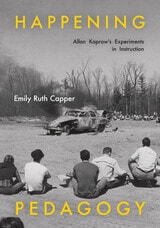
Happening Pedagogy
Allan Kaprow's Experiments in InstructionEmily Ruth Capper
University of Chicago Press, 2026
How Allan Kaprow’s happenings fused modernist pedagogy with an emerging college culture.
In Happening Pedagogy, art historian Emily Ruth Capper argues that Allan Kaprow’s famed invention of the happening brought together experimental traditions of modernist pedagogy with emerging forms of American undergraduate student culture—from hazing rituals to campus protests. Capper traces Kaprow’s trajectory from 1947 to 1968, following him through the classrooms of three of his instructors who were prominent figures in postwar American art—painter Hans Hofmann, art historian Meyer Schapiro, and composer John Cage—and across his own classrooms at institutions including Rutgers and Stony Brook University. Although Kaprow’s teachers were educated in the distinct disciplines of studio art, art history, and music, all three designed their classrooms to cultivate student creativity and critical reflection through forms of social exchange.
Capper shows that Kaprow transformed these modernist classrooms into new pedagogical environments that he developed within the novel context of the suburban state university. Drawing on archival sources, she describes how Kaprow engaged the culture and creative work of middle-class college students, whose rituals he took seriously as an avant-garde vernacular. In this way, Kaprow’s happenings represent a critical extension of modernism as a social practice of sensory attunement, experimentation, and philosophical critique. Through Kaprow’s work, modernist pedagogy became an artistic medium in itself, and his participation-based creative practices helped define the broad resurgence of the American neo-avant-garde after 1960.
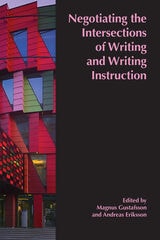
Negotiating the Intersections of Writing and Writing Instruction
Proceedings from the 2019 Conference of the European Association for the Teaching of Academic Writingedited by Magnus Gustafsson and Andreas Eriksson
University Press of Colorado, 2022

Rethinking Reference and Instruction with Tablets
Rebecca K. Miller
American Library Association, 0
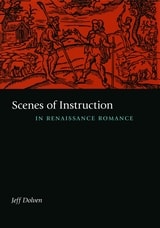
Scenes of Instruction in Renaissance Romance
Jeff Dolven
University of Chicago Press, 2007
We take it for granted today that the study of poetry belongs in school—but in sixteenth-century England, making Ovid or Virgil into pillars of the curriculum was a revolution. Scenes of Instruction in Renaissance Romance explores how poets reacted to the new authority of humanist pedagogy, and how they transformed a genre to express their most radical doubts.
Jeff Dolven investigates what it meant for a book to teach as he traces the rivalry between poet and schoolmaster in the works of John Lyly, Philip Sydney, Edmund Spenser, and John Milton. Drawing deeply on the era’s pedagogical literature, Dolven explores the links between humanist strategies of instruction and romance narrative, rethinking such concepts as experience, sententiousness, example, method, punishment, lessons, and endings. In scrutinizing this pivotal moment in the ancient, intimate contest between art and education, Scenes of Instruction in Renaissance Romance offers a new view of one of the most unconsidered—yet fundamental—problems in literary criticism: poetry’s power to please and instruct.
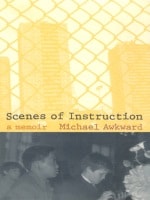
Scenes of Instruction
A MemoirMichael Awkward
Duke University Press, 1999
With a recurring focus on how his mother’s tragic weaknesses and her compelling strengths affected his development, Awkward intersperses the chronologically arranged autobiographical sections with ruminations on his own interests in literary and cultural criticism. As a male scholar who has come under fire for describing himself as a feminist critic, he reflects on such issues as identity politics and the politics of academia, affirmative action, and the Million Man March.
By connecting his personal experiences with larger political, cultural, and professional questions, Awkward uses his life as a palette on which to blend equations of race and reading, urbanity and mutilation, alcoholism, pain, gender, learning, sex, literature, and love.
The Community College Library
Reference and InstructionJanet Pinkley
American Library Association, 2022
Community college librarians are engaged in meaningful work designing and delivering library programs and services that meet the needs of their diverse populations and support student learning. The Community College Library series is meant to lift the voices of community college librarians and highlight their creativity, tenacity, and commitment to students.
The Community College Library: Reference and Instruction collects research, programs, and new approaches to reference and instruction implemented by community college librarians around the U.S. Chapters include sample activities and materials and cover topics including using race-centered and trauma-informed practices in the reference interview; incorporating online workshops into an existing information literacy program; and using student-driven pedagogy to navigate the early stages of research.
This book demonstrates the innovative and replicable ways community college librarians are meeting the information and research needs of their college population both in person and remotely, all while providing a safe, inclusive space for students to explore and learn.
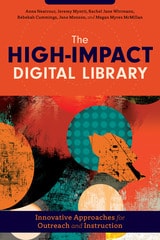
The High-Impact Digital Library
Innovative Approaches for Outreach and InstructionAnna Neatrour, Jeremy Myntti, Rachel Jane Wittmann, Rebekah Cummings, Jane Monson, and Megan Myres McMillan, in collaboration with Core Publishing
American Library Association, 2025
- discusses the results of a unique survey that provides new and structured information on digital library outreach and instruction;
- presents outreach case studies illustrating uses of social media promotion, integration of digital collections into teaching and instruction activities, partnerships with external campus units or community organizations, and other activities;
- explores many types of instruction, from drop-in class sessions and training to course-integrated instruction and ways that digital library practitioners can contribute to the Open Educational Resources (OER) and open pedagogy movements;
- details the digital humanities and digital scholarship programs developed at the University of Utah by many of the authors through cross-departmental collaboration;
- describes the ways in which the pandemic spurred many institutions to use rapid response collecting to practice community engagement; and
- speculates on future directions for outreach and instruction for digital libraries.
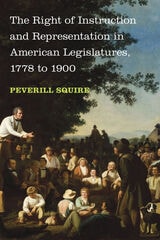
The Right of Instruction and Representation in American Legislatures, 1778 to 1900
Peverill Squire
University of Michigan Press, 2021
Writing and School Reform
Writing Instruction in the Age of Common Core and Standardized TestingJoanne Addison
University Press of Colorado, 2017
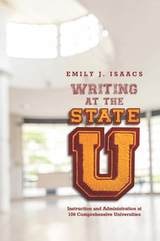
Writing at the State U
Instruction and Administration at 106 Comprehensive UniversitiesEmily Isaacs
Utah State University Press, 2017
Writing at the State U presents a comprehensive, empirical examination of writing programs at 106 universities. Rather than using open survey calls and self-reporting, Emily Isaacs uses statistical analysis to show the extent to which established principles of writing instruction and administration have been implemented at state comprehensive universities, the ways in which writing at those institutions has differed from writing at other institutions over time, and how state institutions have responded to major scholarly debates concerning first-year composition and writing program administration.
Isaacs’s findings are surprising: state university writing programs give lip service to important principles of writing research, but many still emphasize grammar instruction and a skills-based approach, classes continue to be outsized, faculty development is optional, and orientation toward basic writing is generally remedial. As such, she considers where a closer match between writing research and writing instruction might help to expose and remedy these difficulties and identifies strategies and areas where faculty or writing program administrators are empowered to enact change.
Unique in its wide scope and methodology, Writing at the State U sheds much-needed light on the true state of the writing discipline at state universities and demonstrates the advantages of more frequent and rigorous quantitative studies of the field.