Results by title
4 books match the query 'Instrument'
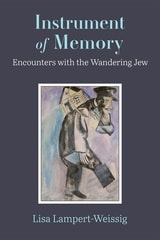
Instrument of Memory
Encounters with the Wandering JewLisa Lampert-Weissig
University of Michigan Press, 2024
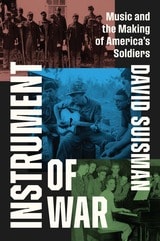
Instrument of War
Music and the Making of America's SoldiersDavid Suisman
University of Chicago Press, 2024
An original history of music in the lives of American soldiers.
Since the Civil War, music has coursed through the United States military. Soldiers have sung while marching, listened to records and armed forces radio, and packed the seats at large-scale USO shows. The bugle call “reveille” has roused soldiers in the morning, and “taps” has marked the end of a long day. Whether the sounds come from brass instruments, weary and homesick singers, or a pair of heavily used earbuds, where there has been war, there has been music, too.
Instrument of War is a first-of-its-kind study of music in the lives of American soldiers. Although musical activity has been part of war since time immemorial, the significance of the U.S. military as a musical institution has generally gone unnoticed. Historian David Suisman traces how the U.S. military has used—and continues to use—music to train soldiers and regulate military life, and how soldiers themselves have turned to music to cope with war’s emotional and psychological realities. Opening our ears to these practices, Suisman reveals how music has enabled more than a century and a half of American war-making. Instrument of War unsettles assumptions about music as a force of uplift and beauty, demonstrating how it has also been entangled in large-scale state violence.
From chanting “Sound off!” in basic training to switching on a phonograph or radio or cueing up an iPod playlist during a patrol, the sound of music has long resonated in soldiers’ wartime experiences. Now we all can finally hear it.
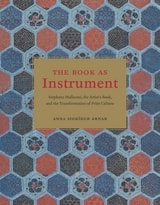
The Book as Instrument
Stéphane Mallarmé, the Artist's Book, and the Transformation of Print CultureAnna Sigrídur Arnar
University of Chicago Press, 2011
Stéphane Mallarmé (1842–98) was a French Symbolist poet, theorist, and teacher whose ideas and legendary salons set the stage for twentieth-century experimentation in poetry, music, theater and art. A canonical figure in the legacy of modernism, Mallarmé was also a lifelong champion of the book as both a literary endeavor and a carefully crafted material object.
In The Book as Instrument, Anna Sigrídur Arnar explores how this object functioned for Mallarmé and his artistic circle, arguing that the book became a strategic site for encouraging a modern public to actively partake in the creative act, an idea that informed later twentieth-century developments such as conceptual and performance art. Arnar demonstrates that Mallarmé was invested in creating radically empowering reading experiences, and the diverse modalities he proposed for both reading and looking anticipate interactive media prevalent in today’s culture. In describing the world of books, visual culture, and mass media of the late nineteenth century, Arnar touches upon an array of themes that continues to preoccupy us in our own moment, including speculations on the future of the book. Enhanced by gorgeous illustrations, The Book as Instrument is sure to fascinate anyone interested in the ever-vibrant experiment between word and image that makes the page and the multi-sensory pleasures of reading.
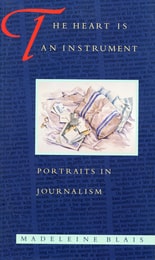
The Heart Is an Instrument
Portraits in JournalismMadeleine Blais
University of Massachusetts Press, 1992
From the Foreword by Geneva Overholser
What is it about really fine writers, how they delight, intrigue, compel us?
Style, you say. But style is not something you begin with. Rather, it's what you end up with, a result of far more fundamental traits. Traits such as an ear and an eye and a heart, traits that Madeleine Blais has honed superbly well.
This is a book well named: The Heart Is an Instrument: Portraits in Journalism. The heart is surely first among Blais's gifts. Whether she is writing about the famous—playwright Tennessee Williams, novelist Mary Gordon—or about the least elevated among us—a teenage prostitute infected with the AIDS virus, a homeless schizophrenic—she brings to her subjects an incomparable empathy.