Results by title
6 books match the query 'Instruments'
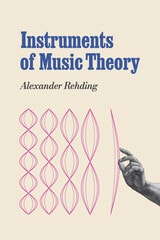
Instruments of Music Theory
Alexander Rehding
University of Chicago Press, 2027
Shows how musical instruments and the sounds they produce are not incidental, but an integral part of music theory.
Many musicians dread music theory: Its rules and diagrams can feel stern and lifeless, far removed from the sounds that make music so thrilling. In this book, Alexander Rehding looks at music theory from a different angle. He argues that the sounds of the instruments on which music theory is demonstrated—starting with the piano in the music classroom—play a much more active role than we usually notice. They are “instruments” in a double sense: musical noisemakers, but also tools in a kind of scientific experiment. Rehding strips these devices down to their sound-generating mechanisms to show us how to read musical instruments for their theoretical content.
Instruments of Music Theory turns our attention to instruments such as multiphonic sirens, tuning forks, Chladni plates, Aeolian harps, and Wheatstone concertinas—these devices generate sounds that call for new ways of listening, measuring, and thinking about music. Bringing together music theory, critical organology, and media theory, this book can be read as a user’s manual for how to put sound back into music theory. Rehding shows us how instruments do not only produce sound—they produce knowledge about music. Through the lens of these new instruments, Instruments of Music Theory recasts fundamental musical ideas such as pitch, harmony, form, and scale from the ground up to give new meaning to the stuff we call music.
Instruments of the True Measure
PoemsLaura Da'
University of Arizona Press, 2018
Surveying and geography underpin the collection, but even as Da’ investigates these signifiers of measurement, she pushes the reader to interrogate their function within the stark atrocities of American history. Da’ laments this harsh dichotomy, observing that America’s mathematical point of beginning is located in the heart of her tribe’s homeland: “I do not have the Shawnee words to describe this place; the notation that is available to me is 40°38´32.61´´ N 80°31´9.76´´ W.”

Osiris, Volume 9
InstrumentsEdited by Albert Van Helden and Thomas L. Hankins
University of Chicago Press, 1994
Contributors include Albert Van Helden on telescopes and authority, Jan Golinski on the demonstrative order of proof in Lavoisier's chemistry, Bruce J. Hunt on the development of electrical standards, Deborah Warner on terrestrial magnetism, Bruce Hevly on Stanford's supervoltage X-ray tube, Robert W. Smith and Jose h N. Tatarewicz on devices and black boxes, Thatcher Deane on the imperial astronomical bureau in the Ming dynasty, Thomas L. Hankins on Louis-Bertrand Castel's ocular harpsichord, Simon Schaffer on demonstration devices in Georgian mechanics, Timothy Lenoir on Helmholtz and the materialities of communication, and Robert Frank on instruments, biological techniques, and the "all-or-none" principle.
Sikh Kirtan and Its Journeys
Instruments, Theories, TechnologiesGurminder Kaur Bhogal
University of Chicago Press, 2025
Kirtan—the sung expression of sacred verses—spans the Indian subcontinent, but it plays a unique role in the Sikh faith. In Sikh Kirtan and ItsJourneys, musicologist Gurminder Kaur Bhogal introduces the devotional tradition of kirtan, examining it alongside the writings of holy figures, the Sikh Gurus and Bhagats, and its practice among musicians. The long-established tradition of kirtan originated in a canon of instruments and songs, each of which produces a singular spiritual and worldly effect when kirtan is sung. However, the realities of colonization and migration have necessitated changes to these canonical practices. Bhogal offers a deep exploration of the traditions that gave rise to kirtan and a robust portrait of the many transformations kirtan has undergone, particularly in the wide-ranging Sikh diaspora, dedicating special attention to marginal kirtan players such as women and innovators developing digital techniques and styles. A practicing kirtaniya, Bhogal has spent her life studying and performing this music, steeped in the histories and controversies her book describes.
Through a rigorous explanation of the traditions and evolutions of kirtan, Bhogal ultimately shows that kirtan is fluid, multi-faceted, and ever-changing because it reflects the shifting spiritual needs and musical tastes of devotees and practitioners across the world. Moreover, wherever kirtan is offered and received, it heightens corporeal vibrations between practitioners and devotees to motivate a sense of social purpose, social responsibility, and selfless service.
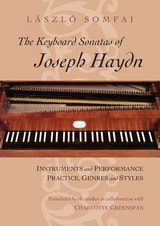
The Keyboard Sonatas of Joseph Haydn
Instruments and Performance Practice, Genres and StylesLászló Somfai
University of Chicago Press, 1995
Laszlo Somfai begins with a thorough study of Haydn's keyboard instruments and their development. After recommending instruments appropriate for modern use, he discusses performance practice and style, explains the peculiarities of Haydn's manuscripts in the context of eighteenth-century notation, and provides specific suggestions for playing ornaments, improvising, slurring, and dynamics. He also investigates Haydn's sonata genres within their historical context and discusses the problems of establishing a chronology of their composition. Finally, Somfai analyzes the organization and style of each musical form. The book includes an index listing the sonatas by date of first publication, and an extensive bibliography.

The Organ in Manitoba
A History of the Instruments, the Builders, and the PlayersJames B. Hartman
University of Manitoba Press, 1997