Results by title

4 books match the query 'Insular possessions'
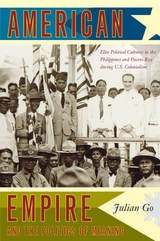
cover of American Empire and the Politics of Meaning: Elite Political Cultures in the Philippines and Puerto Rico during U.S. Colonialism

American Empire and the Politics of Meaning

Elite Political Cultures in the Philippines and Puerto Rico during U.S. Colonialism

Julian Go

Duke University Press, 2007

When the United States took control of the Philippines and Puerto Rico in the wake of the Spanish-American War, it declared that it would transform its new colonies through lessons in self-government and the ways of American-style democracy. In both territories, U.S. colonial officials built extensive public school systems, and they set up American-style elections and governmental institutions. The officials aimed their lessons in democratic government at the political elite: the relatively small class of the wealthy, educated, and politically powerful within each colony. While they retained ultimate control for themselves, the Americans let the elite vote, hold local office, and formulate legislation in national assemblies.

American Empire and the Politics of Meaning is an examination of how these efforts to provide the elite of Puerto Rico and the Philippines a practical education in self-government played out on the ground in the early years of American colonial rule, from 1898 until 1912. It is the first systematic comparative analysis of these early exercises in American imperial power. The sociologist Julian Go unravels how American authorities used “culture” as both a tool and a target of rule, and how the Puerto Rican and Philippine elite received, creatively engaged, and sometimes silently subverted the Americans’ ostensibly benign intentions. Rather than finding that the attempt to transplant American-style democracy led to incommensurable “culture clashes,” Go assesses complex processes of cultural accommodation and transformation. By combining rich historical detail with broader theories of meaning, culture, and colonialism, he provides an innovative study of the hidden intersections of political power and cultural meaning-making in America’s earliest overseas empire.
[more]
cover of Archipelagic American Studies

Archipelagic American Studies

Brian Russell Roberts and Michelle Ann Stephens, editors

Duke University Press, 2017

Departing from conventional narratives of the United States and the Americas as fundamentally continental spaces, the contributors to Archipelagic American Studies theorize America as constituted by and accountable to an assemblage of interconnected islands, archipelagoes, shorelines, continents, seas, and oceans. They trace these planet-spanning archipelagic connections in essays on topics ranging from Indigenous sovereignty to the work of Édouard Glissant, from Philippine call centers to US militarization in the Caribbean, and from the great Pacific garbage patch to enduring overlaps between US imperialism and a colonial Mexican archipelago. Shaking loose the straitjacket of continental exceptionalism that hinders and permeates Americanist scholarship, Archipelagic American Studies asserts a more relevant and dynamic approach for thinking about the geographic, cultural, and political claims of the United States within broader notions of America.
 
Contributors
Birte Blascheck, J. Michael Dash, Paul Giles, Susan Gillman, Matthew Pratt Guterl, Hsinya Huang, Allan Punzalan Isaac, Joseph Keith, Yolanda Martínez-San Miguel, Brandy Nālani McDougall, Ifeoma Kiddoe Nwankwo, Craig Santos Perez, Brian Russell Roberts, John Carlos Rowe, Cherene Sherrard-Johnson, Ramón E. Soto-Crespo, Michelle Ann Stephens, Elaine Stratford, Etsuko Taketani, Alice Te Punga Somerville, Teresia Teaiwa, Lanny Thompson, Nicole A. Waligora-Davis
[more]
cover of Borderwaters: Amid the Archipelagic States of America

Borderwaters

Amid the Archipelagic States of America

Brian Russell Roberts

Duke University Press, 2021
Conventional narratives describe the United States as a continental country bordered by Canada and Mexico. Yet, since the late twentieth century the United States has claimed more water space than land space, and more water space than perhaps any other country in the world. This watery version of the United States borders some twenty-one countries, particularly in the archipelagoes of the Pacific and the Caribbean. In Borderwaters Brian Russell Roberts dispels continental national mythologies to advance an alternative image of the United States as an archipelagic nation. Drawing on literature, visual art, and other expressive forms that range from novels by Mark Twain and Zora Neale Hurston to Indigenous testimonies against nuclear testing and Miguel Covarrubias's visual representations of Indonesia and the Caribbean, Roberts remaps both the fundamentals of US geography and the foundations of how we discuss US culture.
[more]
cover of Positively No Filipinos Allowed: Building Communities and Discourse

Positively No Filipinos Allowed

Building Communities and Discourse

edited by Antonio T. Tiongson, Jr., Edgardo V. Gutierrez and Ricardo V. Gutierrez, foreword by Lisa Lowe

Temple University Press, 2006

From the perspectives of ethnic studies, history, literary criticism, and legal studies, the original essays in this volume examine the ways in which the colonial history of the Philippines has shaped Filipino American identity, culture, and community formation. The contributors address the dearth of scholarship in the field as well as show how an understanding of this complex history provides a foundation for new theoretical frameworks for Filipino American studies.
[more]