Results by title
4 books match the query 'Insult'
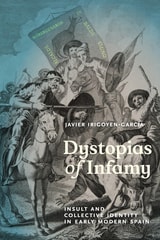
Dystopias of Infamy
Insult and Collective Identity in Early Modern SpainJavier Irigoyen-García
Bucknell University Press, 2022
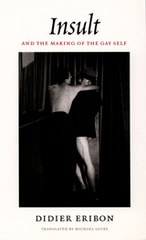
Insult and the Making of the Gay Self
Didier Eribon
Duke University Press, 2004
Eribon describes the emergence of homosexual literature in Britain and France at the turn of the last century and traces this new gay discourse from Oscar Wilde and the literary circles of late-Victorian Oxford to André Gide and Marcel Proust. He asserts that Foucault should be placed in a long line of authors—including Wilde, Gide, and Proust—who from the nineteenth century onward have tried to create spaces in which to resist subjection and reformulate oneself. Drawing on his unrivaled knowledge of Foucault’s oeuvre, Eribon presents a masterful new interpretation of Foucault. He calls attention to a particular passage from Madness and Civilization that has never been translated into English. Written some fifteen years before The History of Sexuality, this passage seems to contradict Foucault’s famous idea that homosexuality was a late-nineteenth-century construction. Including an argument for the use of Hannah Arendt’s thought in gay rights advocacy, Insult and the Making of the Gay Self is an impassioned call for critical, active engagement with the question of how gay life is shaped both from without and within.

Insult to Injury
Libel, Slander, and Invasions of PrivacyChrista Jones
University Press of Colorado, 2003
Toward a Rhetoric of Insult
Thomas Conley
University of Chicago Press, 2010
From high school cafeterias to the floor of Congress, insult is a truly universal and ubiquitous cultural practice with a long and earthy history. And yet, this most human of human behaviors has rarely been the subject of organized and comprehensive attention—until Toward a Rhetoric of Insult. Viewed through the lens of the study of rhetoric, insult, Thomas M. Conley argues, is revealed as at once antisocial and crucial for human relations, both divisive and unifying.
Explaining how this works and what exactly makes up a rhetoric of insult prompts Conley to range across the vast and splendidly colorful history of offense. Taking in Monty Python, Shakespeare, Eminem, Cicero, Henry Ford, and the Latin poet Martial, Conley breaks down various types of insults, examines the importance of audience, and explores the benign side of abuse. In doing so, Conley initiates readers into the world of insult appreciation, enabling us to regard insults not solely as means of expressing enmity or disdain, but as fascinating aspects of human interaction.