Results by title
2 books match the query 'Intellectual Culture'
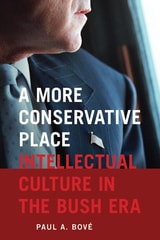
A More Conservative Place
Intellectual Culture in the Bush EraPaul A. Bové
Dartmouth College Press, 2013
Identifying the historical antecedents of President George W. Bush’s imperial ambitions and the sources of the reactionary thought and politics that underlie them, Paul A. Bové shows how neoconservatism represents a singular danger to democracy. At the same time, he criticizes the equally disheartening inability of the academic Left to oppose neoconservatives and its tendency to mirror their views instead. Divorced from historical knowledge and intellectual rigor, the neocon mindset reflects a cultural and historical amnesia that feeds on ignorance and conformity. Exposing the threats to national survival inherent in the alliance of right-wing politics and academic tribalism, Bové emphasizes the need to reconnect with the powers of imagination and the complexity of human historical experience. With urgency and passion, Bové shows how the neocons have succeeded in cowing or coopting academic intellectuals and how language has been used and abused for the maintenance and extension of an undemocratic regime.
[more]

Mastering Discourse
The Politics of Intellectual CulturePaul A. Bové
Duke University Press, 1992
Mastering Discourse gathers and elaborates more than a decade of thought on the problems of the intellectual in contemporary society, by one of the most distinguished critics writing on these issues today. From Derrida and Foucault to Kristeva and Irigaray, Paul A. Bové looks at the practices of literary and cultural theory, and discusses the way theorists have produced their institutional positions and politics. Examining some of the major theories developed out of and in relation to the problems of discourse, Bové analyzes the limited successes and failures of these efforts.
Mastering Discourses offers an account of why "theory" fails to deal adequately with the politics of discursive cultures and warns that unless critics take much more seriously their own disciplinary inscriptions they will always reproduce structures of power and knowledge that they claim to oppose. Moreover, Bové argues, they will not fulfill the main role of the post-enlightenment intellectual, namely: to respond effectively to the present, through new theoretical and historical formulations that address the changing world of transnational capitalism and its neoliberal ideologies.
Mastering Discourses offers an account of why "theory" fails to deal adequately with the politics of discursive cultures and warns that unless critics take much more seriously their own disciplinary inscriptions they will always reproduce structures of power and knowledge that they claim to oppose. Moreover, Bové argues, they will not fulfill the main role of the post-enlightenment intellectual, namely: to respond effectively to the present, through new theoretical and historical formulations that address the changing world of transnational capitalism and its neoliberal ideologies.
[more]