Results by title
18 books match the query 'Intellectual freedom'

A History of ALA Policy on Intellectual Freedom
A Supplement to the Intellectual Freedom ManualTrina Magi
American Library Association, 2015
Collecting several key documents and policy statements, this supplement to the tenth edition of the Intellectual Freedom Manual traces a history of ALA's commitment to fighting censorship. Beginning with an introductory essay that chronicles ALA policy making on intellectual freedom, this important resource includes sections discussing such foundational issues as
- library advocacy on social and political issues, from post-World War I disarmament, to Vietnam-era protests, to the call to revisit the field’s rhetoric concerning neutrality;
- the evolution of the Library Bill of Rights, such as the 1978 revision that eliminated its use of sex-linked pronouns and ALA Council actions rescinding the 2018 interpretation on meeting rooms;
- protecting the freedom to read;
- diverse collections and equity, diversity, and inclusion, new to this edition;
- ALA’s complicated history on race, including a 1936 statement opposing discrimination, inaction amidst litigation to desegregate libraries in the 1950s and 1960s, and protests over Florida’s Stand Your Ground Law;
- ALA's Code of Ethics;
- how to respond to challenges and concerns about library resources;
- internet filtering, minors and online activity, and education and information literacy;
- programs and displays;
- policy on governmental intimidation;
- copyright; and
- privacy and confidentiality, including the retention of library usage records.
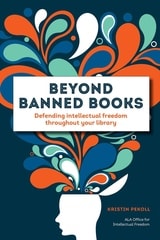
Beyond Banned Books
Defending Intellectual Freedom throughout Your LibraryKristin Pekoll
American Library Association, 2019
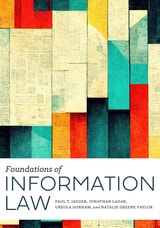
Foundations of Information Law
Paul T. Jaeger, Jonathan Lazar, Ursula Gorham, and Natalie Greene Taylor
American Library Association, 2023
- discusses information law as part of a continuum of interrelated issues rather than an assortment of discrete topics;
- examines information law in the context of different types of libraries;
- delves into the manifold legal issues raised when interacting with patrons and communities, from intellectual freedom topics like censorship and public activities in the library to the legal issues surrounding materials and information access;
- elucidates operational and management legal issues, including library security, interacting with law enforcement, advocacy, lobbying, funding, human resources, and liability;
- promotes literacy of the law, its structures, and its terminology as a professional skill;
- gives readers the tools to find and understand different sources of legal authority and demonstrates how to interpret them when they conflict; and
- explores information law as a national and cross-national issue.
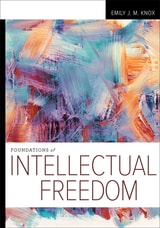
Foundations of Intellectual Freedom
Emily J. M. Knox
American Library Association, 2022
- the historical and legal roots of intellectual freedom, with an in-depth examination of John Stuart Mill’s “On Liberty” and Article 19 of the U.N Declaration of Human Rights, and its central concepts and principles;
- the intersection of intellectual freedom, freedom of expression, and social justice;
- professional values, codes of ethics, ALA’s Library Bill of Rights, and Freedom to Read/View Statements;
- pro- and anti- censorship arguments and their use in impeding and facilitating access to information;
- book banning and internet filtering;
- privacy and its relationship to information services;
- U.S. case law and precedents;
- the basics of U.S. copyright law, including fair use, and how it differs from international copyright law; and
- emerging global issues and their impact on future intellectual freedom.
Guide to Ethics in Acquisitions
Wyoma vanDuinkerken
American Library Association, 2015
Intellectual Freedom Manual
Trina Magi
American Library Association, 2015
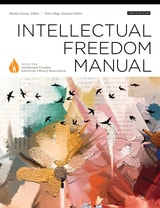
Intellectual Freedom Manual
Trina Magi
American Library Association, 2021
The newest edition of the Intellectual Freedom Manual is more than simply an update of a foundational text that has served as a crucial resource for more than four decades. It is a living document that serves as the authoritative reference for day-to-day guidance on maintaining free and equal access to information for all people. Whether you’re developing or revising policies, on-boarding new staff or trustees, responding to challenges and controversies, or studying librarianship, you’ll find this an indispensable resource, with features such as
- ALA policy statements, approved by committees and Council, articulating core intellectual freedom principles and best practices;
- 8 new interpretations of the Library Bill of Rights, which address urgent issues like internet filtering, public performances, political activity, religion, and equity, diversity, and inclusion;
- “Issues at a Glance” sidebars which present key concepts, points of law, tips, and questions for reflection;
- expanded content about developing library policies that support intellectual freedom;
- updated information on censorship of library programs, displays, and databases;
- “Advocacy and Assistance,” a section offering concrete guidance when you’re called on to talk to the media or meet with legislators;
- Deeper Look essays which examine the laws related to library operations;
- advice on when to call the police, when not to, and how to handle personally identifiable information when they arrive; and
- an expanded glossary.
Intellectual Freedom Manual
American Library Association, 2006
Intellectual Freedom Manual
American Library Association, 2010
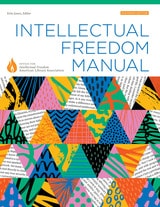
Intellectual Freedom Manual, Eleventh Edition
Erin Office for Intellectual Freedom
American Library Association, 2026
When someone faces a difficult intellectual freedom (IF) issue, they usually don’t have time to wade through dense text to find the answers they need. Designed as a real-world reference, OIF’s Intellectual Freedom Manual provides trusted, comprehensive guidance for every library worker, from the volunteer to the director, in plain language. Whether you’re developing or reviewing policies, on-boarding new staff or trustees, responding to challenges and controversies, or studying librarianship, you’ll find this a vital tool, with features such as
- contributions that center the voices of Black, Indigenous, and other People of Color (BIPOC) and LGBTQIA+ people, who are often targeted by censorship efforts;
- chapters that begin with an overview explaining the big ideas and offering reflection questions;
- an introduction to IF and why it matters, drawing on ALA's core IF documents and supported with adaptable policy worksheets;
- information and best practice guidance on key topics such as access, children and youth, censorship and internet filtering, collection development and management, copyright, meeting rooms and exhibit spaces, library programming, politics and religion, privacy, and visits and requests from law enforcement;
- stories from real people whose lives have been impacted by IF, showing how library policies shape culture, protect staff and users, and affect real people;
- concise breakdowns of IF issues from legal experts, helping you understand the laws and how they apply in real situations;
- practical advice on advocating for IF, getting help when challenges arise, lobbying, and working with your elected officials;
- a thorough index to help you quickly find the information you need; and
- a helpful glossary and selected bibliography of additional resources.
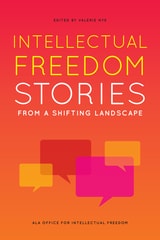
Intellectual Freedom Stories from a Shifting Landscape
Valerie Nye
American Library Association, 2020
Intellectual freedom is a complex concept that democracies and free societies around the world define in different ways but always strive to uphold. And ALA has long recognized the crucial role that libraries play in protecting this right. But what does it mean in practice? How do library workers handle the ethical conundrums that often accompany the commitment to defending it? Rather than merely laying out abstract policies and best practices, this important new collection gathers real-world stories of intellectual freedom in action to illuminate the difficulties, triumphs, and occasional setbacks of advocating for free and equal access to information for all people in a shifting landscape. Offering insight to LIS students and current practitioners on how we can advance the profession of librarianship while fighting censorship and other challenges, these personal narratives explore such formidable situations as
- presenting drag queen story times in rural America;
- a Black Lives Matter “die-in” at the undergraduate library of the University of Wisconsin-Madison;
- combating censorship at a prison library;
- hosting a moderated talk about threats to modern democracy that included a neo-Nazi spokesman;
- a provocative exhibition that triggered intimidating phone calls, emails, and a threat to burn down an art library;
- calls to eliminate non-Indigenous children’s literature from the collection of a tribal college library; and
- preserving patrons’ right to privacy in the face of an FBI subpoena.
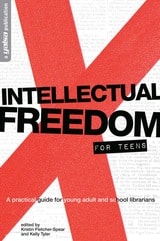
Intellectual Freedom for Teens
A Practical Guide for Young Adult & School LibrariansKristin Fletcher-Spear
American Library Association, 2014
Protecting Intellectual Freedom in Your Public Library
American Library Association, 2012
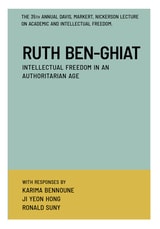
Ruth Ben-Ghiat
Intellectual Freedom in an Authoritarian AgeRuth Ben-Ghiat
Disobedience Press, 2026
In this lecture, Ruth Ben-Ghiat, an internationally renowned historian of fascism and authoritarian regimes past and present, stresses that universities have always been core targets of anti-democratic forces: “Strongmen disappear people, and they also disappear knowledge.” It’s an operation of noise and silence, she tells us. Aggressively take over institutions with the authoritarian worldview, hollow them out through “moral deregulation,” and bankrupt individuals by enticing them to distrust facts and betray their values. The goal, she argues, is to frighten civil society into silence in a coordinated attempt to stamp out dissent.
Ben-Ghiat speaks from experience: she had to deliver this talk, part of the University of Michigan’s yearly lecture devoted to academic freedom, on Zoom due to safety concerns.
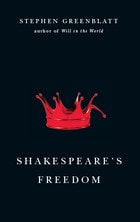
Shakespeare's Freedom
Stephen Greenblatt
University of Chicago Press, 2010
Shakespeare lived in a world of absolutes—of claims for the absolute authority of scripture, monarch, and God, and the authority of fathers over wives and children, the old over the young, and the gentle over the baseborn. With the elegance and verve for which he is well known, Stephen Greenblatt, author of the best-selling Will in the World, shows that Shakespeare was strikingly averse to such absolutes and constantly probed the possibility of freedom from them. Again and again, Shakespeare confounds the designs and pretensions of kings, generals, and churchmen. His aversion to absolutes even leads him to probe the exalted and seemingly limitless passions of his lovers.
Greenblatt explores this rich theme by addressing four of Shakespeare’s preoccupations across all the genres in which he worked. He first considers the idea of beauty in Shakespeare’s works, specifically his challenge to the cult of featureless perfection and his interest in distinguishing marks. He then turns to Shakespeare’s interest in murderous hatred, most famously embodied in Shylock but seen also in the character Bernardine in Measure for Measure. Next Greenblatt considers the idea of Shakespearean authority—that is, Shakespeare’s deep sense of the ethical ambiguity of power, including his own. Ultimately, Greenblatt takes up Shakespearean autonomy, in particular the freedom of artists, guided by distinctive forms of perception, to live by their own laws and to claim that their creations are singularly unconstrained.
A book that could only have been written by Stephen Greenblatt, Shakespeare’s Freedom is a wholly original and eloquent meditation by the most acclaimed and influential Shakespearean of our time.
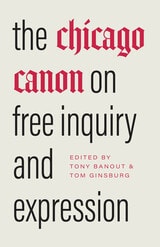
The Chicago Canon on Free Inquiry and Expression
Edited by Tony Banout and Tom Ginsburg
University of Chicago Press, 2024
Free inquiry and expression are hotly contested, both on campus and in social and political life. Since its founding in the late nineteenth century, the University of Chicago has been at the forefront of conversations around free speech and academic freedom in higher education. The University’s approach to free expression grew from a sterling reputation as a research university as well as a commitment to American pragmatism and democratic progress, all of which depended on what its first president referred to as the “complete freedom of speech on all subjects.” In 2015, more than 100 years later, then University provost and president J. D. Isaacs and Robert Zimmer echoed this commitment, releasing a statement by a faculty committee led by law professor Geoffrey R. Stone that has come to be known as the Chicago Principles, now adopted or endorsed by one hundred US colleges and universities. These principles are just a part of the long-standing dialogue at the University of Chicago around freedom of expression—its meaning and limits. The Chicago Canon on Free Inquiry and Expression brings together exemplary documents – some published for the first time here – that explain and situate this ongoing conversation with an introductory essay that brings the tradition to light.
Throughout waves of historical and societal challenges, this first principle of free expression has required rearticulation and new interpretations. The documents gathered here include, among others, William Rainey Harper’s “Freedom of Speech” (1900), the Kalven Committee’s report on the University’s role in political and social action (1967), and Geoffrey R. Stone’s “Free Speech on Campus: A Challenge of Our Times” (2016). Together, the writings of the canon reveal how the Chicago tradition is neither static nor stagnant, but a vibrant experiment; a lively struggle to understand, practice, and advance free inquiry and expression.
At a time of nationwide campus speech debates, engaging with these texts and the questions they raise is essential to sustaining an environment of broad intellectual and ideological diversity. This book offers a blueprint for the future of higher education’s vital work and points to the civic value of free expression.
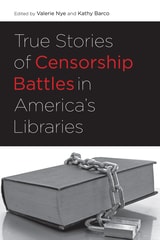
True Stories of Censorship Battles in America's Libraries
Valerie Nye
American Library Association, 2012
Intellectual freedom is a core value of librarianship, but fighting to keep controversial materials on the shelves can sometimes feel like a lonely battle. And not all censorship controversies involve the public objecting to a book in the collection—libraries are venues for displays and meetings, and sometimes library staff themselves are tempted to preemptively censor a work. Those facing censorship challenges can find support and inspiration in this book, which compiles dozens of stories from library front lines. Edifying and enlightening, this collection
- Tells the stories of librarians who withstood difficult circumstances to champion intellectual freedom
- Touches on prickly issues such as age-appropriateness, some librarians' temptation to preemptively censor, sensitive cultural expressions, and criminality in the library
- Presents case studies of defenses that were unsuccessful, so librarians facing similar challenges can learn from these defeats
There are fewer situations more stressful in a librarian's professional life than being personally confronted with a demand to remove a book from the shelves or not knowing how to respond to other kinds of censorship challenges. Reading this book will help fortify and inform those in the fray.
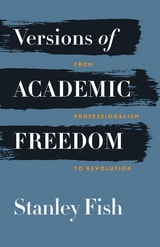
Versions of Academic Freedom
From Professionalism to RevolutionStanley Fish
University of Chicago Press, 2014
Depending on who’s talking, academic freedom is an essential bulwark of democracy, an absurd fig leaf disguising liberal agendas, or, most often, some in-between muddle that both exaggerates its own importance and misunderstands its actual value to scholarship. Fish enters the fray with his typical clear-eyed, no-nonsense analysis. The crucial question, he says, is located in the phrase “academic freedom” itself: Do you emphasize “academic” or “freedom”? The former, he shows, suggests a limited, professional freedom, while the conception of freedom implied by the latter could expand almost infinitely. Guided by that distinction, Fish analyzes various arguments for the value of academic freedom: Is academic freedom a contribution to society's common good? Does it authorize professors to critique the status quo, both inside and outside the university? Does it license and even require the overturning of all received ideas and policies? Is it an engine of revolution? Are academics inherently different from other professionals? Or is academia just a job, and academic freedom merely a tool for doing that job?
No reader of Fish will be surprised by the deftness with which he dismantles weak arguments, corrects misconceptions, and clarifies muddy arguments. And while his conclusion—that academic freedom is simply a tool, an essential one, for doing a job—may surprise, it is unquestionably bracing. Stripping away the mystifications that obscure academic freedom allows its beneficiaries to concentrate on what they should be doing: following their intellectual interests and furthering scholarship.