Results by title
3 books match the query 'Intelligence'
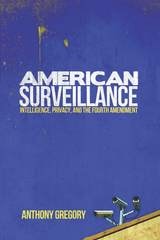
American Surveillance
Intelligence, Privacy, and the Fourth AmendmentAnthony Gregory
University of Wisconsin Press, 2016
Anthony Gregory challenges such simplifications, offering a nuanced history and analysis of these difficult issues. He highlights the complexity of the relationship between the gathering of intelligence for national security and countervailing efforts to safeguard individual privacy. The Fourth Amendment prohibiting unreasonable searches and seizures offers no panacea, he finds, in combating assaults on privacy—whether by the NSA, the FBI, local police, or more mundane administrative agencies. Given the growth of technology, together with the ambiguities and practical problems of enforcing the Fourth Amendment, advocates for privacy protections need to work on multiple policy fronts.
“This fascinating review of the shifts and accretions of American law and culture is filled with historical surprises and twenty-first-century shocks, so beneficial in an era of gross American ahistoricality and cultural acquiescence to the technological state. Every flag-waving patriot, every dissenter, every judge and police officer, every small-town mayor and every president should read America Surveillance. We have work to do!”—Lt. Col. Karen U. Kwiatkowski, (Ret.), former Senior Operations Staff Officer, Office of the Director, National Security Agency
Tell Me a Story
Narrative and IntelligenceRoger C. Schank
Northwestern University Press, 1995
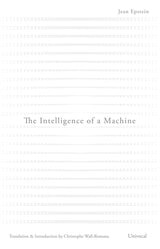
The Intelligence of a Machine
Jean Epstein
University of Minnesota Press, 2014
The advent of the cinema radically altered our comprehension of time, space, and reality. With his experience as a pioneering avant-garde filmmaker, Jean Epstein uses the universes created by the cinematograph to deconstruct our understanding of how time and space, reality and unreality, continuity and discontinuity, determinism and randomness function both inside and outside the cinema. Time, he says, should be regarded as the first, not the fourth, dimension—and the cinematograph allows us, for the first time, to manipulate it in directions and speeds of our choosing.
The theoretical work of Jean Epstein greatly influenced later generations of cinema philosophers, notably Gilles Deleuze and Jacques Rancière, but the bulk of his work remains unpublished. The Intelligence of a Machine, his first major title published in English, is one of the earliest philosophies of cinema.