Results by title
2 books match the query 'Intensity'

Intensity
An Essay in Whiteheadian OntologyJudith A. Jones
Vanderbilt University Press, 1998
This important and provocative book on the work of Alfred North Whitehead (1861-1947) explores how his avowed atomism is consistent with his equally essential commitment to a view of reality as a thoroughly interconnected sphere of relations. Judith Jones challenges Whitehead's readers to reconsider certain prevailing interpretations of his organic philosophy. To Jones, a rereading of Whitehead's overall philosophic project is essential to evaluating his contributions to metaphysics and ontology. SinceWhitehead's basic worldview is holistic, a return to viewing Whitehead's work as a whole helps clarify his ontological intentions and contributions to metaphysics.
For this purpose, the concept of "intensity," which Jones defines as the quality and form of feeling involved in subjective experience, is basic to Whitehead's thinking about process at all naturalistic levels and is therefore particularly useful as a lens through which to view his entire system. "Intensity" is at once Whitehead's most basic metaphysical idea and a notion useful in deciphering the overall unity of purpose in his writings. A central aim of this book is to develop an aesthetically sensitive sense of being that demonstrates the profound and original contributions of process philosophy to realism.
Jones shows that a thorough understanding of the concept of intensity yields modes of thought that help overcome knotty problems in conceiving Whitehead's distinction between the private experience of individuals and the public relations those individuals experience in relationship to other entities. Drawing frequently on poetic allusions to aid her interpretations, she focuses specifically on the status of intensity in intellectual and moral experience and develops an ethics of "attention" as an elaboration of Whitehead's aesthetic metaphysics.
The result is a book that should be enthusiastically greeted and debated by scholars of Whitehead and by all who are interested in the field of process thought, including students of theology, literature, and feminist studies. Jones's unorthodox conclusions, backed up with scrupulous attention to both the Whitehead canon and related secondary literature, present challenges to accepted interpretations that cannot be ignored.
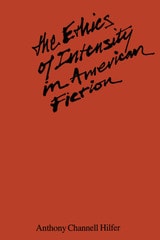
The Ethics of Intensity in American Fiction
By Anthony Channell Hilfer
University of Texas Press, 1981
Drawing upon the philosophical theories of William James, Dewey, and Mead and focusing upon major works by Whitman, Stein, Howells, Dreiser, and Henry James, Anthony Hilfer explores how these authors have structured their characters' consciousness, their purpose in doing so, and how this presentation controls the reader's moral response.
Hilfer contends that there was a significant change in the mode of character presentation in American literature of the late nineteenth and early twentieth centuries. The self defined in terms of a Victorian ethic and judged adversely for its departures from that code shifted to the self defined in terms of emotional intensity and judged adversely for its failures of nerve. In the first mode, characters are almost always wrong to yield to desire; in the second, characters are frequently wrong not to and, in fact, are seen less as the sum of their ethical choices than as the process of their longings.
His conclusion: modern fiction is as overbalanced toward pathos as Victorian fiction was toward ethos. but the continued dialectic between the two is a tension that ought not be resolved.