Results by title
2 books match the query 'Interface'

Critical Digital Art History
Interface and Data Politics in the Post-Digital EraEdited by Amanda Wasielewski and Anna Näslund
Intellect Books, 2024
Digital art history has often aligned itself with the practical concerns of digital technology and the responsibilities of art institutions and associated institutional roles such as collection managers, information specialists, curators, and conservators. This emphasis on practicalities and implementation, while undeniably important, has often left little room for critical examination of the broader implications of digital technology and computational methodologies in art history.
A long-standing concern of the field—and a major focal point of this book—is museum and collecting practices in the digital era. While there is a certain degree of continuity in the field, there are also important shifts and changes to address—namely, the widespread uptake of artificial intelligence tools and increased attention to both the broader historical and societal aspects of the use of digital repositories and tools. This anthology seeks to address the dearth of critical reflection by critically assessing specific case study examples and considering the political dimensions associated with large-scale digitization and the application of digital tools within museums and collection management.
The Interface
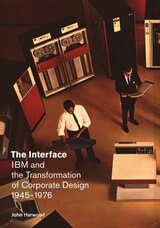
IBM and the Transformation of Corporate Design, 1945–1976John Harwood
University of Minnesota Press, 2016
In February 1956 the president of IBM, Thomas Watson Jr., hired the industrial designer and architect Eliot F. Noyes, charging him with reinventing IBM’s corporate image, from stationery and curtains to products such as typewriters and computers and to laboratory and administration buildings. What followed—a story told in full for the first time in John Harwood’s The Interface—remade IBM in a way that would also transform the relationships between design, computer science, and corporate culture.
IBM’s program assembled a cast of leading figures in American design: Noyes, Charles Eames, Paul Rand, George Nelson, and Edgar Kaufmann Jr. The Interface offers a detailed account of the key role these designers played in shaping both the computer and the multinational corporation. Harwood describes a surprising inverse effect: the influence of computer and corporation on the theory and practice of design. Here we see how, in the period stretching from the “invention” of the computer during World War II to the appearance of the personal computer in the mid-1970s, disciplines once well outside the realm of architectural design—information and management theory, cybernetics, ergonomics, computer science—became integral aspects of design.
As the first critical history of the industrial design of the computer, of Eliot Noyes’s career, and of some of the most important work of the Office of Charles and Ray Eames, The Interface supplies a crucial chapter in the story of architecture and design in postwar America—and an invaluable perspective on the computer and corporate cultures of today.