Results by title
4 books match the query 'Interior Design'
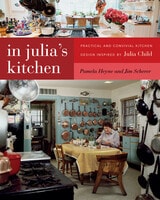
In Julia's Kitchen
Practical and Convivial Kitchen Design Inspired by Julia ChildPamela Heyne and Jim Scherer
University Press of New England, 2016
“Most architects I know don’t know anything about cooking, and their designs are not practical for cooks!” Julia Child wrote to architect Pamela Heyne. Indeed, our contemporary kitchens are showplaces with islands, hidden appliances, and cold stone surfaces. They resemble laboratories more than the heart of the home, and they are neither cook friendly nor family friendly. American culinary icon Julia Child embraced the significance of the family meal and was devoted to sharing delicious food with friends and family at the comfortable dining table in her kitchen, a place where conversation was as important as cuisine. Pamela Heyne and Julia’s long-time food photographer Jim Scherer collaborate to share Julia’s kitchen design and lifestyle concepts in this book, which examines the kitchens in her Cambridge, Massachusetts, home; at la Pitchoune, the Childs’ French vacation retreat; and in her television studio. The authors reveal which materials, layouts, and equipment Julia preferred and why, providing practical advice interspersed with Julia’s inimitable, wry humor. They bring Julia’s wisdom into the contemporary kitchen, exploring current trends, including modern green sensibilities, and varied styles of kitchens, featuring architectural designs by Heyne, Jacques Pepin’s kitchen, a renovation Julia Child consulted on for PBS’s This Old House, several celebrity home kitchens, and more.
[more]
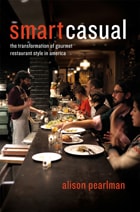
Smart Casual
The Transformation of Gourmet Restaurant Style in AmericaAlison Pearlman
University of Chicago Press, 2013
Fine dining and the accolades of Michelin stars once meant chandeliers, white tablecloths, and suited waiters with elegant accents. The stuffy attitude and often scant portions were the punchlines of sitcom jokes—it was unthinkable that a gourmet chef would stoop to plate a burger or a taco in his kitchen. And yet today many of us will queue up for a seat at a loud, crowded noodle bar or eagerly seek out that farm-to-table restaurant where not only the burgers and fries are organic but the ketchup is homemade—but it’s not just us: the critics will be there too, ready to award distinction. Haute has blurred with homey cuisine in the last few decades, but how did this radical change happen, and what does it say about current attitudes toward taste? Here with the answers is food writer Alison Pearlman. In Smart Casual: The Transformation of Gourmet Restaurant Style in America, Pearlman investigates what she identifies as the increasing informality in the design of contemporary American restaurants.
By design, Pearlman does not just mean architecture. Her argument is more expansive—she is as interested in the style and presentation of food, the business plan, and the marketing of chefs as she is in the restaurant’s floor plan or menu design. Pearlman takes us hungrily inside the kitchens and dining rooms of restaurants coast to coast—from David Chang’s Momofuku noodle bar in New York to the seasonal, French-inspired cuisine of Alice Waters and Thomas Keller in California to the deconstructed comfort food of Homaro Cantu’s Moto in Chicago—to explore the different forms and flavors this casualization is taking. Smart Casual examines the assumed correlation between taste and social status, and argues that recent upsets to these distinctions have given rise to a new idea of sophistication, one that champions the omnivorous. The boundaries between high and low have been made flexible due to our desire to eat everything, try everything, and do so in a convivial setting.
Through lively on-the-scene observation and interviews with major players and chefs, Smart Casual will transport readers to restaurants around the country to learn the secrets to their success and popularity. It is certain to give foodies and restaurant-goers something delectable to chew on.
[more]
The Covert Life of Hospital Architecture
Edited by Julie Zook and Kerstin Sailer
University College London, 2022
A strong visual text that makes research on hospital architecture comprehensible.
This book addresses hospital architecture as a set of interlocked, overlapping spatial and social conditions, identifying ways that hospital spaces work to produce desired outcomes such as greater patient safety, increased care provider communication, and more intelligible corridors.
The volume brings together emerging research on hospital environments. Opening with a description of hospital architecture that emphasizes everyday relations, the book examines the patient room and its intervisibility with adjacent spaces, care teams and on-ward support for their work, and the intelligibility of public circulation spaces for visitors. The final chapter moves outside the hospital to describe the current healthcare crisis of the global pandemic. Reflective essays by practicing designers follow each chapter, bringing perspectives from professional practice into the discussion.
This volume provides new insights into how to better design hospitals through principles that have been tested empirically. It will become a reference for healthcare planners, designers, architects, and administrators, as well as for readers from sociology, psychology, and other areas of the social sciences.
[more]
Unworking
The Reinvention of the Modern OfficeJeremy Myserson and Phillip Ross
Reaktion Books, 2022
As we look toward a future of hybrid or virtual offices, a timely call to rethink the very nature and design of the workplace.
Over the past one hundred years, the office has been integral to the development of modern society. It has shaped the architecture of our cities, the behavior of our organizations, and the everyday movements of millions of people. In 2020, however, the global pandemic brought our attendance in the office to an abrupt halt and triggered a complete reevaluation of the purpose of the workplace. This book offers a panoramic view of the office and explores what happens next. The authors advance a manifesto for “unworking”—unlearning old habits and rituals established for an outdated office and crafting and creating new ones fit for an age of digital technology, design innovation, and diverse workforces.
Over the past one hundred years, the office has been integral to the development of modern society. It has shaped the architecture of our cities, the behavior of our organizations, and the everyday movements of millions of people. In 2020, however, the global pandemic brought our attendance in the office to an abrupt halt and triggered a complete reevaluation of the purpose of the workplace. This book offers a panoramic view of the office and explores what happens next. The authors advance a manifesto for “unworking”—unlearning old habits and rituals established for an outdated office and crafting and creating new ones fit for an age of digital technology, design innovation, and diverse workforces.
[more]