Results by title
6 books match the query 'Intermarriage'
Dawn's Light Woman & Nicolas Franchomme
Marriage and Law in the Illinois CountryCarl J. Ekberg and Sharon K. Person
Southern Illinois University Press, 2022
Native women’s marital rights and roles in colonial Illinois society
Kaskaskia, Illinois, once the state’s capital, torn from the state by flood waters, and now largely forgotten, was once the home to a couple who helped transform the region in the 1720s from a frontier village to a civil society. In the heart of France’s North American empire, the village was a community of French-Canadian fur traders and Kaskaskia Indians who not only lived together but often intermarried. These Indigenous and French intermarriages were central to colonial Illinois society, and the coupling of Marguerite 8assecam8c8e (Dawn’s Light Woman) and Nicolas Franchomme, in particular, was critical to expanding the jurisdiction of French law.
While the story of Marguerite and Nicolas is unknown today, it is the story of how French customary law (Coutume de Paris) governed colonial marriage, how mixed Indian-French marriages stood at the very core of early colonial Illinois society, and how Illinois Indian women benefited, socially and legally, from being married to French men. All of this came about due to a lawsuit in which Nicolas successfully argued that his wife had legal claim to her first husband’s estate—a legal decision that created a precedent for society in the Illinois Country.
Within this narrative of a married couple and their legal fight—based on original French manuscripts and supported by the comprehensively annotated 1726 Illinois census—is also the story of the village of Kaskaskia during the 1720s, of the war between Fox Indians and French settlers, with their Indian allies, in Illinois, and of how the spread of plow agriculture dramatically transformed the Illinois Country’s economy from largely fur trade–based to expansively agricultural.
Jewish on Their Own Terms
How Intermarried Couples are Changing American JudaismThompson, Jennifer A
Rutgers University Press, 0
Over half of all American Jewish children are being raised by intermarried parents. This demographic group will have a tremendous impact on American Judaism as it is lived and practiced in the coming decades. To date, however, in both academic studies about Judaism and in the popular imagination, such children and their parents remain marginal.
Jennifer A. Thompson takes a different approach. In Jewish on Their Own Terms, she tells the stories of intermarried couples, the rabbis and other Jewish educators who work with them, and the conflicting public conversations about intermarriage among American Jews. Thompson notes that in the dominant Jewish cultural narrative, intermarriage symbolizes individualism and assimilation. Talking about intermarriage allows American Jews to discuss their anxieties about remaining distinctively Jewish despite their success in assimilating into American culture.
In contrast, Thompson uses ethnography to describe the compelling concerns of all of these parties and places their anxieties firmly within the context of American religious culture and morality. She explains how American and traditional Jewish gender roles converge to put non-Jewish women in charge of raising Jewish children. Interfaith couples are like other Americans in often harboring contradictory notions of individual autonomy, universal religious truths, and obligations to family and history.
Focusing on the lived experiences of these families, Jewish on Their OwnTerms provides a complex and insightful portrait of intermarried couples and the new forms of American Judaism that they are constructing.
Love in a Global Village
A Celebration of Intercultural Families in the MidwestJessie Carroll Grearson
University of Iowa Press, 2000
In praise of diversity, Jessie Grearson and Lauren Smith offer Love in a Global Village: A Celebration of Intercultural Families in the Midwest, an account of the triumphs of fifteen intercultural families and the perseverance of their relationships in midwestern America. The couples recount their courtships, their adventures and difficulties, and their individual choices to create families and build lives together despite differences of race, language, religion, and culture.
Welcomed into homes in towns like Kalona, Iowa, and Springfield, Missouri, Grearson and Smith introduce readers to unexpected fusions of culture in middle America. By focusing on small communities where intercultural relationships are exceptions rather than the norm, Smith and Grearson offer affirmation that multicultural households can endure and flourish almost anywhere.
Mixed Blood
Intermarriage & Ethnic: Intermarriage And Ethnic Identity In Twentieth Century AmericaPaul R. Spickard
University of Wisconsin Press, 1991
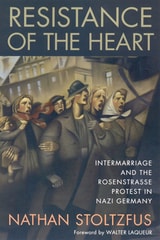
Resistance of the Heart
Intermarriage and the Rosenstrasse Protest in Nazi GermanyNathan Stoltzfus
Rutgers University Press, 2001
In February 1943 the Gestapo arrested approximately 10,000 Jews remaining in Berlin. Most died at Auschwitz. Two thousand of those Jews, however, had non-Jewish partners and were locked into a collection center on a street called Rosenstrasse. As news of the surprise arrest pulsed through the city, hundreds of Gentile spouses, mostly women, hurried to the Rosenstrasse in protest. A chant broke out: "Give us our husbands back."
Over the course of a week protesters vied with the Gestapo for control of the street. Now and again armed SS guards sent the women scrambling for cover with threats that they would shoot. After a week the Gestapo released these Jews, almost all of whom survived the war.
The Rosenstrasse Protest was the triumphant climax of ten years of resistance by intermarried couples to Nazi efforts to destroy their families. In fact, ninety-eight percent of German Jews who did not go into hiding and who survived Nazism lived in mixed marriages. Why did Hitler give in to the protesters? Using interviews with survivors and thousands of Nazi records never before examined in detail, Nathan Stoltzfus identifies the power of a special type of resistance--the determination to risk one's own life for the life of loved ones. A "resistance of the heart..."
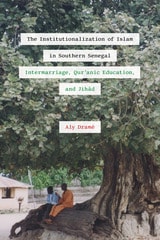
The Institutionalization of Islam in Southern Senegal
Intermarriage, Qur'anic Education, and JihadAly Dramé
University of Michigan Press, 2025
Drawing on archival documents, oral history and traditions, travelers’ accounts, the Arabic text Pakao al-Qurano (Holy Book of Pakao), and original ethnography, The Institutionalization of Islam in Southern Senegal demonstrates how these communities reframe the debates about the institutionalization of Islam in Senegambia geographically, chronologically, and thematically.