Results by title
2 books match the query 'International Labor Organization'
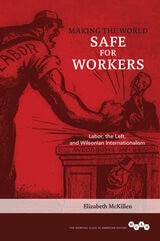
Making the World Safe for Workers
Labor, the Left, and Wilsonian InternationalismElizabeth McKillen
University of Illinois Press, 2018
In this intellectually ambitious study, Elizabeth McKillen explores the significance of Wilsonian internationalism for workers and the influence of American labor in both shaping and undermining the foreign policies and war mobilization efforts of Woodrow Wilson's administration. McKillen highlights the major fault lines and conflicts that emerged within labor circles as Wilson pursued his agenda in the context of Mexican and European revolutions, World War I, and the Versailles Peace Conference. As McKillen shows, the choice to collaborate with or resist U.S. foreign policy remained an important one for labor throughout the twentieth century. In fact, it continues to resonate today in debates over the global economy, wars in Iraq and Afghanistan, and the impact of U.S. policies on workers at home and abroad.
[more]
Social Justice for Women
The International Labor Organization and WomenCarol Riegelman Lubin and Anne Winslow
Duke University Press, 1990
The International Labor Organization (ILO), founded in 1919 at the Paris Peace Conference, was the first international organization established prior to World War II to mention women in its constitution. Organized to promote the “protection of young children, young persons and women,” its original Labor Charter stood by the principle that “men and women should receive equal renumeration for work of equal value.” Social Justice for Women provides the first comprehensive and analytical history of the ILO with respect to women, examining the origins, operations, and successes and weaknesses of its policies.
Carol Riegelman Lubin, a staff member of ILO for seventeen years, and Anne Winslow, for twenty-two years editor for the Carnegie Endowment, explore the important role played by women of the American and British trade union movement in the founding of the ILO. In surveying the organization’s history and structure, they ask how the ILO’s concern with women has manifested over the years, if it was faithful to its constitution, how it dealt with conflicting needs of women from industrialized nations and Third World countries, and what its relationship was to the international feminist movement. Drawing on case studies and analyses of literature on women and work, the authors identify the role of other international organizations in response to the ILO in fostering, or sometimes hindering, women’s development in the labor area.
Carol Riegelman Lubin, a staff member of ILO for seventeen years, and Anne Winslow, for twenty-two years editor for the Carnegie Endowment, explore the important role played by women of the American and British trade union movement in the founding of the ILO. In surveying the organization’s history and structure, they ask how the ILO’s concern with women has manifested over the years, if it was faithful to its constitution, how it dealt with conflicting needs of women from industrialized nations and Third World countries, and what its relationship was to the international feminist movement. Drawing on case studies and analyses of literature on women and work, the authors identify the role of other international organizations in response to the ILO in fostering, or sometimes hindering, women’s development in the labor area.
[more]