Results by title
20 books match the query 'International law'
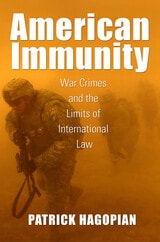
American Immunity
War Crimes and the Limits of International LawPatrick Hagopian
University of Massachusetts Press, 2013
In 1955 the Supreme Court ruled that veterans of the U.S. armed forces could not be court-martialed for overseas crimes that were not detected until after they had left military service. Territorial limitations placed such acts beyond the jurisdiction of civilian courts, and there was no other American court in which they could be adjudicated. As a result, a jurisdictional gap emerged that for decades exempted former troops from prosecution for war crimes. “This was not merely a theoretical possibility,” Patrick Hagopian writes. Over a dozen former soldiers who participated in the My Lai massacre did in fact “get away with murder.” Further court rulings expanded the gap to cover civilian employees and contractors that accompanied the armed forces.
In American Immunity, Hagopian places what he calls the “superpower exemption” in the context of a long-standing tension between international law and U.S. sovereignty. He shows that despite the U.S. role in promulgating universal standards of international law and forming institutions where those standards can be enforced, the United States has repeatedly refused to submit its own citizens and troops to the jurisdiction of international tribunals and failed to uphold international standards of justice in its own courts.
In 2000 Congress attempted to close the jurisdictional gap with passage of the Military Extraterritorial Jurisdiction Act. The effectiveness of that legislation is still in question, however, since it remains unclear how willing civilian American juries will be to convict veterans for conduct in foreign war zones.

Beyond Occupation
Apartheid, Colonialism and International Law in the Occupied Palestinian TerritoriesEdited by Virginia Tilley
Pluto Press, 2012
Beyond Occupation looks at three contentious terms that regularly arise in contemporary arguments about Israel's practices towards Palestinians in the occupied territories – occupation, colonialism and apartheid – and considers whether their meanings in international law truly apply to Israel's policies. This analysis is timely and urgent – colonialism and apartheid are serious breaches of human rights law and apartheid is a crime against humanity under the Rome Statute of the International Criminal Court.
The contributors present conclusive evidence that Israel’s administration of the Palestinian territories is consistent with colonialism and apartheid, as these regimes are defined in human rights law. Their analysis further shows that these practices are deliberate Israeli state policies, imposed on the Palestinian civilian population under military occupation.
These findings raise serious implications for the legality and legitimacy of Israel's continuing occupation of the Palestinian territories and the responsibility of the entire international community to challenge practices considered contrary to fundamental values of the international legal order.
Empire's Law
The American Imperial Project and the 'War to Remake the World'Edited by Amy Bartholomew
Pluto Press, 2006
Jean L. Cohen Professor of Political Science, Columbia University
"This remarkable collection of essays illuminates -- more fully than any other volume -- the world order costs of the Iraq War, especially the radical denial of the relevance of international law in the US's pursuit of global empire. To understand this overarching geopolitical challenge of the early 21st century, citizens the world over should treat Empire's Law as required reading."
Richard A. Falk, Albert G. Milbank Professor of International Law and Practice Emeritus, Princeton University and currently Visiting Professor of Global and International Studies, University of California, Santa Barbara
"Right now there can't be enough discussion of America's role in world politics ... This is a much-needed collection from leading scholars."
Neil Stammers, Senior Lecturer in the Department of International Relations and Politics, University of Sussex
What is the legacy of the war in Iraq? Can democracy and human rights really be imposed "by fire and sword"? This book brings together some of the world's most outstanding theorists in the debate over empire and international law. They provide a uniquely lucid account of the relationship between American imperialism, the use and abuse of "humanitarian intervention", and its legal implications. Empire's Law is ideal for students who want a comprehensive critical introduction to the impact that the doctrine of pre-emptive war has had on our capacity to protect human rights and promote global justice.
Leading contributors including Leo Panitch, Sam Gindin, Jurgen Habermas, Ulrich Preuss, Andrew Arato, Samir Amin, Reg Whitaker, Denis Halliday and Hans von Sponeck tackle a broad range of issues. Covering everything from the role of Europe and the UN, to people's tribunals, to broader theoretical accounts of the contradictions of war and human rights, the contributors offer new and innovative ways of examining the problems that we face. It is essential reading for all students who want a systematic framework for understanding the long-term consequences of imperialism.
Amy Bartholomew is an Associate Professor in the Department of Law at Carleton University.
Foundations of World Order
The Legalist Approach to International Relations, 1898–1922Francis Anthony Boyle
Duke University Press, 1999
Although both the League of Nations and the Permanent Court of International Justice were rejected by the U.S. Senate, Boyle shows how the early governance of these institutions—precursors, respectively, to the United Nations and the International Court of Justice—informed later efforts to reduce and regulate transnational threats and the use of military force. Delving into such topics as the United States and its initial stance of neutrality in World War I and its imperial policy toward Latin America and the Caribbean, Boyle offers detailed readings of the relevant treaties, tribunals, and conferences, and assesses the political actors involved. Taking up the legalist point of view, he discusses the codification of customary international law, the obligatory arbitration of international disputes, and the creation of a new regime for the settlement of such disputes.
Boyle has provided in Foundations of World Order a compelling portrait of the relationship between political power and law, and of the impact of these forces on U.S. diplomacy. This volume will serve as a valuable resource to students, scholars, and practitioners of international law; it will also be of great interest to historians and political scientists engaged with issues of U.S. foreign policy and diplomatic history.
From Coexistence to Conquest
International Law and the Origins of the Arab-Israeli Conflict, 1891-1949Victor Kattan
Pluto Press, 2009
From Coexistence to Conquest seeks to explain how the Arab-Israeli conflict developed by looking beyond strict legalism to the men behind the policies adopted by the Great Powers at the dawn of the twentieth century. It controversially argues that Zionism was adopted by the British Government in its 1917 Balfour Declaration primarily as an immigration device and that it can be traced back to the 1903 Royal Commission on Alien Immigration and the Alien’s Act 1905.
The book places the violent reaction of the Palestine Arabs to mass Jewish immigration in the context of Zionism, highlighting the findings of several British commissions of inquiry which recommended that Britain abandon its policy. The book also revisits the controversies over the question of self-determination, and the partition of Palestine.
The Chapter on the 1948 conflict seeks to update international lawyers on the scholarship of Israel’s ‘new’ historians and reproduces some of the horrific accounts of the atrocities that took place. The penultimate chapter argues that Israel was created through an act of conquest or subjugation. The book concludes with a sobering analysis of the conflict arguing that neither Jews nor Arabs were to blame for starting it.
International Law, Sustainable Development and Water Management
Antoinette Hildering
Eburon Academic Publishers, 2005

Law and Moral Action in World Politics
Cecelia Lynch
University of Minnesota Press, 2000
Law and Religion in a Secular Age
Rafael Domingo
Catholic University of America Press, 2023
Lawyers Beyond Borders
Advancing International Human Rights Through Local Laws and CourtsMaria Armoudian
University of Michigan Press, 2021
Despite international conventions and human rights declarations, millions of people have suffered and continue to suffer torture, slavery, or violent deaths, with no remedy or recourse. They have fallen, in essence, “below the law,” outside of law’s protection. Often violated by their own governments, sometimes with support from transnational corporations, or nations benefiting from human rights violations, how can these victims find justice? Lawyers Beyond Borders reveals the inner workings of the advances and retreats in the quest for redress and restoration of human rights for those whom international legal-political systems have failed. The process of justice begins in the US, with a handful of human rights lawyers steeped in the American tradition of advancing civil rights through civil litigation. As the civil rights movement gained traction and an ample supply of lawyers, this small cadre turned their attention toward advancing international human rights, via the US legal system. They sought to build another piece of the rights revolution, this time for survivors of egregious human rights violations in faraway lands. These cases were among the most unlikely to be slated for victory: The abuses occurred abroad; the victims are aliens, usually with few, if any, resources; the perpetrators are politically powerful, resourced, and well connected, often members of governments, militaries, or multinational corporations. The legal and political systems’ structures are mostly stacked against these survivors, many who bear the scars of trauma and terror.
Lawyers Beyond Borders is about agency. It is about how, in the face of powerful interests and seemingly insurmountable obstacles—political, psychological, economic, geographical, and physical—a small group of lawyers and survivors navigated a terrain of daunting barriers to begin building, case-by-case, new pathways to justice for those who otherwise would have none.
Making Endless War
The Vietnam and Arab-Israeli Conflicts in the History of International LawBrian Cuddy and Victor Kattan, Editors
University of Michigan Press, 2023
Making Endless War is built on the premise that any attempt to understand how the content and function of the laws of war changed in the second half of the twentieth century should consider two major armed conflicts, fought on opposite edges of Asia, and the legal pathways that link them together across time and space. The Vietnam and Arab-Israeli conflicts have been particularly significant in the shaping and attempted remaking of international law from 1945 right through to the present day. This carefully curated collection of essays by lawyers, historians, philosophers, sociologists, and political geographers of war explores the significance of these two conflicts, including their impact on the politics and culture of the world’s most powerful nation, the United States of America. The volume foregrounds attempts to develop legal rationales for the continued waging of war after 1945 by moving beyond explaining the end of war as a legal institution, and toward understanding the attempted institutionalization of endless war.
Philanthropy, Conflict Management and International Law
The 1914 Carnegie Report on the Balkan Wars of 1912/13Stefan Troebst
Central European University Press, 2022
This book centers on the Report of the International Commission to Inquire into the Causes and Conduct of the Balkan Wars, published in Washington in the early summer of 1914 by the Carnegie Endowment for International Peace. The volume was born from the conviction that the full assessment of the significance of the Carnegie Report—one of the first international non-governmental fact-finding missions with the intention to promote peace—requires a deeper exploration of the context of its birth.
The authors examine how the countries involved in the wars handled the inquires of the Carnegie Commission and the role of the report in the remembrance of the wars in the respective states. Although the report considered both the Ottoman Empire and the Balkan nation-states insufficiently civilized to wage wars within the limits of the codes of conduct of international law, this orientalist conclusion can in part be explained by the liberal internationalist strategy of the Carnegie Endowment, and of the commission members’ professional, political, and ethnic background. Overshadowed by the outbreak of World War I, the Carnegie Report’s direct impact on international arbitration or international criminal law was limited, yet—in the authors’ opinion—it ultimately contributed to the further juridification of international relations
Remoteness Reconsidered
The Atacama Desert and International LawChristopher R. Rossi
University of Michigan Press, 2021
Much of our understanding of the world is framed from the perspective of a dominant power center, or from standard readings of historical events. The architecture of international information distribution, academic centers, and the lingua franca of international scholarly discourse also shape these stories. Remoteness Reconsidered employs the idea of remoteness as an analytical tool for viewing international law's encounter with the Americas from the unusual, peripheral perspective of the Atacama Desert. The Atacama is one of the most remote places on Earth, although that less-than-accurate perspective comes from standard historical accounts of the region, accounts that originate from the “center.” Changing the usual frame of reference leads to a reconsideration of the idea of remoteness and of the subsequent marginalization of historical narratives that influence hemispheric international relations in important ways today. Lessons about international law's encounters with neoliberalism, indigenous and human rights, and the management and extraction of mineral resources take on new significance by following a spatial turn toward the idea of remoteness as applied to the Atacama Desert.
Sovereigns, Quasi Sovereigns, and Africans
Race and Self-Determination in International LawSiba N’Zatioula Grovogui
University of Minnesota Press, 1996
Sovereigns, Quasi Sovereigns, and Africans was first published in 1996. Minnesota Archive Editions uses digital technology to make long-unavailable books once again accessible, and are published unaltered from the original University of Minnesota Press editions.
In this trenchant critique, Siba N'Zatioula Grovogui demonstrates the failure of international law to address adequately the issues surrounding African self-determination during decolonization. Challenging the view that the only requirement for decolonization is the elimination of the legal instruments that provided for direct foreign rule, Sovereigns, Quasi Sovereigns, and Africans probes the universal claims of international law.
Grovogui begins by documenting the creation of the "image of Africa" in European popular culture, examining its construction by conquerors and explorers, scientists and social scientists, and the Catholic Church. Using the case of Namibia to illuminate the general context of Africa, he demonstrates that the principles and rules recognized in international law today are not universal, but instead reflect relations of power and the historical dominance of specific European states.
Grovogui argues that two important factors have undermined the universal applicability of international law: its dependence on Western culture and the way that international law has been structured to preserve Western hegemony in the international order. This dependence on Europeandominated models and legal apparatus has resulted in the paradox that only rights sanctioned by the former colonial powers have been accorded to the colonized, regardless of the latter's needs. In the case of Namibia, Grovogui focuses on the discursive strategies used by the West and their southern African allies to control the legal debate, as well as the tactics used by the colonized to recast the terms of the discussion.
Grovogui blends critical legal theory, historical research, political economy, and cultural studies with profound knowledge of contemporary Africa in general and Namibia in particular. Sovereigns, Quasi Sovereigns, and Africans represents the very best of the new scholarship, moving beyond narrow disciplinary boundaries to illuminate issues of decolonization in Africa.
Siba N'Zatioula Grovogui is assistant professor of political science at Johns Hopkins University. He previously practiced law in his native Guinea.

Soviet International Law and the World Economic Order
Kazimierz Grzybowski
Duke University Press, 1987
Strengthening International Courts
The Hidden Costs of LegalizationLeslie Johns
University of Michigan Press, 2015
Examining detailed case studies of the International Court of Justice and the transition from the General Agreement on Tariffs and Trade to the World Trade Organization, Leslie Johns finds that a court’s design has nuanced and mixed effects on international cooperation. A strong court is ideal when laws are precise and the court is nested within a political structure like the European Union. Strong courts encourage litigation but make states more likely to comply with agreements when compliance is easy and withdraw from agreements when it is difficult. A weak court is optimal when law is imprecise and states can easily exit agreements with minimal political or economic repercussions. Johns concludes the book with recommendations for promoting cooperation by creating more precise international laws and increasing both delegation and obligation to international courts.
The Global Environment and International Law
By Joseph F. C. DiMento
University of Texas Press, 2003
2004 — A Choice Outstanding Academic Book
International law has become the key arena for protecting the global environment. Since the 1970s, literally hundreds of international treaties, protocols, conventions, and rules under customary law have been enacted to deal with such problems as global warming, biodiversity loss, and toxic pollution. Proponents of the legal approach to environmental protection have already achieved significant successes in such areas as saving endangered species, reducing pollution, and cleaning up whole regions, but skeptics point to ongoing environmental degradation to argue that international law is an ineffective tool for protecting the global environment.
In this book, Joseph DiMento reviews the record of international efforts to use law to make our planet more livable. He looks at how law has been used successfully—often in highly innovative ways—to influence the environmental actions of governments, multinational corporations, and individuals. And he also assesses the failures of international law in order to make policy recommendations that could increase the effectiveness of environmental law. He concludes that a "supranational model" is not the preferred way to influence the actions of sovereign nations and that international environmental law has been and must continue to be a laboratory to test approaches to lawmaking and implementation for the global community.
The Perils of Global Legalism
Eric A. Posner
University of Chicago Press, 2009
The first months of the Obama administration have led to expectations, both in the United States and abroad, that in the coming years America will increasingly promote the international rule of law—a position that many believe is both ethically necessary and in the nation’s best interests.
With The Perils of Global Legalism, Eric A. Posner explains that such views demonstrate a dangerously naive tendency toward legalism—an idealistic belief that law can be effective even in the absence of legitimate institutions of governance. After tracing the historical roots of the concept, Posner carefully lays out the many illusions—such as universalism, sovereign equality, and the possibility of disinterested judgment by politically unaccountable officials—on which the legalistic view is founded. Drawing on such examples as NATO’s invasion of Serbia, attempts to ban the use of land mines, and the free-trade provisions of the WTO, Posner demonstrates throughout that the weaknesses of international law confound legalist ambitions—and that whatever their professed commitments, all nations stand ready to dispense with international agreements when it suits their short- or long-term interests.
Provocative and sure to be controversial, The Perils of Global Legalism will serve as a wake-up call for those who view global legalism as a panacea—and a reminder that international relations in a brutal world allow no room for illusions.
The United States and International Law
Paradoxes of Support across Contemporary IssuesLucrecia García Iommi and Richard W. Maass
University of Michigan Press, 2022
The United States spearheaded the creation of many international organizations and treaties after World War II and maintains a strong record of compliance across several issue areas, yet it also refuses to ratify major international conventions like the UN Convention on the Law of the Sea and the Convention on the Elimination of All Forms of Discrimination Against Women. Why does the United States often seem to support international law in one way while neglecting or even violating it in another?
The United States and International Law: Paradoxes of Support across Contemporary Issues analyzes the seemingly inconsistent U.S. relationship with international law by identifying five types of state support for international law: leadership, consent, internalization, compliance, and enforcement. Each follows different logics and entails unique costs and incentives. Accordingly, the fact that a state engages in one form of support does not presuppose that it will do so across the board. The contributors to this volume examine how and why the United States has engaged in each form of support across twelve issue areas that are central to twentieth- and twenty-first-century U.S. foreign policy: conquest, world courts, war, nuclear proliferation, trade, human rights, war crimes, torture, targeted killing, maritime law, the environment, and cybersecurity. In addition to offering rich substantive discussions of U.S. foreign policy in each of these areas, their findings reveal patterns across the U.S. relationship with international law that shed light on behavior that often seems paradoxical at best, hypocritical at worst. The results help us understand why the United States engages with international law as it does, the legacies of the Trump administration, and what we should expect from the United States under the Biden administration and beyond.
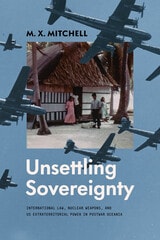
Unsettling Sovereignty
International Law, Nuclear Weapons, and US Extraterritorial Power in Postwar OceaniaM. X. Mitchell
University of Chicago Press, 2026
Marshall Islanders and their ancestral lands and waters played important roles in reshaping the United States’ offshore power, state sovereignty, and the international politics of decolonization.
In the years following World War II, the United States conducted sixty-seven devastating nuclear blasts in the Marshall Islands—yet the archipelago was never a US territory. Working through the United Nations, US diplomats engineered a new, one-of-a-kind extraterritorial status, called strategic trusteeship, to control the Native lands, waters, and peoples of the Marshall, Caroline, and Northern Mariana Islands. Strategic trusteeship permitted the US to militarize a vast expanse of Western Oceania. This novel and racialized legal form of international dependency was integral to US nuclear weapons detonations and damage in the region.
In Unsettling Sovereignty, M. X. Mitchell recounts this untold legal history, exploring how nuclear weapons changed claims and practices of sovereignty from the 1940s to the present. US nuclear blasting in the Marshall Islands troubled conventional renderings of state sovereignty under international law. The explosions, disastrous for Marshallese communities and their ancestral atolls, also caused hazardous nuclear fallout, which spread around the globe. Islanders and their allies turned to law, using legal wrangling over blasting and fallout to raise new questions about the location, time, and subjects of state violence in a period of decolonization; the intersections between race, Indigeneity, and wide-scale technogenic harm; and the pitfalls and unfulfilled promises of international law. Mitchell shows that the Marshallese people and their lands and waters were, and remain, central to redefining sovereignty in an era of boundless pollution and climate change.
World Politics and International Law
Francis Anthony Boyle
Duke University Press, 1985
In the second part, the author dissects the Entebbe raid, where Israeli forces rescued a group of hostages being detained by hijackers at a Ugandan airport. His analysis shows the deficiencies of the international system in dealing with such a complex issue, where several contradictory principles of international law could be applied and were defended by various protagonists.
The third part starts with a parallel problem--the Iranian hostages crisis, where a group of U.S. officials found themselves in an unprecedented situation of being captured by a band of students. A critical analysis of the handling of this problem by the Carter Administration is followed by vignettes of other crises faced by the Administration and by its successor, the Reagan Administration. This part is less analytical and more prescriptive. The author is no long satisfied with pointing out what went wrong; instead, he departs from the usual hands-off policy of political scientists and tries to indicate how much better each situation could have been handled if the decision makers had been paying more attention to international law and international organizations. The theme is slowly developed that in the long run national interest is better served not by practicing power politics and relying on the use of threat of force but by strengthening those international institutions that can provide a neutral environment for first slowing down a crisis and then finding an equitable solution acceptable to most of the parties in conflict.
The value of this book lies primarily in giving the reader a real insight into several important issues of today that are familiar to most people only from newspaper headlines and television news. While not everybody can agree with all his criticisms of the mistakes of various governments, there is an honest attempt by the author to present issues impartially and to let the blame fall where it may. Being both an international lawyer and a political scientist, the author has had the advantage of combining the methodology of these two social sciences into a rich tapestry with some startling shades and tones.