Results by title
11 books match the query 'International organization'

Anarchy, Order and Integration
How to Manage InterdependenceHarvey Starr
University of Michigan Press, 2000

Global Trends and Global Governance
Edited by Paul Kennedy, Dirk Messner, and Franz Nuscheler
Pluto Press, 2001
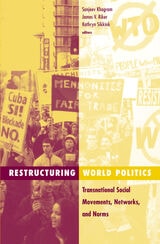
Restructuring World Politics
Transnational Social Movements, Networks, And NormsSanjeev Khagram
University of Minnesota Press, 2002
From the earliest campaign against Augusto Pinochet’s repressive practices to the recent massive demonstrations against the World Trade Organization, transnational collective action involving nongovernmental organizations has been restructuring politics and changing the world. Ranging from Santiago to Seattle and covering more than twenty-five years of transnational advocacy, the essays in Restructuring World Politics offer a clear, richly nuanced picture of this process and its far-reaching implications in an increasingly globalized political economy. The book brings together scholars, activists, and policy makers to show how such advocacy addresses—and reshapes—key issues in the areas of labor, human rights, gender justice, democratization, and sustainable development throughout the world.
A primary goal of transnational advocacy is to create, strengthen, implement, and monitor international norms. How transnational networks go about doing this, why and when they succeed, and what problems and complications they face are the main themes of this book. Looking at a wide range of cases where nongovernmental actors attempt to change norms and the practices of states, international organizations, and firms in the private sector—from debt restructuring to protecting human rights, from anti-dam projects in India to the prodemocracy movement in Indonesia—the authors compellingly depict international nongovernmental organizations and transnational social movements as considerable, emerging powers in international politics, initiating, facilitating, and directing the transformation of global norms and practices.
Contributors: Karen Brown Thompson, U of Minnesota; Charles T. Call, Brown U; Elizabeth A. Donnelly, Harvard U; Darren Hawkins, Brigham Young U; Thalia G. Kidder; Smitu Kothari; Paul J. Nelson, U of Pittsburgh; August Nimtz, U of Minnesota; Mark Ritchie, Institute for Agriculture and Trade Policy; Jackie Smith, SUNY Stony Brook; Daniel C. Thomas, U of Illinois, Chicago.
Temple of Peace
International Cooperation and Stability since 1945Ingo Trauschweizer
Ohio University Press, 2021
This collection raises timely questions about peace and stability as it interrogates the past and present status of international relations.
The post–World War II liberal international order, upheld by organizations such as the United Nations, the North Atlantic Treaty Organization, and similar alliances, aspired to ensure decades of collective security, economic stability, and the rule of law. All of this was a negotiated process that required compromise—and yet it did not make for a peaceful world.
When Winston Churchill referred to the UN framework as “the temple of peace” in his famous 1946 Iron Curtain speech, he maintained that international alliances could help provide necessary stability so free people could prosper, both economically and politically. Though the pillars of international order remain in place today, in a world defined as much by populism as protest, leaders in the United States no longer seem inclined to serve as the indispensable power in an alliance framework that is built on shared values, human rights, and an admixture of hard and soft power.
In this book, nine scholars and practitioners of diplomacy explore both the successes and the flaws of international cooperation over the past seventy years. Collectively, the authors seek to address questions about how the liberal international order was built and what challenges it has faced, as well as to offer perspectives on what could be lost in a post-American world.
The Microbial State
Global Thriving and the Body PoliticStefanie R. Fishel
University of Minnesota Press, 2017
For three centuries, concepts of the state have been animated by one of the most powerful metaphors in politics: the body politic, a claustrophobic and bounded image of sovereignty. Climate change, neoliberalism, mass migration, and other aspects of the late Anthropocene have increasingly revealed the limitations of this metaphor. Just as the human body is not whole and separate from other bodies—comprising microbes, bacteria, water, and radioactive isotopes—Stefanie R. Fishel argues that the body politic of the state exists in dense entanglement with other communities and forms of life.
Drawing on insights from continental philosophy, science and technology studies, and international relations theory, this path-breaking book critiques the concept of the body politic on the grounds of its very materiality. Fishel both redefines and extends the metaphor of the body politic and its role in understanding an increasingly posthuman, globalized world politics. By conceiving of bodies and states as lively vessels, living harmoniously with multiplicity and the biosphere, she argues that a radical shift in metaphors can challenge a politics based on fear to open new forms of global political practice and community.
Reframing the concept of the body politic to accommodate greater levels of complexity, Fishel suggests, will result in new configurations for the political and social organization necessary to build a world in which the planet’s inhabitants do not merely live but actively thrive.
The Network Inside Out
Annelise Riles
University of Michigan Press, 2001
The immediate subject of Riles's ethnographic work was a group of Fijian bureaucrats and activists preparing for and participating in the United Nations Fourth World Conference on Women. Participants in this meeting and the activities surrounding it understood themselves to be "focal points" in national, regional, and global "networks."
Starting from the premise that anthropologists are "inside" the Network, that is, that they are producers, consumers, and aesthetes, not simply observers, of the artifacts of late modern institutional life, Riles enacts a new ethnographic method for turning the network "inside out." The resulting experiment in the theory and ethnography of transnational institutional practices makes an important contribution to the anthropology of knowledge.
With its focus on developing a method for studying transnational phenomena, The Network Inside Out will appeal not only to anthropologists, but also to legal scholars and political scientists.
Annelise Riles is Assistant Professor, Northwestern University School of Law, Research Fellow, American Bar Foundation.
The Third Sector
Community Organizations, NGOs, and NonprofitsMeghan Elizabeth Kallman and Terry Nichols Clark
University of Illinois Press, 2019

The United States and the Second Hague Peace Conference
American Diplomacy and International Organization, 1899–1914Calvin DeArmond Davis
Duke University Press, 1975

The View from Prague
The Expectations of World Leaders at the Dawn of the 21st CenturyJirí Musil
Central European University Press, 2007
The WTO as an International Organization
Edited by Anne O. Krueger
University of Chicago Press, 1997
"[T]his book is a tour de force, with consistently fine papers by leading experts, and it is worthy of any bookshelf." —Joel P. Trachtman, American Journal of International Law
"This latest conference volume from the National Bureau of Economic Research is likely to be the definitive reference work on the WTO for years to come. . . . Specialists and non-specialists alike will gain a great deal from a careful reading of this impressive volume." —John Ravenhill, Australian Journal of Political Science
"For anyone who is interested in the further development of the rule system for the world economy, this book is a must." —Horst Siebert, Review of World Economics
World Rule
Accountability, Legitimacy, and the Design of Global GovernanceJonathan GS Koppell
University of Chicago Press, 2010
Dilemmas from climate change to financial meltdowns make it clear that global interconnectedness is the norm in the twenty-first century. As a result, global governance organizations (GGOs)—from the World Trade Organization to the Forest Stewardship Council—have taken on prominent roles in the management of international affairs. These GGOs create and promulgate rules to address a host of pressing problems. But as World Rule reveals, they struggle to meet two challenges: building authority despite limited ability to impose sanctions and maintaining legitimacy while satisfying the demands of key constituencies whose support is essential to a global rulemaking regime.
Through a novel empirical study of twenty-five GGOs, Jonathan GS Koppell provides a clearer picture of the compromises within and the competition among these influential institutions by focusing attention on their organizational design. Analyzing four aspects of GGO organization in depth—representation and administration, the rulemaking process, adherence and enforcement, and interest group participation—Koppell describes variation systemically, identifies patterns, and offers explanations that link GGO design to the fundamental challenge of accountability in global governance.