Results by title
16 books match the query 'Interpretations'
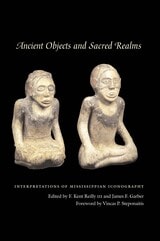
Ancient Objects and Sacred Realms
Interpretations of Mississippian IconographyEdited by F. Kent Reilly, III, and James F. Garber
University of Texas Press, 2006
Between AD 900-1600, the native peoples of the Mississippi River Valley and other areas of the Eastern Woodlands of the United States conceived and executed one of the greatest artistic traditions of the Precolumbian Americas. Created in the media of copper, shell, stone, clay, and wood, and incised or carved with a complex set of symbols and motifs, this seven-hundred-year-old artistic tradition functioned within a multiethnic landscape centered on communities dominated by earthen mounds and plazas. Previous researchers have referred to this material as the Southeastern Ceremonial Complex (SECC).
This groundbreaking volume brings together ten essays by leading anthropologists, archaeologists, and art historians, who analyze the iconography of Mississippian art in order to reconstruct the ritual activities, cosmological vision, and ideology of these ancient precursors to several groups of contemporary Native Americans. Significantly, the authors correlate archaeological, ethnographic, and art historical data that illustrate the stylistic differences within Mississippian art as well as the numerous changes that occur through time. The research also demonstrates the inadequacy of the SECC label, since Mississippian art is not limited to the Southeast and reflects stylistic changes over time among several linked but distinct religious traditions. The term Mississippian Iconographic Interaction Sphere (MIIS) more adequately describes the corpus of this Mississippian art. Most important, the authors illustrate the overarching nature of the ancient Native American religious system, as a creation unique to the native American cultures of the eastern United States.

Contemporary Lithic Analysis in the Southeast
Problems, Solutions, and InterpretationsPhilip J. Carr
University of Alabama Press, 2012
William Andrefsky Jr. / Andrew P. Bradbury / Philip J. Carr / CarolynConklin /
Deaf History Unveiled
Interpretations from the New ScholarshipJohn Vickrey Van Cleve
Gallaudet University Press, 1999
Other studies track societal paternalism toward deaf people in Italy, Hungary, and the United States. Adding to its intrigue, the new research in this milestone study provides evidence for previously uncredited self-determination of Deaf people in establishing education, employment, and social structures common throughout the Northern Hemisphere. Historians, teachers, and students alike will prize Deaf History Unveiled as a singular collection of insights that will change historical perspectives on the Deaf experience worldwide.
Dewey's Logical Theory
New Studies and InterpretationsF. Thomas Burke
Vanderbilt University Press, 2002
This collection breaks new ground in its relevance to contemporary philosophy of logic and epistemology and pays special attention to applications in ethics and moral philosophy.
Imagining Politics
Interpretations in Political Science and Political TelevisionStephen Benedict Dyson
University of Michigan Press, 2019
Imagining Politics critically examines two interpretations of government. The first comes from pop culture fictions about politics, the second from academic political science. Stephen Benedict Dyson argues that televised political fictions and political science theories are attempts at meaning-making, reflecting and shaping how a society thinks about its politics.
By taking fiction seriously, and by arguing that political science theory is homologous to fiction, the book offers a fresh perspective on both, using fictions such as The West Wing, House of Cards, Borgen, Black Mirror, and Scandal to challenge the assumptions that construct the discipline of political science itself.
Imagining Politics is also about a political moment in the West. Two great political shocks—Brexit and the election of Donald Trump—are set in a new context here. Dyson traces how Brexit and Trump campaigned against our image of politics as usual, and won.

Interpretations of American History
Francis G. Couvares
University of Massachusetts Press, 2025
Without a doubt, the teaching of American history has changed since George Billias and Gerald Grob first issued Interpretations of American History, a comprehensive introduction to the major debates and schools of thought within the field of American history. For this ninth edition, Francis G. Couvares has thoroughly updated the text to include both developments in scholarly debate and changes in the format. He has consolidated two chapters on the revolutionary era into one, and he has also merged formerly separate chapters on profit and commerce in the trading of human beings and the complex and resilient culture that enslaved people sustained. Additionally, he has written a completely new chapter on environmental history and updated the final chapters of the text to include recent scholarship that connects the history of the Civil Rights Movement to the Black Lives Matter Movement; scholarship that discusses intersectionality within feminism, and recent work on political realignment and fragmentation.
In a major revision to the format, Couvares has omitted excerpts of scholarly articles. However, for curious students or research assignments, he includes ample current references. Further, this updated edition anticipates electronic reading of discrete chapters rather than the entire book, and each chapter stands alone well enough to be assigned individually.
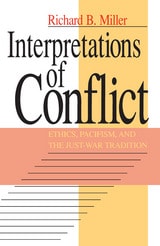
Interpretations of Conflict
Ethics, Pacifism, and the Just-War TraditionRichard B. Miller
University of Chicago Press, 1991
Miller's study of the ethics of war could not be more timely.
Miller brings together the opposed traditions of pacifism and
just-war theory and puts them into a much-needed dialogue
on the ethics of war.
Beginning with the duty of nonviolence as a point of
convergence between the two rival traditions, Miller provides
an opportunity for pacifists and just-war theorists to refine
their views in a dialectical exchange over a set of ethical
and social questions. From the interface of these two long-
standing and seemingly incompatible traditions emerges a
surprisingly fruitful discussion over a common set of values,
problems, and interests: the presumption against harm, the
relation of justice and order, the ethics of civil
disobedience, the problem of self-righteousness in moral
discourse about war, the ethics of nuclear deterrence, and
the need for practical reasoning about the morality of war.
Miller pays critical attention to thinkers such as Augustine
and Thomas Aquinas, as well as to modern thinkers like H.
Richard Niebuhr, Paul Ramsey, Martin Luther King, Jr., James
Douglass, the Berrigans, William O'Brien, Michael Walzer, and
James Childress. He demonstrates how pacifism and just-war
tenets can be joined around both theoretical and practical
issues.
Interpretations of Conflict is a work of massive
scholarship and careful reasoning that should interest
philosophers, theologians, and religious ethicists alike. It
enhances our moral literacy about injury, suffering, and
killing, and offers a compelling dialectical approach to
ethics in a pluralistic society.
Richard B. Miller is assistant professor of religious
studies at Indiana University.
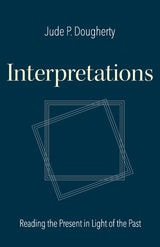
Interpretations
Reading the Present in Light of the PastJude P. Dougherty
Catholic University of America Press, 2018
The first part of Interpretations is an attempt to understand modernity’s break with the past, the repudiation of Scholasticism and the classical tradition. Dougherty does this by referencing the dominant preoccupations of the Middle Ages, of the Renaissance, of the Reformation, of eighteenth-century British empiricism, and of nineteenth-century German philosophy, drawing upon the readings of Remi Brague, Pierre Manent, and others. What unifies these reflections is the role of religion (both in Christianity and Islam) in society and its impact on the culture, as well as looking at what is called “modernity” where this role becomes reduced or absent.
The second part of the volume examines selected addresses by Pope Emeritus Benedict XVI from a philosophical point of view. Benedict, like others through the course of history, has recognized the role of religion in producing cultural unity. These essays are an appreciation primarily of the subtlety of the former pontiff’s thought.
The third part of Interpretations collects essays and addresses on the practice and nature of philosophy that Dean Dougherty has given throughout his career at The Catholic University of America, and reflects the trajectory of his career and the development of his thought.

Leon Forrest
Introductions and InterpretationsJohn G. Cawelti
University of Wisconsin Press, 1997
Loosening The Seams
Interpretations Of Gerald VizenorA. Robert Lee
University of Wisconsin Press, 2000
The seventeen essays gathered in this volume take the measure of Vizenor’s achievement. Among the contributors are leading Native American writers Louis Owens, Arnold Krupat, Elaine A. Jahner, and Barry O’Connell.
Reading Southern History
Essays on Interpreters and InterpretationsGlenn Feldman
University of Alabama Press, 2001
This collection of essays examines the contributions of some of the most notable interpreters of southern history and culture, furthering our understanding of the best historical work produced on the region.
Historian Glenn Feldman gathers together a group of essays that examine the efforts of important scholars to discuss and define the South's distinctiveness. The volume includes 18 chapters on such notable historians as John Hope Franklin, Anne Firor Scott, Frank L. Owsley, W. J. Cash, and C. Vann Woodward, written by 19 different researchers, both senior historians and emerging scholars, including Jacquelyn Dowd Hall, John Shelton Reed, Bruce Clayton, and Ted Ownby. The essays examine the major work or works of each scholar under consideration as well as that scholar's overall contribution to the study of southern history.
Reading Southern History will enlighten readers on the more compelling themes currently and traditionally explored by southern historians. It will appeal greatly to professors and students as a valuable multidisciplinary introduction to the study of southern history, since several of the essays are on scholars who are working outside the discipline of history proper, in the fields of political science, sociology, journalism, and economics. Feldman's collection, therefore, sheds light on a broad spectrum of themes important in southern history, including the plight of poor whites, race, debates over race and class, the "reconstruction syndrome," continuity versus discontinuity in relation to blacks and whites, and regional culture and distinctiveness.
Reading Southern History will be valuable to students and scholars of women's studies, African American history, working-class history, and ethnic studies, as well as traditional southern history. Most important, the publication makes a significant contribution to the development and ongoing study of the historiography of the South.
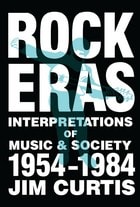
Rock Eras
Interpretations of Music and Society, 1954-1984Jim Curtis
University of Wisconsin Press, 1987
Paper is temporarily out of stock, Cloth (0-87972-368-8) is available at the paper price until further notice.
The Conflict of Interpretations
Paul Ricoeur
Northwestern University Press, 1974
The Conflict of Interpretations
Essays in HermeneuticsPaul Ricoeur
Northwestern University Press, 2007

The Paleolithic of Siberia
New Discoveries and InterpretationsEdited and Compiled by Anatoli P. Derev'anko: Demitri B. Shimkin and W. Roger Powers (American Editors). Translated by Inna P. Laricheva
University of Illinois Press, 1998
It traces the routes of human migration throughout Eurasia, shows Siberian lithic industries as they evolved from the Early through the Middle and Late Paleolithic, and correlates them with reports from Mongolia, China, Japan, and America.

Thomas Hart Benton
Discoveries and InterpretationsHenry Adams
University of Missouri Press, 2027
Few American artists have incited more controversy than Thomas Hart Benton. Argumentative, brilliant, and enormously influential, Benton painted for nearly seventy years, inspiring acclaim and loathing among students, friends, fellow artists, and outraged critics.
Now, in a series of provocative essays, premier Benton scholar Henry Adams examines the many facets of the man as artist and the pitched battles of his long career, including the fight that raged over the subject matter of his murals, the real reasons for Benton’s feud with the radical left and his fall from grace in the New York art world, and his tumultuous, 36-year-long love-hate relationship with the student with whom he worked most closely, another iconic artist of the 20th century, Jackson Pollock. Adams ends with an account of his own twenty-five-year struggle to expose fakes of Benton’s work.