Results by title
5 books match the query 'Intersex people'

Body Problems
What Intersex Priest Sally Gross Teaches Us About Embodiment, Justice, and BelongingM. Wolff
Duke University Press, 2025

Envisioning African Intersex
Challenging Colonial and Racist Legacies in South African MedicineAmanda Lock Swarr
Duke University Press, 2023
All author royalties from Envisioning African Intersex will be donated to Intersex South Africa.
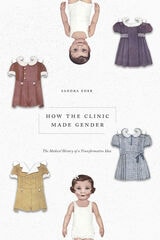
How the Clinic Made Gender
The Medical History of a Transformative IdeaSandra Eder
University of Chicago Press, 2022
Today, a world without “gender” is hard to imagine. Gender is at the center of contentious political and social debates, shapes policy decisions, and informs our everyday lives. Its formulation, however, is lesser known: Gender was first used in clinical practice. This book tells the story of the invention of gender in American medicine, detailing how it was shaped by mid-twentieth-century American notions of culture, personality, and social engineering.
Sandra Eder shows how the concept of gender transformed from a pragmatic tool in the sex assignment of children with intersex traits in the 1950s to an essential category in clinics for transgender individuals in the 1960s. Following gender outside the clinic, she reconstructs the variable ways feminists integrated gender into their theories and practices in the 1970s. The process by which ideas about gender became medicalized, enforced, and popularized was messy, and the route by which gender came to be understood and applied through the treatment of patients with intersex traits was fraught and contested. In historicizing the emergence of the sex/gender binary, Eder reveals the role of medical practice in developing a transformative idea and the interdependence between practice and wider social norms that inform the attitudes of physicians and researchers. She shows that ideas like gender can take on a life of their own and may be used to question the normative perceptions they were based on. Illuminating and deeply researched, the book closes a notable gap in the history of gender and will inspire current debates on the relationship between social norms and medical practice.

Intersex Figures in Modern Japanese Literature and Art
Leslie Winston
University of Michigan Press, 2025
Intersex Figures in Modern Japanese Literature and Art explores the history of intersex or futanari figures in modern Japanese literature and culture to examine the provocative discourses that defied a sexual regime as the modern nation-state of Japan advanced its national and imperial designs. As sexologists and medical practitioners continued reinforcing categories of “male” and “female,” “normal” and “pathological,” intersex literary figures garnered attention because the perceived subject was expected to be male or female—any variation was unintelligible. Many of the same century-old tropes and societal attitudes of needing to “cure” intersex persist. At the same time the 1991 novel Ringu by Suzuki Kōji testifies to a denial of futanari subjectivity, while the 1998 Japanese horror film (Ringu) and its 2002 American remake (The Ring) erase intersex all together.
Winston interrogates how the trope of the futanari is deployed for pragmatic or aesthetic purposes, thereby complicating the trajectory of the dominant sexological ideology of the time. Winston reads the figurative futanari in the works of Shimizu Shikin, Tanizaki Jun’ichirō, and Takabatake Kashō, and reveals how the artists’ different approaches to the futanari served their agendas and expressed views that challenged the dominant discourse on intersex.

Intersex and Identity
The Contested SelfSharon E. Preves
Rutgers University Press, 2003
Approximately one in every two thousand infants born in America each year is sexually ambiguous in such a way that doctors cannot immediately determine the child’s sex. Some children’s chromosomal sexuality contradicts their sexual characteristics. Others have the physical traits of both sexes, or of neither. Is surgical intervention or sex assignment of intersexed children necessary for their physical and psychological health, as the medical and mental health communities largely assume? Should parents raise sexually ambiguous children as one gender or another and keep them ignorant of their medical history?
Drawing upon life history interviews with adults who were treated for intersexuality as children, Sharon E. Preves explores how such individuals experience and cope with being labeled sexual deviants in a society that demands sexual conformity. Preves frames their stories within a sociological discussion of gender, the history of intersex medicalization, the recent political mobilization of intersexed adults, and the implications of their activism on identity negotiation, medical practice, and cultural norms. By demonstrating how intersexed people manage and create their own identities, often in conflict with their medical diagnosis, Preves argues that medical intervention into intersexuality often creates, rather than mitigates, the stigma these people suffer.