Results by title
2 books match the query 'Interviewing on television'
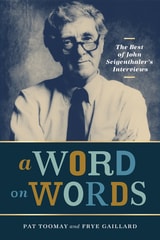
A Word on Words
The Best of John Seigenthaler's InterviewsEdited by Pat Toomay and Frye Gaillard; Epilogue by Andrew Maraniss
Vanderbilt University Press, 2023
For years the legendary John Seigenthaler hosted A Word on Words on Nashville's public television station, WNPT. During the show’s four-decade run (1972 to 2013), he interviewed some of the most interesting and most important writers of our time. These in-depth exchanges revealed much about the writers who appeared on his show and gave a glimpse into their creative processes. Seigenthaler was a deeply engaged reader and a generous interviewer, a true craftsman. Frye Gaillard and Pat Toomay have collected and transcribed some of the iconic interactions from the show.
Featuring interviews with:
Arna Bontemps • Marshall Chapman • Pat Conroy • Rodney Crowell • John Egerton • Jesse Hill Ford • Charles Fountain • William Price Fox • Kinky Friedman • Frye Gaillard • Nikki Giovanni • Doris Kearns Goodwin • David Halberstam • Waylon Jennings • John Lewis • David Maraniss • William Marshall • Jon Meacham • Ann Patchett • Alice Randall • Dori Sanders • John Seigenthaler Sr. • Marty Stuart • Pat Toomay
[more]
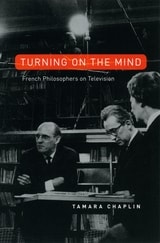
Turning On the Mind
French Philosophers on TelevisionTamara Chaplin
University of Chicago Press, 2007
In 1951, the eight o’clock nightly news reported on Jean-Paul Sartre for the first time. By the end of the twentieth century, more than 3,500 programs dealing with philosophy and its practitioners—including Bachelard, Badiou, Foucault, Lyotard, and Lévy—had aired on French television. According to Tamara Chaplin, this enduring commitment to bringing the most abstract and least visual of disciplines to the French public challenges our very assumptions about the incompatibility of elite culture and mass media. Indeed, it belies the conviction that television is inevitably anti-intellectual and the quintessential archenemy of the book.
Chaplin argues that the history of the televising of philosophy is crucial to understanding the struggle over French national identity in the postwar period. Linking this history to decolonization, modernization, and globalization, Turning On the Mind claims that we can understand neither the markedly public role that philosophy came to play in French society during the late twentieth century nor the renewed interest in ethics and political philosophy in the early twenty-first unless we acknowledge the work of television. Throughout, Chaplin insists that we jettison presumptions about the anti-intellectual nature of the visual field, engages critical questions about the survival of national cultures in a globalizing world, and encourages us to rethink philosophy itself, ultimately asserting that the content of the discipline is indivisible from the new media forms in which it has found expression.
[more]