Results by title
20 books match the query 'Intimacy (Psychology)'

Are You Two Sisters?
The Journey of a Lesbian CoupleSusan Krieger
Temple University Press, 2022
Authored by one of the most respected figures in the field of personal ethnographic narrative, this book serves as both a memoir and a sociological study, telling the story of one lesbian couple’s lifelong journey together.
Are You Two Sisters? is Susan Krieger’s candid, revealing, and engrossing memoir about the intimacies of a lesbian couple. Krieger explores how she and her partner confront both the inner challenges of their relationship and the invisibility of lesbian identity in the larger world.
Using a lively novelistic and autoethnographic approach that toggles back and forth in time, Krieger reflects on the evolution of her forty-year relationship. She describes building a life together, from sharing pets and travels to getting married. Are You Two Sisters? addresses not only questions of gender and sexuality, but also of disability, as Krieger explores how the couple adapts to her increasing blindness.
Krieger’s title comes from a question asked by a stranger outside a remote desert bar as she and her partner traveled in the Southwest. Her apprehension about answering that question suggests how, even after the legalization of gay marriage, lesbianism often remains hidden—an observation that makes Krieger’s poignant narrative all the more moving.

Behind Closed Doors
Sex Education TransformedNatalie Fiennes
Pluto Press, 2019
Fear-mongering, moral panic and outdated attitudes prevail, but if #MeToo has taught us anything, it's how dangerous it is to keep conversations about sex hidden from view. Behind Closed Doors invests in a radical, inclusive and honest sex education, taking us beyond learning about the 'birds and the bees', to identifying inequality that stands in the way of sexual freedom.
From contraceptives to virginity, consent to pornography, transphobia to sexual abuse, the book shows how our desires are influenced by powerful political processes that can be transformed.
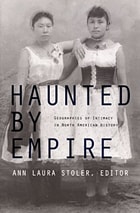
Haunted by Empire
Geographies of Intimacy in North American HistoryAnn Laura Stoler, ed.
Duke University Press, 2006
Haunted by Empire includes Ann Laura Stoler’s seminal essay “Tense and Tender Ties” as well as her bold introduction, which carves out the exciting new analytic and methodological ground animated by this comparative venture. The contributors engage in a lively cross-disciplinary conversation, drawing on history, anthropology, literature, philosophy, and public health. They address such topics as the regulation of Hindu marriages and gay sexuality in the early-twentieth-century United States; the framing of multiple-choice intelligence tests; the deeply entangled histories of Asian, African, and native peoples in the Americas; the racial categorizations used in the 1890 U.S. census; and the politics of race and space in French colonial New Orleans. Linda Gordon, Catherine Hall, and Nancy F. Cott each provide a concluding essay reflecting on the innovations and implications of the arguments advanced in Haunted by Empire.
Contributors. Warwick Anderson, Laura Briggs, Kathleen Brown, Nancy F. Cott, Shannon Lee Dawdy, Linda Gordon, Catherine Hall, Martha Hodes, Paul A. Kramer, Lisa Lowe, Tiya Miles, Gwenn A. Miller, Emily S. Rosenberg, Damon Salesa, Nayan Shah, Alexandra Minna Stern, Ann Laura Stoler, Laura Wexler

Intimacy
Edited by Lauren Berlant
University of Chicago Press, 2000
How is it that "private matters" are analyzed endlessly in public forums on a daily basis? Why is it assumed that "getting a life" means having a private relationship? Intended to unravel some of the tangled relations that fall under the broad category of "intimacy," this provocative collection of sixteen essays articulates the ways in which intimate lives are connected with the institutions, ideologies, and desires that organize people's worlds.
Locating its domain in the familiar spaces of friendship, love, sex, family, and feeling "at home," Intimacy also examines the estrangement, betrayal, loneliness, and even violence that may accompany the demise of relationships, both personal and political. These include intimacies among strangers, such as happens in times of national scandal or habits of everyday life. The contributors to this volume traverse many disciplines and cultures, tracking the processes by which intimate lives absorb and repel the dominant rhetoric, law, ethics, and ideologies of public spheres. Drawing on examples from contemporary culture, history, art, literature, and music, this book illuminates the ways in which intimacy has become linked with stories of citizenship, capitalism, aesthetic forms, and the writing of history. As it challenges conventional notions of private life, Intimacy is sure to spark controversy about its institutions as well.
Some of these essays in this book were previously published in an award-winning issue of the journal "Critical Inquiry."
Contributors include Lauren Berlant, Svetlana Boym, Steven Feld, Deborah R. Grayson, Michael Hanchard, Dagmar Herzog, Annamarie Jagose, Laura Kipnis, Laura Letinsky, Biddy Martin, Maureen McLane, Mary Poovey, Elizabeth A. Povinelli, Eve Kosovsky Sedgwick, Joel Snyder, Candace Vogler, Michael Warner, and others.

Intimate Connections
Love and Marriage in Pakistan’s High MountainsAnna-Maria Walter
Rutgers University Press, 2022

Intimate Creativity
Partners In Love And ArtIrving Sarnoff
University of Wisconsin Press, 2002
Integrating the psychology of love and creativity, this pioneering book explores both how a couple’s involvement as lovers influences their creative collaboration and how working together affects their relationship. Representing a variety of genres—painting, sculpture, photography, and installation art—the celebrated couples profiled here include, among others, Christo and Jeanne-Claude, Elizabeth Diller and Ricardo Scofidio, and Kristin Jones and Andrew Ginzel.
Intrigued by this process of "intimate creativity," psychologists Irving and Suzanne Sarnoff (themselves partners in love and work) decided to conduct in-depth interviews with partners in visual art because they defy the supremely individualistic tradition of their field. Whatever their age or sexual orientation, these artist-couples combine their talents to form a collective identity as a professional team. Passionately intense about their shared commitment, they communicate endlessly to resolve conflicts and reach consensus. Providing mutual validation and support, they increase their productivity and the quality of their work; they minimize their fear and frustration and enhance their pleasure in being together.
The authors also draw on historical and contemporary literature about similar couples, ranging from Jean Arp and Sophie Taeuber to Gilbert and George to Claes Oldenburg and Coosje van Bruggen. Stimulating and engaging, this book highlights the features of a unique collaborative process, considers the connection between creativity and sexuality, and suggests possibilities for any couple to expand their intimacy.

Intimate Inequalities
Millennials' Romantic Relationships in Contemporary TimesCristen Dalessandro
Rutgers University Press, 2021

Intimate Reading
Textual Encounters in Medieval Women’s Visions and VitaeJessica Barr
University of Michigan Press, 2020
This new volume is structured around five case studies. Chapters consider the biographies of 13th-century holy women from Liège, the writings of Margery Kempe, Gertrude of Helfta, Mechthild of Magdeburg, Marguerite Porete, and Julian of Norwich. At the heart of Intimate Reading is the question of how reading works—what it means to enter imaginatively and intellectually into the words of another. The volume showcases the complexity of medieval understandings of the work of reading, deepening our perception of the written word’s capacity to signify something that lies even beyond rational comprehension.

Just Between Us
An Ethnography of Male Identity and Intimacy in Rural Communities of Northern MexicoGuillermo Núñez Noriega
University of Arizona Press, 2014
Using fieldwork from rural Sonora, Mexico, Guillermo Núñez Noriega posits that men accept this intimacy outside gender categories and stereotypes, despite the traditional patriarchal society. This work contests homophobia and the heterosexual ideal of men and attempts to break down the barriers between genders.
The photograph Núñez Noriega uses to explore the shifting attitudes and perceptions of sexuality and gender provokes more questions than answers. Recognizing the societal regulations at play, the author demonstrates the existence in contemporary Mexico of an invisible regime of power that constructs and regulates the field of possibilities for men’s social actions, especially acts of friendship, affection, and eroticism with other men. The work investigates “modes of speaking” about being a man, on being gay, on the implicit meanings of the words homosexual, masculine, trade, fairy, and others—words that construct possibilities for intimacy, particularly affective and erotic intimacy among men.
Multiple variants of homoeroticism fall outside the dominant model, Núñez Noriega argues, a finding that offers many lessons on men and masculine identities. This book challenges patriarchal definitions of sex, gender, and identity; it promotes the unlearning of dominant conventions of masculinity to allow new ways of being.
Love and Globalization
Transformations of Intimacy in the Contemporary WorldMark B. Padilla
Vanderbilt University Press, 2007
The richly-textured ethnographies provoke a series of questions about emerging vocabularies for friendship and romance; the adoption of cultural forms from faraway places; the emergence of new desires, pleasures, and emotions that circulate as commodities in the global marketplace; and the ways economic processes shape public and private expressions of sexual intimacy.
Remembering Our Intimacies
Mo'olelo, Aloha 'Aina, and EaJamaica Heolimeleikalani Osorio
University of Minnesota Press, 2021
Recovering Kānaka Maoli (Native Hawaiian) relationality and belonging in the land, memory, and body of Native Hawai’i
Hawaiian “aloha ʻāina” is often described in Western political terms—nationalism, nationhood, even patriotism. In Remembering Our Intimacies, Jamaica Heolimeleikalani Osorio centers in on the personal and embodied articulations of aloha ʻāina to detangle it from the effects of colonialism and occupation. Working at the intersections of Hawaiian knowledge, Indigenous queer theory, and Indigenous feminisms, Remembering Our Intimacies seeks to recuperate Native Hawaiian concepts and ethics around relationality, desire, and belonging firmly grounded in the land, memory, and the body of Native Hawai’i.
Remembering Our Intimacies argues for the methodology of (re)membering Indigenous forms of intimacies. It does so through the metaphor of a ‘upena—a net of intimacies that incorporates the variety of relationships that exist for Kānaka Maoli. It uses a close reading of the moʻolelo (history and literature) of Hiʻiakaikapoliopele to provide context and interpretation of Hawaiian intimacy and desire by describing its significance in Kānaka Maoli epistemology and why this matters profoundly for Hawaiian (and other Indigenous) futures.
Offering a new approach to understanding one of Native Hawaiians’ most significant values, Remembering Our Intimacies reveals the relationships between the policing of Indigenous bodies, intimacies, and desires; the disembodiment of Indigenous modes of governance; and the ongoing and ensuing displacement of Indigenous people.

Sex, or the Unbearable
Lauren Berlant and Lee Edelman
Duke University Press, 2014
Through virtuoso interpretations of works of cinema, photography, critical theory, and literature, including Lydia Davis's story "Break It Down" (reprinted in full here), Berlant and Edelman explore what it means to live with negativity, with those divisions that may be irreparable. Together, they consider how such negativity affects politics, theory, and intimately felt encounters. But where their critical approaches differ, neither hesitates to voice disagreement. Their very discussion—punctuated with moments of frustration, misconstruction, anxiety, aggression, recognition, exhilaration, and inspiration—enacts both the difficulty and the potential of encounter, the subject of this unusual exchange between two eminent critics and close friends.
Sexuality across the Life Course
Edited by Alice S. Rossi
University of Chicago Press, 1994
In this wide-reaching volume, distinguished sociologist Alice S. Rossi addresses these questions and others through fourteen diverse essays on sexual behavior, covering adolescence through old age and studying such groups as singles, married couples, and homosexuals. This extensive study also explores the effects of chronic disease and medication on sexual functioning, recent developments in psychotherapy for sexual problems, and sexual abuse of children, incest, and rape.
"The interdisciplinary nature of the project has resulted in a text that is accessible to anyone with a behavioral science background. Well written, well edited, and well received by this reviewer."—Joan C. Chrisler, Journal of Sex & Marital Therapy
"This is a book that needs to be on the bookshelf of any AIDS researcher."—AIDS Book Review Journal
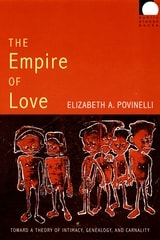
The Empire of Love
Toward a Theory of Intimacy, Genealogy, and CarnalityElizabeth A. Povinelli
Duke University Press, 2006
For more than twenty years, Povinelli has traveled to the social worlds of indigenous men and women living at Belyuen, a small community in the Northern Territory of Australia. More recently she has moved across communities of alternative progressive queer movements in the United States, particularly those who identify as radical faeries. In this book she traces how liberal binary concepts of individual freedom and social constraint influence understandings of intimacy in these two worlds. At the same time, she describes alternative models of social relations within each group in order to highlight modes of intimacy that transcend a reductive choice between freedom and constraint.
Shifting focus away from identities toward the social matrices out of which identities and divisions emerge, Povinelli offers a framework for thinking through such issues as what counts as sexuality and which forms of intimate social relations result in the distribution of rights, recognition, and resources, and which do not. In The Empire of Love Povinelli calls for, and begins to formulate, a politics of “thick life,” a way of representing social life nuanced enough to meet the density and variation of actual social worlds.

The Minor Intimacies of Race
Asian Publics in North AmericaChristine Kim
University of Illinois Press, 2016

The Politics of Intimacy
Rethinking the End-of-Life ControversyAnna Durnová
University of Michigan Press, 2018
Debates on the end-of-life controversy are complex because they seem to highjack national and cultural traditions. Where previous books have focused on ideological grounds, The Politics of Intimacy explores dying as the site where policies are negotiated and implemented. Intimacy comprises the emotional experience of the end of life and how we acknowledge it—or not—through institutions. This process shows that end-of-life controversy relies on the conflict between the individual and these institutions, a relationship that is the cornerstone of Western liberal democracies.
Through interviews with mourners, stakeholders, and medical professionals, examination of media debates in France and the Czech Republic, Durnová shows that liberal institutions, in their attempts to accommodate the emotional experience at the end of life, ultimately fail. She describes this deadlock as the “politics of intimacy,” revealing that political institutions deploy power through collective acknowledgment of individual emotions but fail to maintain this recognition because of this same experience.

The Queen of America Goes to Washington City
Essays on Sex and CitizenshipLauren Berlant
Duke University Press, 1997
As Berlant traces the guiding images of U.S. citizenship through the process of privatization, she discusses the ideas of intimacy that have come to define national culture. From the fantasy of the American dream to the lessons of Forrest Gump, Lisa Simpson to Queer Nation, the reactionary culture of imperilled privilege to the testimony of Anita Hill, Berlant charts the landscape of American politics and culture. She examines the consequences of a shrinking and privatized concept of citizenship on increasing class, racial, sexual, and gender animosity and explores the contradictions of a conservative politics that maintains the sacredness of privacy, the virtue of the free market, and the immorality of state overregulation—except when it comes to issues of intimacy.
Drawing on literature, the law, and popular media, The Queen of America Goes to Washington City is a stunning and major statement about the nation and its citizens in an age of mass mediation. As it opens a critical space for new theory of agency, its narratives and gallery of images will challenge readers to rethink what it means to be American and to seek salvation in its promise.
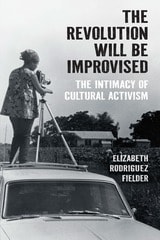
The Revolution Will Be Improvised
The Intimacy of Cultural ActivismElizabeth Rodriguez Fielder
University of Michigan Press, 2024
Reading the output of these programs, Elizabeth Rodriguez Fielder argues that intimacy-making became an extension of participatory democracy. In doing so, Rodriguez Fielder supplants the success-failure binary for understanding social movements, focusing instead on how care work aligns with creative production. The Revolution Will Be Improvised returns to improvisation’s roots in economic and social necessity and locates it as a core tenet of the aesthetics of obligation, where a commitment to others drives the production and result of creative work. Thus, this book puts forward a methodology to explore the improvised, often ephemeral, works of art activism.
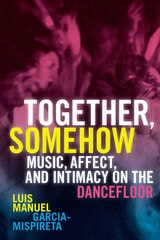
Together, Somehow
Music, Affect, and Intimacy on the DancefloorLuis Manuel Garcia-Mispireta
Duke University Press, 2023

Witchcraft, Intimacy, and Trust
Africa in ComparisonPeter Geschiere
University of Chicago Press, 2013
Geschiere begins in the forests of southeast Cameroon with the Maka, who fear “witchcraft of the house” above all else. Drawing a variety of local conceptions of intimacy into a global arc, he tracks notions of the home and family—and witchcraft’s transgression of them—throughout Africa, Europe, Brazil, and Oceania, showing that witchcraft provides powerful ways of addressing issues that are crucial to social relationships. Indeed, by uncovering the link between intimacy and witchcraft in so many parts of the world, he paints a provocative picture of human sociality that scrutinizes some of the most prevalent views held by contemporary social science.
One of the few books to situate witchcraft in a global context, Witchcraft, Intimacy, and Trust is at once a theoretical tour de force and an empirically rich and lucid take on a difficult-to-understand spiritual practice and the private spaces throughout the world it so greatly affects.