Results by title
5 books match the query 'Introduced organisms'
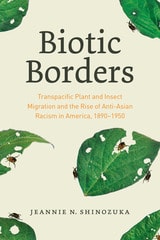
Biotic Borders
Transpacific Plant and Insect Migration and the Rise of Anti-Asian Racism in America, 1890–1950Jeannie N. Shinozuka
University of Chicago Press, 2022
In the late nineteenth century, increasing traffic of transpacific plants, insects, and peoples raised fears of a "biological yellow peril" when nursery stock and other agricultural products shipped from Japan to meet the growing demand for exotics in the United States. Over the next fifty years, these crossings transformed conceptions of race and migration, played a central role in the establishment of the US empire and its government agencies, and shaped the fields of horticulture, invasion biology, entomology, and plant pathology. In Biotic Borders, Jeannie N. Shinozuka uncovers the emergence of biological nativism that fueled American imperialism and spurred anti-Asian racism that remains with us today.
Shinozuka provides an eye-opening look at biotic exchanges that not only altered the lives of Japanese in America but transformed American society more broadly. She shows how the modern fixation on panic about foreign species created a linguistic and conceptual arsenal for anti-immigration movements that flourished in the early twentieth century. Xenophobia inspired concerns about biodiversity, prompting new categories of “native” and “invasive” species that defined groups as bio-invasions to be regulated—or annihilated. By highlighting these connections, Shinozuka shows us that this story cannot be told about humans alone—the plants and animals that crossed with them were central to Japanese American and Asian American history. The rise of economic entomology and plant pathology in concert with public health and anti-immigration movements demonstrate these entangled histories of xenophobia, racism, and species invasions.
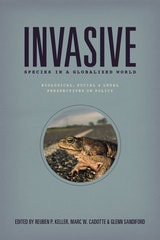
Invasive Species in a Globalized World
Ecological, Social, and Legal Perspectives on PolicyEdited by Reuben P. Keller, Marc W. Cadotte, and Glenn Sandiford
University of Chicago Press, 2014
Yet even though ecological research has led to public conversation and policy recommendations, those recommendations have frequently been ignored, and the efforts to counter invasive species have been largely unsuccessful. Recognizing the need to engage experts across the life, social, and legal sciences as well as the humanities, the editors of this volume have drawn together a wide variety of ecologists, historians, economists, legal scholars, policy makers, and communications scholars, to facilitate a dialogue among these disciplines and understand fully the invasive species phenomenon. Aided by case studies of well-known invasives such as the cane toad of Australia and the emerald ash borer, Asian carp, and sea lampreys that threaten US ecosystems, Invasive Species in a Globalized World offers strategies for developing and implementing anti-invasive policies designed to stop their introduction and spread, and to limit their effects.
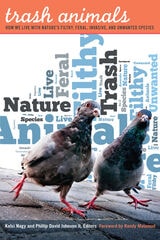
Trash Animals
How We Live with Nature’s Filthy, Feral, Invasive, and Unwanted SpeciesKelsi Nagy
University of Minnesota Press, 2013
Why are some species admired or beloved while others are despised? An eagle or hawk circling overhead inspires awe while urban pigeons shuffling underfoot are kicked away in revulsion. Fly fishermen consider carp an unwelcome trash fish, even though the trout they hope to catch are often equally non-native. Wolves and coyotes are feared and hunted in numbers wildly disproportionate to the dangers they pose to humans and livestock.
In Trash Animals, a diverse group of environmental writers explores the natural history of wildlife species deemed filthy, unwanted, invasive, or worthless, highlighting the vexed relationship humans have with such creatures. Each essay focuses on a so-called trash species—gulls, coyotes, carp, cockroaches, magpies, prairie dogs, and lubber grasshoppers, among others—examining the biology and behavior of each in contrast to the assumptions widely held about them. Identifying such animals as trash tells us nothing about problematic wildlife but rather reveals more about human expectations of, and frustrations with, the natural world.
By establishing the unique place that maligned species occupy in the contemporary landscape and in our imagination, the contributors challenge us to look closely at these animals, to reimagine our ethics of engagement with such wildlife, and to question the violence with which we treat them. Perhaps our attitudes reveal more about humans than they do about the animals.
Contributors: Bruce Barcott; Charles Bergman, Pacific Lutheran U; James E. Bishop, Young Harris College; Andrew D. Blechman; Michael P. Branch, U of Nevada, Reno; Lisa Couturier; Carolyn Kraus, U of Michigan–Dearborn; Jeffrey A. Lockwood, U of Wyoming; Kyhl Lyndgaard, Marlboro College; Charles Mitchell, Elmira College; Kathleen D. Moore, Oregon State U; Catherine Puckett; Bernard Quetchenbach, Montana State U, Billings; Christina Robertson, U of Nevada, Reno; Gavan P. L. Watson, U of Guelph, Ontario, Canada.
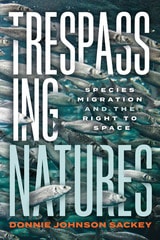
Trespassing Natures
Species Migration and the Right to SpaceDonnie Johnson Sackey
The Ohio State University Press, 2024
As old worlds become hostile and new spaces become hospitable, many species are shifting their ranges to live in locations where they have never previously existed. Biological and sociocultural realms collide and boundaries blur, making it increasingly difficult to mark definitively who belongs and who is a trespasser. In Trespassing Natures, Donnie Johnson Sackey troubles the idea of biological “invasion,” turning our attention away from scientific considerations and toward the discursive and rhetorical dimensions of this term—offering a new paradigm that recasts this issue as a question of what it means to live in multi-species communities. Presenting case studies on bed bugs, bighead carp, feral cats, and mackerel, Sackey argues that the identification of a species as an invader is not merely a scientific act, but a cultural and political one. By questioning issues around space, identity, and the institutions that make human participation apparent, Sackey redirects focus away from the belief that a single species threatens space. Ultimately, Trespassing Natures asks us to expand our idea of community and question who has the right to space.
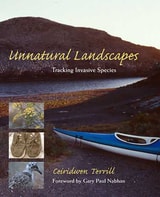
Unnatural Landscapes
Tracking Invasive SpeciesCeiridwen Terrill; Foreword by Gary Paul Nabhan
University of Arizona Press, 2007
Although widely publicized threats—such as pollution, land development, changes in the atmospheric condition, fire, and drought—are frequently credited with posing the greatest danger to indigenous animals and plants, invasive species are quickly becoming a far more insidious peril to the survival of native wildlife. A result of both accident and human intervention, the frequency with which exotic species are being introduced into nonnative environments is increasing at an alarming rate.
In Unnatural Landscapes, Ceiridwen Terrill combines lucid science writing with first-person tales of adventure to provide a compelling introduction to invasion ecology and restoration management. Traveling aboard her trusty kyak, The Grebe, Terrill brings readers on a firsthand tour of various “islands” in the Southwest and Mexico—both actual islands and self-contained habitat communities. From the islands of Anaho, Santa Cruz, and Anacapa to Isla Tiburón in the Sea of Cortez, Mexicali irrigation canals, and Pyramid Lake, Terrill takes an in-depth look at the damage that invasive species cause.
Drawing on field observations, research, and interviews with scientists, resource managers, and local residents, this book provides readers with the background and knowledge they need to understand and to begin combating what is quickly becoming the most important environmental crisis facing the fragile ecosystems of the Southwest.
For more information on invasive species visit the Author's Web site.