Results by title
264 books match the query 'Introduction' and 31 start with a
A New Approach to Textual Criticism
An Introduction to the Coherence-Based Genealogical MethodTommy Wasserman
SBL Press, 2017
An essential introduction for scholars and students of New Testament Greek
With the publication of the widely used 28th edition of Nestle-Aland’s Novum Testamentum Graece and the 5th edition of the United Bible Society Greek New Testament, a computer-assisted method known as the Coherence-Based Genealogical Method (CBGM) was used for the first time to determine the most valuable witnesses and establish the initial text. This book offers the first full-length, student-friendly introduction to this important new method. After setting out the method’s history, separate chapters clarify its key concepts, including genealogical coherence, textual flow diagrams, and the global stemma. Examples from across the New Testament are used to show how the method works in practice. The result is an essential introduction that will be of interest to students, translators, commentators, and anyone else who studies the Greek New Testament.
Features
- A clear explanation of how and why the text of the Greek New Testament is changing
- Step-by-step guidance on how to use the CBGM in textual criticism
- Diagrams, illustrations, and glossary of key terms
Afro-Caribbean Religions
An Introduction to Their Historical, Cultural, and Sacred TraditionsNathaniel Samuel Murrell
Temple University Press, 2009
This accessibly written introduction to Afro-Caribbean religions examines the cultural traditions and transformations of all of the African-derived religions of the Caribbean along with their cosmology, beliefs, cultic structures, and ritual practices. Ideal for classroom use, Afro-Caribbean Religions also includes a glossary defining unfamiliar terms and identifying key figures.
American Independent Cinema
An IntroductionTzioumakis, Yannis
Rutgers University Press, 2006
From the prestige films of Cagney Productions to recent, ultra-low budget cult hits, such as Clerks and The Blair Witch Project, American independent cinema has produced some of the most distinctive films ever made. This comprehensive introduction draws on key films, filmmakers, and film companies from the early twentieth century to the present to examine the factors that shaped this vital and evolving mode of filmmaking.
Specifically, it explores the complex and dynamic relations between independent and mainstream Hollywood cinema, showing how institutional, industrial, and economic changes in the latter have shaped and informed the former. Ordered chronologically, the book begins with Independent Filmmaking in the Studio Era (examining both top-rank and low-end film production), moves to the 1950s and 1960s (discussing both the adoption of independent filmmaking as the main method of production as well as exploitation filmmaking), and finishes with contemporary American independent cinema (exploring areas such as the New Hollywood, the rise of mini-major and major independent companies and the institutionalization of independent cinema in the 1990s). Each chapter includes case studies which focus on specific films, filmmakers, and production and distribution companies.
American Reform Judaism
An IntroductionDana Evan Kaplan
Rutgers University Press, 2003
The only comprehensive and up-to-date look at Reform Judaism, this book analyzes the forces currently challenging the Reform movement, now the largest Jewish denomination in the United States.
To distinguish itself from Orthodox and Conservative Judaism, the Reform movement tries to be an egalitarian, open, and innovative version of the faith true to the spirit of the tradition but nonetheless fully compatible with modern secular life. Promoting itself in this way, Reform Judaism has been tremendously successful in recruiting a variety of people—intermarried families, feminists, gays and lesbians, and interracial families among others—who resist more traditional forms of worship.
As an unintended result of this success, the movement now struggles with an identity crisis brought on by its liberal theology, which teaches that each Jew is free to practice Judaism more or less as he or she pleases. In the absence of the authority that comes from a theology based on a commanding, all-powerful God, can Reform Judaism continue to thrive? Can it be broadly inclusive and still be uniquely and authentically Jewish?
Taking this question as his point of departure, Dana Evan Kaplan provides a broad overview of the American Reform movement and its history, theology, and politics. He then takes a hard look at the challenges the movement faces as it attempts to reinvent itself in the new millennium. In so doing, Kaplan gives the reader a sense of where Reform Judaism has come from, where it stands on the major issues, and where it may be going.
Addressing the issues that have confronted the movement—including the ordination of women, acceptance of homosexuality, the problem of assimilation, the question of rabbinic officiation at intermarriages, the struggle for acceptance in Israel, and Jewish education and others—Kaplan sheds light on the connection between Reform ideology and cultural realities. He unflinchingly, yet optimistically, assesses the movement’s future and cautions that stormy weather may be ahead.

An Introduction To Hegel
The Stages of Modern PhilosophyHoward P. Kainz
Ohio University Press, 1996
In a sense it would be inappropriate to speak of “Hegel’s system of philosophy,” because Hegel thought that in the strict sense there is only one system of philosophy evolving in the Western world. In Hegel’s view, although at times philosophy’s history seems to be a chaotic series of crisscrossing interpretations of meanings and values, with no consensus, there has been a teleological development and consistent progress in philosophy and philosophizing from the beginning; Hegel held that his own version of “German idealism” was simply bringing to final expression the latest refinements of an ongoing, perennial system.
If we take Hegel at his word, then one of the best entries into his system would be through the history of philosophy, showing how systems and schools of thought prior to Hegel led up to his system. The most important currents to focus on, however, would be in modern philosophy, in which especially intensive changes led ultimately to German idealism and Hegel’s immediate predecessors.
Fortunately, Hegel lectured extensively on the history of modern philosophy and structured his lectures in such a way as to throw light on the status of the “one system” of Western philosophy at the time — the status to which Hegel felt he had been contributing and was continuing to contribute. These lectures are of interest, first of all, as a systematic chronicle of philosophical positions in the heyday of modern philosophy, from Bacon to Hegel. Second, they are interesting because Hegel’s critical comments on his predecessors clarify his own positions: for example, the dialectic method and the importance of triplicity, the relationship of philosophy to the scientific method, the necessity for avoidance of the extremes of empiricism and of idealism, the subject/object problematic, the “identity” of rationality and reality, and the technical meaning in Hegel’s philosophy of “absolute,” “infinity,” and the “idea.”

An Introduction to Ancient Iranian Religion
Readings from the Avesta and the Achaemenid InscriptionsWilliam W. Malandra, EditorTranslated by William W. Malandra
University of Minnesota Press, 1983
An Introduction to Ancient Iranian Religion was first published in 1983. Minnesota Archive Editions uses digital technology to make long-unavailable books once again accessible, and are published unaltered from the original University of Minnesota Press editions.
When Persia fell to Islam in the mid-seventh century, the ancient Iranian religion of Zoroastrianism all but disappeared (although it is still practiced by small groups in India and Iran). As one of the dominant religions of antiquity, it influenced the Judeo- Christian tradition as well as some forms of gnosticism. Despite its age and venerable place in the history of world religions, Zoroastrianism remains little known outside of a few philologists and historians of religion. Because of the difficulty of translation, there is little primary textual material available for nonspecialists; the few translations that do exist are quite old.
In An Introduction to Ancient Iranian Religion, William Malandra provides not only modern English translations of the sacred texts but also a comprehensive introduction to the subject of Zoroastrianism itself. In an introductory essay Malandra outlines the main features of Zoroastrianism in its historical, cultural, and spiritual setting. His new translations of readings from the Avesta, the sacred book of Zoroastrianism, and selections from the Achaemenid inscriptions of the great kings Darius and Xerxes are accompanied by interpretive notes that allow students to make their way through this difficult material. This book is, therefore, not just a collection of texts but a selfcontained introduction to Zoroastrianism that can be used by the nonspecialist without recourse to additional interpretive works.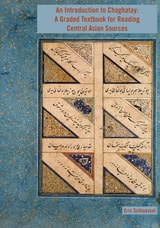
An Introduction to Chaghatay
A Graded Textbook for Reading Central Asian SourcesEric Schluessel
Michigan Publishing Services, 2018
An Introduction to Chaghatay is the first textbook in over a century to introduce this language to English-speaking students. This book is designed to build a foundation in reading Chaghatay without assuming any background knowledge on the part of the reader. These graded, cumulative lessons include common vocabulary, accessible grammar explanations, and examples of Chaghatay manuscripts. Authentic texts introduce the student to different genres, including hagiographies, documents, “stories of the prophets,” and newspapers while introducing critical skills in paleography.
Eric Schluessel is Assistant Professor of Chinese History and Politics at the University of Montana. He holds a PhD in History and East Asian Languages from Harvard University, an MA in Linguistics from the School of Oriental and African Studies, and an MA in Central Eurasian Studies from Indiana University. He is the author of several articles on the history of Chinese Central Asia and is currently preparing a critical edition and translation of Mullah Musa Sayrami’s Tarikh-i Hamidi, a chronicle of Xinjiang in the nineteenth century.

An Introduction to Collection Development for School Librarians
Mona Kerby
American Library Association, 2019
An Introduction to Empire in the New Testament
Adam Winn
SBL Press, 2016
Explore how empire is a crucial foreground for reading and interpreting the New Testament
In the last three decades, significant attention has been given to the way in which New Testament texts engage and respond to the imperial world in which they were written. The purpose of the present volume is to introduce students and non-specialists to the growing subfield of New Testament studies known as empire studies. Contributors seek to make readers aware of the significant work that has already been produced, while also pointing them to new ways in which this field is moving forward. The contributors are Bruce W. Longenecker, Richard A. Horsley, Warren Carter, Adam Winn, Eric D. Barreto, Beth M. Sheppard, Neil Elliot, James R. Harrison, Harry O. Maier, Deborah Krause, Jason A.Whitlark, Matthew R. Hauge, Kelly D. Liebengood, and Davina C. Lopez.
Features:
An Introduction to Fractional Control
Duarte Valério
The Institution of Engineering and Technology, 2012
An Introduction to Greek Epigraphy of the Hellenistic and Roman Periods from Alexander the Great down to the Reign of Constantine
B. H. McLean
University of Michigan Press, 2011
“In short, this is a reference work of the best kind. For the beginner, it is indispensable. And for those who already know something about its subject matter, the book is in many ways useful, informative, and interesting. We all owe a debt to [the author] for undertaking this significant project, and for completing it so well.”
—Michael Peachin, Classical World
“. . . provides invaluable road maps for non-epigraphers faced with passages of inscribed Greek.”
—Graham Shipley, Bryn Mawr Classical Review
Greek inscriptions form a valuable resource for the study of all aspects of the Greco-Roman world. They are primary witnesses to society's laws and institutions, religious habits, and language. This volume provides students with the tools to take advantage of the historical value of these treasures. It examines letter forms, ancient names, and ancient calendars, knowledge of which is essential in reading inscriptions of all kinds.
B. H. McLean discusses the classification of inscriptions into their various categories and analyzes particular types of inscriptions, including decrees, honorary inscriptions, dedications, funerary inscriptions, and manumissions. Finally, McLean includes special topics that bear upon the interpretation of specific features of inscriptions, such as Greek and Roman administrative titles and functions.
An Introduction to Legal Reasoning
Edward H. Levi
University of Chicago Press, 1962
An Introduction to Legal Reasoning
Edward H. Levi
University of Chicago Press, 2013
For this edition, the book includes a substantial new foreword by leading contemporary legal scholar Frederick Schauer that helpfully places this foundational book into its historical and legal contexts, explaining its continuing value and relevance to understanding the role of analogical reasoning in the law. This volume will continue to be of great value to students of logic, ethics, and political philosophy, as well as to members of the legal profession and everyone concerned with problems of government and jurisprudence.
An Introduction to Legal Reasoning
Edward H. Levi
University of Chicago Press, 2013
Originally published in 1949, An Introduction to Legal Reasoning is widely acknowledged as a classic text. As its opening sentence states, “This is an attempt to describe generally the process of legal reasoning in the field of case law and in the interpretation of statutes and of the Constitution.” In elegant and lucid prose, Edward H. Levi does just that in a concise manner, providing an intellectual foundation for generations of students as well as general readers.
For this edition, the book includes a substantial new foreword by leading contemporary legal scholar Frederick Schauer that helpfully places this foundational book into its historical and legal contexts, explaining its continuing value and relevance to understanding the role of analogical reasoning in the law. This volume will continue to be of great value to students of logic, ethics, and political philosophy, as well as to members of the legal profession and everyone concerned with problems of government and jurisprudence.
An Introduction to Nuclear Astrophysics
Richard N. Boyd
University of Chicago Press, 2008
In An Introduction to Nuclear Astrophysics, author Richard Boyd includes basic nomenclature and information so that students from astronomy or physics can quickly orient themselves in the material. Subsequent chapters describe earthbound and space born instruments operating in service to nuclear astrophysics worldwide; background topics such as nuclear and neutrino physics, scattering formalism, and thermonuclear reaction rates; and information on galactic chemical evolution, solar nucleosynthesis, s- and r-processes, and gamma-ray bursts. Each chapter includes problem sets against which students may test their knowledge before moving ahead, and the author has included copious references intended to guide students to further study.
An Introduction to Nuclear Astrophysics is an essential textbook for undergraduate and graduate students in astronomy and astrophysics. It is also an invaluable overview of the subject for researchers in nuclear astrophysics and related fields.
An Introduction to Personalism
Juan Manuel Burgos
Catholic University of America Press, 2018
Juan Manuel Burgos shows the reader how personalist philosophy was born in response to the tragedies of two World Wars, the Great Depression, and the totalitarian regimes of the 1930s. Through a revitalization of the concept of the person, an array of thinkers developed a philosophy both rooted in the best of the intellectual tradition and capable of dialoguing with contemporary concerns.
Burgos then delves into the potent ideas of more than twenty thinkers who have contributed to the growth of personalism, including Romano Guardini, Gabriel Marcel, Xavier Zubiri, and Michael Polanyi. Burgos’s encyclopedic knowledge of the movement allows for a concise and well-rounded perspective on each of the personalists studied.
An Introduction to Personalism concludes with a synthesis of personalist thought, bringing together the brightest insights of each personalist philosopher into an organic whole. Burgos argues that personalism is not an eclectic hodge-podge, but a full-fledged school of philosophy, and gives a dynamic and rigorous exposition of the key features of the personalist position.
Our times are marked by numerous and often contradictory ideas about the human person. An Introduction to Personalism presents an engaging anthropological vision capable of taking the lead in the debate about the meaning of human existence and of winning hearts and minds for the cause of the dignity of every person in the 21st century and beyond.
An Introduction to RF Stealth
David Lynch Jr.
The Institution of Engineering and Technology, 2021
An Introduction to Richard Wagner’s Der Ring des Nibelungen
A HandbookWilliam O. Cord
Ohio University Press, 1995
Today, more than a century after its first performance, Richard Wagner’s The Ring of Nibelung endures as one of the most significant artistic creations in the history of opera. This monumental work not only altered previously accepted concepts of music and drama but also inspired creative and intellectual efforts far beyond the field of opera.
Previous studies of the Ring have appealed only to those already acquainted in some way with the Wagnerian art. For the uninitiated, Wagner and his landmark creation have seemed forbidding, and those eager to learn about the masterpiece have faced a vast and frequently esoteric body of commentary. Professor Cord addresses the interests of the non-specialist by taking the reader first into Wagner’s unique intent, and then through the complete history of the Ring.
Cord, who has attended forty performances of the Ring, considers the conception of the poem, its development into a music-drama exemplifying Wagnerian thought, its introduction to the world, and the reactions and interpretation it elicits.

An Introduction to Satellite Communications
D.I. Dalgleish
The Institution of Engineering and Technology, 1989

An Introduction to Tree-Ring Dating
Marvin A. Stokes
University of Arizona Press, 1996
Authors Stokes and Smiley first explain the basic principles of tree-ring dating, then describe details of the process, step by step, from the time a sample is collected until it is incorporated into a master chronology.
The book focuses on coniferous evergreens of the Southwest, particularly piñons, because they have wide geographic distribution, constitute a large population, and show excellent growth response to certain controlling factors. The book is specifically concerned with the task of establishing a calendar date for a wood or charcoal specimen.
This concise but thorough explication of an important discipline will make dendrochonology more meaningful to students and professionals in archaeology, forestry, hydrology, and global change.
An Introduction to Vatican II as an Ongoing Theological Event
Matthew Levering
Catholic University of America Press, 2017
This is an introduction to Vatican II with a detailed summary of each of its four central documents—the dogmatic constitutions—followed by explanations of how to interpret them. In contrast to other introductions, which pay little attention to the theological soil in which the documents of Vatican II germinated, Levering offers a reading of each conciliar Constitution in light of a key theological author from the era: René Latourelle, SJ for Dei Verbum (persons and propositions); Louis Bouyer, CO for Sacrosanctum Concilium (active participation); Yves Congar, OP for Lumen Gentium (true and false reform); and Henri de Lubac, SJ for Gaudium et Spes (nature and grace).
This theological event is “ongoing,” Levering demonstrates, by tracing in each chapter the theological debates that have stretched from the close of the council till the present, and the difficulties the Church continues to encounter in encouraging an ever deeper participation in Jesus Christ on the part of all believers. In this light, the book’s final chapter compares the historicist (Massimo Faggioli) and Christological (Robert Imbelli) interpretations of Vatican II, arguing that historicism can undermine the Council’s fundamental desire for a reform and renewal rooted in Christ. The conclusion addresses the concerns about secularization and loss of faith raised after the Council by Henri de Lubac, Joseph Ratzinger, and Yves Congar, arguing that contemporary Vatican II scholarship needs to take these concerns more seriously.

An Introduction to the Detective Story
Leroy Lad Panek
University of Wisconsin Press, 1987
This book is a no-apologies introduction to Detective Fiction. It's written in an aggressive, modern English well-suited to a genre which has traditionally broken ground in terms of aggressive writing, contemporary scenarios, and tough dialogue.
An Introduction to the Indo-European Languages
Philip Baldi
Southern Illinois University Press, 1983
This comprehensive linguistic survey of the Indo-European groups synthesizes the vast amount of information contained in the specialized handbooks of the individual stocks.
The text begins with an introduction to the concept of the Indo-European language family, the history of its discovery, and the techniques of analysis. The introduction also gives a structural sketch of Proto-Indo-European, the parent language from which the others are descended. Baldi then devotes a chapter to each of the 11 major branches of Indo-European (Italic, Celtic, Indo-Iranian, Greek, Armenian, Albanian, Baltic, Slavic, Germanic, Tocharian, and Anatolian).
Each chapter provides an outline of the external history of the branch, its people, dialects, and other relevant history. This outline is followed by a structural sketch of the most important language or languages of the branch (e.g., Old Irish for Celtic, Sanskrit and Avestan for Indo-Iranian, Latin and Osco-Umbrian for Italic). The sketch also contains the phonology, morphology, and syntax of each language. There is lastly a sample text of each language containing both interlinear and free translation. In those branches where there are special issues (e.g., the relation of Italic to Celtic and Baltic to Slavic, or the problem of archaism in Hittite), additional discussions of these issues are provided. Baldi’s final chapter gives a brief outline of the “minor” Indo-European languages such as Illyrian, Thracian, Raetic, and Phrygian. Adding further to the usefulness of the book are extensive bibliographies, an up-to-date map showing the geographical distribution of the Indo-European languages throughout the world, and a detailed family tree diagram of the members of each subgroup within the Indo-European language family and their interrelationships.
An Introduction to the Literature of Equatorial Guinea
Between Colonialism and DictatorshipMarvin A. Lewis
University of Missouri Press, 2007
Spain’s only former colony in sub-Saharan Africa, Equatorial Guinea is home to a literature of transition—songs of freedom in which authors reflect on their identity within the context of recent colonialism and dictatorship.
An Introduction to the Literature of Equatorial Guinea is the first book-length critical study of this literature, a multigenre analysis encompassing fifty years of poetry, drama, essays, and prose fiction. Both resident and exiled authors offer insights into the impact of colonialism and dictatorship under Spanish rule and consider the fruits of “independence” under the regimes of Francisco Macías Nguema and Teodoro Obiang Nguema. Examining these works from the perspective of postcolonial theory, Marvin A. Lewis shows how writings from Equatorial Guinea depict the clash of traditional and European cultures and reflect a dictatorship that produced poverty, misery, and oppression. He assesses with particular care the impact of the Macías reafricanization process and its manifestations in literature.
In showing how the views of the nation correspond and diverge in works of writers such as Maria Nsue Angue, Donato Ndongo-Bidyogo, and Juan Tomás Ávila Laurel, Lewis brings to light artists who articulate their concerns in Spanish but are African in their souls. In analyzing the works of both renowned and emerging writers, he marks the themes that contribute to the formation of national identity: Hispanic heritage, the myth of Bantu unity, “bonding in adversity” during the Nguema regime, and the Equatoguinean diaspora.
Lewis provides an accessible introduction to the work of central writers in a new area of literary study and includes the most exhaustive and up-to-date bibliography available on the subject. His is a groundbreaking work that broadens our understanding of African literature and will be the bedrock for future studies of this Hispanic corner of Africa.

An Introduction to the Phenomenology of Performance Art
SELF/sT. J. Bacon
Intellect Books, 2022
This book introduces the study and application of performance art through phenomenology, inviting readers to explore contemporary performance art and activate their own practices. Using queer phenomenology to unpack the importance of a multiplicity of self/s, the book teaches readers how to be academically rigorous when capturing embodied experiences. Through approachable exercises, definitions of key phenomenological terms, and interviews and insights from some of the best examples of transgressive performance art practice, the work enriches the wider scholarship of theater studies. Situated within contemporary phenomenological scholarship, the book will appeal to radical artists, educators, and practitioner-researchers.
An Introduction to the Shoshoni Language
Dammen DaigwapeDrusilla Gould
University of Utah Press, 2003
Listen to the open source audio companion to this book:
An Introduction to the Shoshoni Language Chapter 1
An Introduction to the Shoshoni Language Chapter 2
An Introduction to the Shoshoni Language Chapter 3
An Introduction to the Shoshoni Language Chapter 4
An Introduction to the Shoshoni Language Chapter 5
An Introduction to the Shoshoni Language Chapter 6
An Introduction to the Shoshoni Language Chapter 7
An Introduction to the Shoshoni Language Chapter 8
An Introduction to the Study of Medieval Latin Versification
Dag Norberg
Catholic University of America Press, 2004
Animals Without Backbones
An Introduction to the InvertebratesRalph Buchsbaum, Mildred Buchsbaum, John Pearse, and Vicki Pearse
University of Chicago Press, 1987
This new edition has been completely rewritten and redesigned, but it retains the same clarity and careful scholarship that have earned this book its continuing readership for half a century. It is even more lavishly illustrated than earlier editions, incorporating many new drawings and photographs. Informative, concise legends that form an integral part of the text accompany the illustrations. The text has been updated to include findings from recent research. Eschewing pure morphology, the authors use each group of animals to introduce one or more biological principles.
In recent decades, courses and texts on invertebrate zoology at many universities have been available only for advanced biology majors specializing in this area. The Third Edition of Animals Without Backbones remains an ideal introduction to invertebrates for lower-level biology majors, nonmajors, students in paleontology and other related fields, junior college and advanced high school students, and the general reader who pursues the rewarding study of the natural world.
Anthropological Lives
An Introduction to the Profession of AnthropologyVirginia R Dominguez
Rutgers University Press, 2020
Anthropologists profiled: Leslie Aiello, Lee Baker, João Biehl, Tom Boellstorff, Jacqueline Comito, Shannon Dawdy, Virginia R. Dominguez, T.J. Ferguson, Brigittine French, Agustín Fuentes, Amy Goldenberg, Mary Gray, Sarah Green, Monica Heller, Douglas Hertzler, Ed Liebow, Mariano Perelman, Jeremy Sabloff, Carolyn Sargent, Marilyn Strathern, Nandini Sundar, Alaka Wali.
Asian American Literature
An Introduction to the Writings and Their Social ContextElaine Kim
Temple University Press, 1984
Averroes’ Middle Commentary on Aristotle’s Rhetoric
Arabic-English Translation, with Notes and IntroductionLahcen El Yazghi Ezzaher
Southern Illinois University Press, 2023
Abū al-Walīd Muḥammad ibn Aḥmad ibn Rushd (d. 1198 AD), known as Averroes in the West, wrote one of the most significant medieval Arabic commentaries on Aristotle’s famous treatise, Rhetoric. Averroes worked within a tradition that included the Muslim philosophers Al-Farabi (d. 950) and Avicenna (d. 1037), who together built an early canon introducing Aristotle’s writings to the academies of medieval Europe. Here, for the first time, Lahcen El Yazghi Ezzaher translates Averroes’ Middle Commentary into English, with analysis highlighting its shaping of philosophical thought.
Ibn Rushd was born into a prominent family living in Córdoba and Seville during the reign of the Almoḥad dynasty in the Maghreb and al-Andalus. At court, he received support to write a body of rhetorical commentaries extending the work of his Arabic-Muslim predecessors, a critical step in fostering Aristotle’s influence on European scholasticism and Western education. Ezzaher’s meticulous translation of Averroes’ Middle Commentary reflects the depth and breadth of this engagement, incorporating a discussion of the Arabic-Muslim commentary tradition and Averroes’ contribution to it. His research illuminates the complexity of Averroes’ position, articulating the challenges Muslim scholars faced in making non-Muslim texts available to their community. Through his work, we see how people at different historical moments have adapted intellectual concepts to preserve rhetoric’s vitality and relevance in new contexts.
Averroes’ Middle Commentary exemplifies the close connections between ancient Greece and medieval Muslim scholarship and the ways Muslim scholars navigated an appreciation for Aristotelian philosophy alongside a commitment to their cultural and religious systems.