Results by title
6 books match the query 'Introduction Commentary'
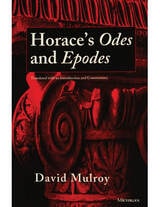
Horace's Odes and Epodes
Translated with an Introduction and CommentaryDavid Mulroy
University of Michigan Press, 1994
In his new book David Mulroy presents a translation of the Odes and Epodes of Horace, who was one of the Augustan regime’s best known and most talented poets. Intended for those with little knowledge of these works as well as for those with a more experienced ear, David Mulroy’s translations are accompanied by explanatory notes on the individual poems. Appendices are also provided that offer information on Suetonius’ biography of Horace, on ambiguity in Horace’s personal allusions, and on the theme of sadism in Horace’s writings.Teachers of Latin writers in translation will want to use this book to make Horace accessible to their students; scholars of Latin literature will find much of value in the notes and appendices as well as in the linguistically satisfying translations.
[more]
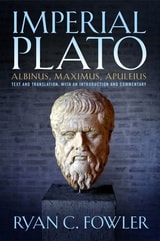
Imperial Plato
Albinus, Maximus, Apuleius: Text and Translation, with an Introduction and CommentaryRyan C. Fowler
Parmenides Publishing, 2016
Imperial Plato presents new translations of three introductions to Plato’s thought from the second half of the second century CE: the Introduction to Plato by Albinus of Smyrna, Dissertation 11 of Maximus of Tyre, and On Plato and his Teaching by Apuleius of Madaurus. These three presentations of Plato’s ideas—one a Greek dialectic introduction with a suggested reading order for Plato's dialogues, another a Greek speech in the sophistic style of the time, and one a lengthy doxological study in Latin—are examples by three distinct authors using divergent methods of the assorted ways in which Plato and Platonism were understood and discussed during the revival of Hellenism and Greek Philosophy, and the period of the Roman Empire often referred to as the Second Sophistic.
[more]
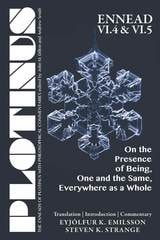
PLOTINUS Ennead VI.4 and VI.5
On the Presence of Being, One and the Same, Everywhere as a Whole: Translation with an Introduction and CommentaryEyjólfur K. Emilsson
Parmenides Publishing, 2015
Ennead VI.4-5, originally written as a single treatise, contains Plotinus’ most general and sustained exposition of the relationship between the intelligible and the sensible realms, addressing and coalescing two central issues in Platonism: the nature of the soul-body relationship and the nature of participation. Its main question is, How can soul animate bodies without sharing their extension? The treatise seems to have had considerable impact: it is much reflected in Porphyry’s important work, Sententiae, and the doctrine of reception according to the capacity of the recipient, for which this treatise is the main source, resonated in medieval thinkers.
[more]
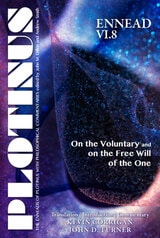
PLOTINUS Ennead VI.8
On the Voluntary and on the Free Will of the One: Translation, with an Introduction, and CommentaryKevin Corrigan
Parmenides Publishing, 2017
Ennead VI.8 gives us access to the living mind of a long dead sage as he tries to answer some of the most fundamental questions we in the modern world continue to ask: are we really free when most of the time we are overwhelmed by compulsions, addictions, and necessities, and how can we know that we are free? Can we trace this freedom through our own agency to the gods, to the Soul, Intellect, and the Good? How do we know that the world is meaningful and not simply the result of chance or randomness?
Plotinus’ On the Voluntary and on the Free Will of the One is a groundbreaking work that provides a new understanding of the importance and nature of free human agency. It articulates a creative idea of agency and radical freedom by showing how such terms as desire, will, self-dependence, and freedom in the human ethical sphere can be genuinely applied to Intellect and the One while preserving the radical inability of all metaphysical language to express anything about God or gods.
Plotinus’ On the Voluntary and on the Free Will of the One is a groundbreaking work that provides a new understanding of the importance and nature of free human agency. It articulates a creative idea of agency and radical freedom by showing how such terms as desire, will, self-dependence, and freedom in the human ethical sphere can be genuinely applied to Intellect and the One while preserving the radical inability of all metaphysical language to express anything about God or gods.
[more]
PLOTINUS
Ennead II.5: On What Is Potentially and What Actually: Translation with an Introduction and CommentaryCinzia Arruzza
Parmenides Publishing, 2015
The term dunamis (potentiality) entered into the philosophical vocabulary with Plato, but it was with Aristotle that it acquired, together with energeia (actuality), the strong technical meaning that the two terms have maintained, with variations, throughout subsequent philosophical tradition.
The significance of the notions of actuality and potentiality in Plotinus’ thought can hardly be overstated. Throughout the Enneads, they are crucial to understanding the specific causality of intelligible realities and the relation of participation between intelligible and sensible realms.
In Ennead II.5, Plotinus for the first time provides a systematic clarification of his peculiar use of these terms, through a sustained revision of Aristotle’s own elaboration of the topic and of his terminology. The treatise discusses the different meanings of potentiality and actuality as well as the way each of them applies or does not apply to the sensible realm, to the intelligible realm, and to matter.
While the structure of the text unfolds in a coherent and cohesive manner, Plotinus’ writing in this treatise is dense and at times dry in its technicality. The detailed commentary guides the reader step by step, making an otherwise particularly difficult text accessible.
[more]
Plotinus Ennead I.8
On the Nature and Source of Evil: Translation with an Introduction and CommentaryAnne Sheppard
Parmenides Publishing, 2025
Ennead I.8 was written not long before Plotinus’ death in 270 AD, at a time when he was particularly concerned with ethical issues. The treatise’ primary purpose is to argue that evil is not intrinsic to the soul, but since Plotinus always considers ethical issues within a metaphysical framework, it includes an account of the ontological status of matter. Plotinus does his best to preserve a belief in the dependence of all things on a single, supremely good First Principle while admitting that there is evil in the world. He offers a subtle account of the origin of evil in the soul as caused not by either the soul or matter on its own but by the combination of the two. Sheppard shows how Plotinus is responding to ideas found in Plato, Aristotle, the Stoics, and Middle Platonism as well as to the challenge presented by Gnosticism, and argues that the views expressed in I.8 are not inconsistent with what Plotinus has to say about matter and its generation elsewhere. She further considers the criticisms of Plotinus’ views put forward by Proclus and concludes that, despite its weaknesses, Plotinus’ account remains an ingenious attempt to defend monism and the essential goodness of the soul while recognizing the existence of evils.
[more]