Results by title
6 books match the query 'Intuition'
Educating Intuition
Robin M. Hogarth
University of Chicago Press, 2001
In Educating Intuition, Robin M. Hogarth lays bare this mysterious process so fundamental to daily life by offering the first comprehensive overview of what the science of psychology can tell us about intuition—where it comes from, how it works, whether we can trust it. From this literature and his own research, Hogarth finds that intuition is a normal and important component of thought that has its roots in processes of tacit learning. Environment, attention, experience, expertise, and the success of the scientific method all form part of Hogarth's perspective on intuition, leading him to the surprising—but natural—conclusion that we can educate our sixth sense. To this end he offers concrete suggestions and exercises to help readers develop their intuitive skills and habits for learning the "right" lessons from experience.
Artfully and accessibly combining cognitive science, the latest research in psychology, and Hogarth's own observations, Educating Intuition eschews the vague approach to the topic that has become commonplace and provides instead a wholly engaging and practical guide to enhancing our intuitive skills.
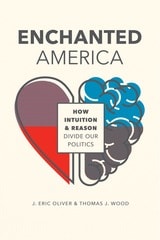
Enchanted America
How Intuition and Reason Divide Our PoliticsJ. Eric Oliver and Thomas J. Wood
University of Chicago Press, 2018
The answer, according to J. Eric Oliver and Thomas J. Wood, can be found in the most important force shaping American politics today: human intuition. Much of what seems to be irrational in American politics arises from the growing divide in how its citizens make sense of the world. On one side are rationalists. They use science and reason to understand reality. On the other side are intuitionists. They rely on gut feelings and instincts as their guide to the world. Intuitionists believe in ghosts and End Times prophecies. They embrace conspiracy theories, disbelieve experts, and distrust the media. They are stridently nationalistic and deeply authoritarian in their outlook. And they are the most enthusiastic supporters of Donald Trump. The primary reason why Trump captured the presidency was that he spoke about politics in a way that resonated with how Intuitionists perceive the world. The Intuitionist divide has also become a threat to the American way of life. A generation ago, intuitionists were dispersed across the political spectrum, when most Americans believed in both God and science. Today, intuitionism is ideologically tilted toward the political right. Modern conservatism has become an Intuitionist movement, defined by conspiracy theories, strident nationalism, and hostility to basic civic norms.
Enchanted America is a clarion call to rationalists of all political persuasions to reach beyond the minority and speak to intuitionists in a way they understand. The values and principles that define American democracy are at stake.
Intuition in Medicine
A Philosophical Defense of Clinical ReasoningHillel D. Braude
University of Chicago Press, 2012
Intuition is central to discussions about the nature of scientific and philosophical reasoning and what it means to be human. In this bold and timely book, Hillel D. Braude marshals his dual training as a physician and philosopher to examine the place of intuition in medicine.
Intuition of the Instant
Gaston Bachelard; Translated from the French by Eileen Rizo-Patron
Northwestern University Press, 2013
Appearing in English for the first time, Intuition of the Instant—Bachelard’s first metaphysical meditation on time and its moral implications—was written in 1932 in the wake of Husserl’s lectures on streaming time-consciousness, Heidegger’s Being and Time, and Henri Bergson’s philosophy of the élan vital. A culmination of Bachelard’s earlier studies in scientific epistemology, this work builds the epistemic framework that would lead theorists of all stripes to advance knowledge by breaking with accepted modes of thought. Intuition of the Instant sows the seeds of Bachelard’s future poetics, most notably in the essay “Poetic Instant and Metaphysical Instant” (1939)—included in this volume, along with an excerpt from Jean Lescure’s lecture “Introduction to Bachelard’s Poetics” (1966). Eileen Rizo-Patron’s translation offers a key to Bachelard’s subsequent works on science, time, and imagination, which remain epistemological touchstones.
Theory of Intuition in Husserl's Phenomenology
Second EditionEmmanuel Levinas
Northwestern University Press, 1995

Water Mask
Monica Devine
University of Alaska Press, 2019