Results by title

3 books match the query 'Investing'

cover of Healing Our Divided Society: Investing in America Fifty Years after the Kerner Report

Healing Our Divided Society

Investing in America Fifty Years after the Kerner Report

Fred Harris and Alan Curtis

Temple University Press, 2018

In 1968, the Kerner Commission concluded that America was heading toward “two societies, one black, one white—separate and unequal.” Today, America’s communities are experiencing increasing racial tensions and inequality, working-class resentment over the unfulfilled American Dream, white supremacy violence, toxic inaction in Washington, and the decline of the nation’s example around the world.

In Healing Our Divided Society, Fred Harris, the last surviving member of the Kerner Commission, along with Eisenhower Foundation CEO Alan Curtis, re-examine fifty years later the work still necessary towards the goals set forth in The Kerner Report. This timely volume unites the interests of minorities and white working- and middle-class Americans to propose a strategy to reduce poverty, inequality, and racial injustice. Reflecting on America’s urban climate today, this new report sets forth evidence-based policies concerning employment, education, housing, neighborhood development, and criminal justice based on what has been proven to work—and not work. 

Contributors include: Oscar Perry Abello, Elijah Anderson, Anil N.F. Aranha, Jared Bernstein, Henry G. Cisneros, Elliott Currie, Linda Darling-Hammond, Martha F. Davis, E. J. Dionne, Jr., Marian Wright Edelman, Delbert S. Elliott, Carol Emig, Jeff Faux, Ron Grzywinski, Michael P. Jeffries, Lamar K. Johnson, Celinda Lake, Marilyn Melkonian, Gary Orfield, Diane Ravitch, Laurie Robinson, Herbert C. Smitherman, Jr., Joseph Stiglitz, Dorothy Stoneman, Kevin  Washburn, Valerie Wilson, Gary Younge,  Julian E. Zelizer, and the editors
[more]
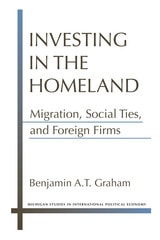
cover of Investing in the Homeland: Migration, Social Ties, and Foreign Firms

Investing in the Homeland

Migration, Social Ties, and Foreign Firms

Benjamin A.T. Graham

University of Michigan Press, 2019

Once viewed as a “brain drain,” migrants are increasingly viewed as a resource for promoting economic development back in their home countries. In Investing in the Homeland, Benjamin Graham finds that diasporans—migrants and their descendants—play a critical role in linking foreign firms to social networks in developing countries, allowing firms to flourish even in challenging political environments most foreign investors shun.

Graham’s analysis draws on new data from face-to-face interviews with the managers of over 450 foreign firms operating in two developing countries: Georgia and the Philippines. Diaspora-owned and diaspora-managed firms are better connected than other foreign firms and they use social ties to resolve disputes and influence government policy. At the same time, Graham shows that diaspora-affiliated firms are no more socially responsible than their purely foreign peers—at root, they are profit-seeking enterprises, not development NGOs. Graham identifies implications for policymakers seeking to capture the development potential of diaspora investment and for managers of multinational firms who want to harness diasporans as a source of sustained competitive advantage.
[more]
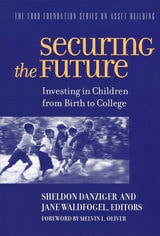
cover of Securing the Future: Investing in Children From Birth to College

Securing the Future

Investing in Children From Birth to College

Sheldon Danziger

Russell Sage Foundation, 2000

More than ever, the economic health of a country depends upon the skills, knowledge, and capacities of its people. How does a person acquire these human assets and how can we promote their development? Securing the Future assembles an interdisciplinary team of scholars to investigate the full range of factors—pediatric, psychological, social, and economic—that bear on a child's development into a well-adjusted, economically productive member of society. A central purpose of the volume is to identify sound interventions that will boost human assets, particularly among the disadvantaged. The book provides a comprehensive evaluation of current initiatives and offers a wealth of new suggestions for effective public and private investments in child development. While children from affluent, highly educated families have good quality child care and an expensive education provided for them, children from poor families make do with informal child care and a public school system that does not always meet their needs. How might we best redress this growing imbalance? The contributors to this volume recommend policies that treat academic attainment together with psychological development and social adjustment. Mentoring programs, for example, promote better school performance by first fostering a young person's motivation to learn. Investments made early in life, such as preschool education, are shown to have the greatest impact on later learning for the least cost. In their focus upon children, however, the authors do not neglect the important links between generations. Poverty and inequality harm the development of parents and children alike. Interventions that empower parents to fight for better services and better schools are also of great benefit to their children. Securing the Future shows how investments in child development are both a means to an end and an end in themselves. They benefit the child directly and they also help that child contribute to the well-being of society. This book points us toward more effective strategies for promoting the economic success and the social cohesion of future generations. A Volume in the Ford Foundation Series on Asset Building
[more]