Results by title
15 books match the query 'Investments'
Advances in Behavioral Finance
Richard H. Thaler
Russell Sage Foundation, 1993
Asymmetric Information, Corporate Finance, and Investment
Edited by R. Glenn Hubbard
University of Chicago Press, 1990
In this volume, specialists from traditionally separate areas in economics and finance investigate issues at the conjunction of their fields. They argue that financial decisions of the firm can affect real economic activity—and this is true for enough firms and consumers to have significant aggregate economic effects. They demonstrate that important differences—asymmetries—in access to information between "borrowers" and "lenders" ("insiders" and "outsiders") in financial transactions affect investment decisions of firms and the organization of financial markets. The original research emphasizes the role of information problems in explaining empirically important links between internal finance and investment, as well as their role in accounting for observed variations in mechanisms for corporate control.

Banking for a Better World
Nanno Kleiterp in Conversation with Marijn WiersmaNanno Kleiterp
Amsterdam University Press, 2017
Capital and Interest
F. A. Hayek
University of Chicago Press, 2015
Critically Capitalist
The Spirit of Asset Capitalism in South KoreaBohyeong Kim
University of Michigan Press, 2025
Drawing on multi-sited ethnography and in-depth interviews with a broad community of aspiring millionaires, Critically Capitalist illuminates how contemporary capitalism thrives by channeling discontent into financial and real estate markets, which in turn has cemented critical capitalism as the cultural and affective backbone of South Korea’s economy.
Financing State and Local Economic Development
Michael Barker, ed.
Duke University Press, 1983
Institutions and Investments
Foreign Direct Investment in China during an Era of ReformsJun Fu
University of Michigan Press, 2000
Invested
How Three Centuries of Stock Market Advice Reshaped Our Money, Markets, and MindsPaul Crosthwaite, Peter Knight, Nicky Marsh, Helen Paul, and James Taylor
University of Chicago Press, 2022
Who hasn’t wished for a surefire formula for riches and a ticket to the good life? For three centuries, investment advisers of all kinds, legit and otherwise, have guaranteed that they alone can illuminate the golden pathway to prosperity—despite strong evidence to the contrary. In fact, too often, they are singing a siren song of devastation. And yet we keep listening.
Invested tells the story of how the genre of investment advice developed and grew in the United Kingdom and the United States, from its origins in the eighteenth century through today, as it saturates our world. The authors analyze centuries of books, TV shows, blogs, and more, all promising techniques for amateur investors to master the ways of the market: from Thomas Mortimer’s pathbreaking 1761 work, Every Man His Own Broker, through the Gilded Age explosion of sensationalist investment manuals, the early twentieth-century emergence of a vernacular financial science, and the more recent convergence of self-help and personal finance. Invested asks why, in the absence of evidence that such advice reliably works, guides to the stock market have remained perennially popular. The authors argue that the appeal of popular investment advice lies in its promise to level the playing field, giving outsiders the privileged information of insiders. As Invested persuasively shows, the fantasies sold by these writings are damaging and deceptive, peddling unrealistic visions of easy profits and the certainty of success, while trying to hide the fact that there is no formula for avoiding life’s economic uncertainties and calamities.
Investment Management in Boston
A HistoryDavid Grayson Allen
University of Massachusetts Press, 2015
Presented here for the first time is the history of Boston's evolution as a center of American money management from early settlement to the twenty-first century. Within a few decades after the Revolution, Bostonians built up an impressive mercantile and industrial economy, and used wealth accrued from the China trade, New England mills, and other ventures to establish the most important stock exchange in America. They also created the “Boston trustee,” a unique professional who managed private fortunes over generations. During the late nineteenth century, Boston financial institutions were renowned as bastions of stability and conservatism in an era of recurrent economic panics and frequent failures.
It was not until the twentieth century that Boston became better known for its role in investment management. In 1924, local financiers created the first mutual fund, an innovation almost a century in the making. After World War II, Boston originated venture capital with the founding of American Research & Development. This was soon followed by the development of private equity, the growth of the mutual fund industry, the pension “revolution” that changed and strengthened money management, the evolution in management of institutional endowments, and the rise of new family offices and hedge funds. The contributions of fiduciaries and investment managers have played an important part in the rise of the “New Boston” and made the city one of the most vibrant financial capitals in the world.
Investment Management in Boston is published in association with Massachusetts Historical Society.
Noise
Living and Trading in Electronic FinanceAlex Preda
University of Chicago Press, 2017
In Noise, Alex Preda explores the world of the people who trade even when by all measures they would be better off not trading. Based on firsthand observations, interviews with traders and brokers, and on international direct trading experience, Preda’s fascinating ethnography investigates how ordinary people take up financial trading, how they form communities of their own behind their computer screens, and how electronic finance encourages them to trade more and more frequently. Along the way, Preda finds the answer to the paradox of amateur trading—the traders aren’t so much seeking monetary rewards in the financial markets, rather the trading itself helps them to fulfill their own personal goals and aspirations.
Social Security Pension Reform in Europe
Edited by Martin Feldstein and Horst Siebert
University of Chicago Press, 2002
The essays here highlight the problems that the European pension reform process faces and how it differs from that of the United States. This timely volume will significantly enrich the debate on pension reform worldwide.
Succeeding Generations
On the Effects of Investments in ChildrenRobert Haveman
Russell Sage Foundation, 1994

The Distributional Aspects of Social Security and Social Security Reform
Edited by Martin Feldstein and Jeffrey B. Liebman
University of Chicago Press, 2002
As this volume suggests, the distributional consequences of these proposals are substantially different and may disproportionately affect those groups who depend on social security to avoid poverty in old age. Together, these studies persuasively show that appropriately designed investment-based social security reforms can effectively reduce the long-term burden of an aging society on future taxpayers, increase the expected future income of retirees, and mitigate poverty rates among the elderly.
The Pure Theory of Capital
F. A. Hayek
University of Chicago Press, 2007
The Pure Theory of Capital, F. A. Hayek’s long-overlooked, little-understood volume, was his most detailed work in economic theory. Originally published in 1941 when fashionable economic thought had shifted to John Maynard Keynes, Hayek’s manifesto of capital theory is now available again for today’s students and economists to discover.
With a new introduction by Hayek expert Lawrence H. White, who firmly situates the book not only in historical and theoretical context but within Hayek’s own life and his struggle to complete the manuscript, this edition commemorates the celebrated scholar’s last major work in economics. Offering a detailed account of the equilibrium relationships between inputs and outputs in an economy, Hayek’s stated objective was to make capital theory—which had previously been devoted almost entirely to the explanation of interest rates—“useful for the analysis of the monetary phenomena of the real world.” His ambitious goal was nothing less than to develop a capital theory that could be fully integrated into the business cycle theory.
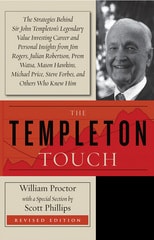
The Templeton Touch
William Proctor
Templeton Press, 2012