Results by title
2 books match the query 'Invisible Hand'

Invoking the Invisible Hand
Social Security and the Privatization DebatesRobert Asen
Michigan State University Press, 2009
In Invoking the Invisible Hand Robert Asen scrutinizes contemporary debates over proposals to privatize Social Security. Asen argues that a rights-based rhetoric employed by Social Security's original supporters enabled advocates of privatization to align their proposals with the widely held belief that Social Security functions simply as a return on a worker's contributions and that it is not, in fact, a social insurance program.
By analyzing major debates over a preeminent American institution, Asen reveals the ways in which language is deployed to identify problems for public policy, craft policy solutions, and promote policies to the populace. He shows how debate participants seek to create favorable contexts for their preferred policies and how they connect these policies to idealized images of the nation.
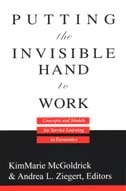
Putting the Invisible Hand to Work
Concepts and Models for Service Learning in EconomicsKimMarie McGoldrick and Andrea L. Ziegert, Editors
University of Michigan Press, 2002
The two parts of this volume provide a theoretical basis for service learning and offer lessons gleaned from applying it in the classroom. The theoretical chapters outline the learning theory and models of service learning as they can be applied in economics. Service learning is introduced here as a technique that teaches students to "do economics." Also included are specific models of service learning and an overview of assessment issues. The applications chapters detail various examples of using service to enhance learning. These range from using a single service experience in a class to courses that use service experiences as the focus and context for learning economics. Course topics cover environmental and natural resources, statistics, econometrics and research methods, principles and economic issues, labor, the economics of gender, forensic economics, and development economics. Each application provides details regarding the institutional environment in which it was implemented, type of course, enrollment, and process through which student learning was enhanced. Handouts and abbreviated syllabi are included.
Economics educators have a stake in improving their students' long-term economic literacy. Service learning offers significant benefits beyond those offered by pedagogies traditionally found in economics classrooms and should be considered as a teaching strategy by economics professors everywhere.
Kim Marie McGoldrick is Associate Professor of Economics, University of Richmond. Andrea L. Ziegert is Associate Professor of Economics, Denison University.