Results by title
7 books match the query 'Irish Literature'

Decolonisation and Criticism
The Construction of Irish LiteratureGerry Smyth
Pluto Press, 1998
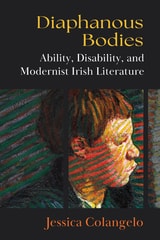
Diaphanous Bodies
Ability, Disability, and Modernist Irish LiteratureJessica Colangelo
University of Michigan Press, 2021
Diaphanous Bodies: Ability, Disability, and Modernist Irish Literature examines ability, as a category of embodiment and embodied experience, and in the process opens up a new area of inquiry in the growing field of literary disability studies. It argues that the construction of ability arises through a process of exclusion and forgetting, in which the depiction of sensory information and epistemological judgment subtly (or sometimes un-subtly) elide the fact of embodied subjectivity. The result is what Colangelo calls “the myth of the diaphanous abled body,” a fiction that holds that an abled body is one which does not participate in or situate experience. The diaphanous abled body underwrites the myth that abled and disabled constitute two distinct categories of being rather than points on a constantly shifting continuum.
In any system of marginalization, the dominant identity always sets itself up as epistemologically and experientially superior to whichever group it separates itself from. Indeed, the norm is always most powerful when it is understood as an empty category or a view from nowhere. Diaphanous Bodies explores the phantom body that underwrites the artificial dichotomy between abled and disabled upon which the representation of embodied experience depends.
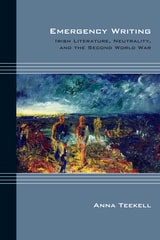
Emergency Writing
Irish Literature, Neutrality, and the Second World WarAnna Teekell
Northwestern University Press, 2018
Taking seriously Ireland’s euphemism for World War II, “the Emergency,” Anna Teekell’s Emergency Writing asks both what happens to literature written during a state of emergency and what it means for writing to be a response to an emergency.
Anchored in close textual analysis of works by Samuel Beckett, Elizabeth Bowen, Flann O’Brien, Louis MacNeice, Denis Devlin, and Patrick Kavanagh, and supported by archival material and historical research, Emergency Writing shows how Irish late modernism was a response to the sociopolitical conditions of a newly independent Irish Free State and to a fully emerged modernism in literature and art. What emerges in Irish writing in the wake of Independence, of the Gaelic Revival, of Yeats and of Joyce, is a body of work that invokes modernism as a set of discursive practices with which to counter the Free State’s political pieties.
Emergency Writing provides a new approach to literary modernism and to the literature of conflict, considering the ethical dilemma of performing neutrality—emotionally, politically, and rhetorically—in a world at war.
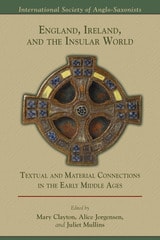
England, Ireland, and the Insular World
Textual and Material Connections in the Early Middle AgesMary Clayton
Arizona Center for Medieval and Renaissance Studies, 2017
ISAS Dublin 2013. England, Ireland and the Insular World: Textual and Material Connections in the Early Middle Ages is a collection of twelve essays related to the theme of the 2013 conference of the International Society of Anglo-Saxonists, ‘Insular Cultures’. Contributors cover a broad range of topics, from early medieval agriculture in Ireland and England, to sculpture, manuscript illumination and script, homilies, hagiography, aristocratic gift-giving, relics, calendars, Beowulf, and Anglo-Saxon perceptions of the Celtic peoples, considering connections, parallels and differences between Anglo-Saxon England and its insular neighbors. The volume will be of interest to all those working on Early Medieval history, literature, archaeology, liturgy, art, and manuscripts.

Gender and Sexuality in Modern Ireland
Anthony Bradley
University of Massachusetts Press, 1997
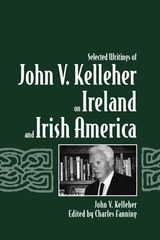
Selected Writings of John V. Kelleher on Ireland and Irish America
John V. Kelleher. Edited by Charles Fanning
Southern Illinois University Press, 2002
A collection of eighteen critical essays and twenty-six translations spanning the career of one of the founding intellects of Irish Studies, the Selected Writings of John V. Kelleher on Ireland and Irish America consists of five accessible sections. The first gathers Kelleher’s essays on the most widely known Irish cultural phenomenon—the literary renaissance of the early twentieth century. Part two contains his judicious assessments of Irish literature in its post-Revolutionary phase. The third section includes Kelleher’s insightful essays on the experience of the Irish in America. The fourth section contains essays that examine early Irish literature and culture, opening with a benchmark essay for Irish Studies, “Early Irish History and Pseudo-History,” which was read at the inaugural meeting of the American Conference for Irish Studies in 1961. The collection concludes with Kelleher’s translations and adaptations of poems in Old, Middle, and Modern Irish, illustrating his command of the language at every stage.
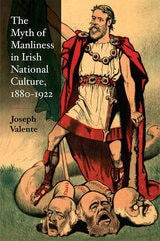
The Myth of Manliness in Irish National Culture, 1880-1922
Joseph Valente
University of Illinois Press, 2011