Results by title
4 books match the query 'Irish question'
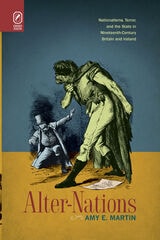
Alter-Nations
Nationalisms, Terror, and the State in Nineteenth-Century Britain and IrelandAmy E. Martin
The Ohio State University Press, 2012

Reimagining the Nation-State
The Contested Terrains of Nation-BuildingJim MacLaughlin
Pluto Press, 2001
Mac Laughlin offers a theoretical and empirical analysis of nation building, taking as a case study the historical connections between Ireland and Great Britain in the clash between 'big nation' historic British nationalism on the one hand, and minority Irish nationalism on the other. Locating the origins of the historic nation in the seventeenth and eighteenth centuries, Mac Laughlin emphasises the difficulties, and specifities, of minority nationalisms in the nineteenth century. In so doing he calls for a place-centred approach which recognises the symbolic and socio-economic significance of territory to the different scales of nation-building. Exploring the evolution of Irish Nationalism, Reimaging the Nation State also shows how minority nations can challenge the hegemony of dominant states and threaten the territorial integrity of historic nations.
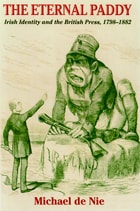
The Eternal Paddy
Irish Identity and the British Press, 1798–1882Michael de Nie
University of Wisconsin Press, 2004
In The Eternal Paddy, Michael de Nie examines anti-Irish prejudice, Anglo-Irish relations, and the construction of Irish and British identities in nineteenth-century Britain. This book provides a new, more inclusive approach to the study of Irish identity as perceived by Britons and demonstrates that ideas of race were inextricably connected with class concerns and religious prejudice in popular views of both peoples. De Nie suggests that while traditional anti-Irish stereotypes were fundamental to British views of Ireland, equally important were a collection of sympathetic discourses and a self-awareness of British prejudice. In the pages of the British newspaper press, this dialogue created a deep ambivalence about the Irish people, an ambivalence that allowed most Britons to assume that the root of Ireland’s difficulties lay in its Irishness.
Drawing on more than ninety newspapers published in England, Scotland, and Wales, The Eternal Paddy offers the first major detailed analysis of British press coverage of Ireland over the course of the nineteenth century. This book traces the evolution of popular understandings and proposed solutions to the "Irish question," focusing particularly on the interrelationship between the press, the public, and the politicians. The work also engages with ongoing studies of imperialism and British identity, exploring the role of Catholic Ireland in British perceptions of their own identity and their empire.
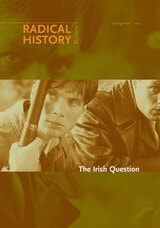
The Irish Question, Volume 2009
Conor McGrady, Donal Ó Drisceoil and Van Gosse, eds.
Duke University Press, 0
One contributor addresses the issue of constitutional nationalism in late-nineteenth- and early-twentieth-century Ireland, while another looks at the recent history of Irish republicanism in relation to the peace process. Other essays examine Protestant society and Unionist hegemony in nineteenth-century Ulster, immigration and racism as the Irish experienced them in postwar Britain, and the historiography of race and racialization in Ireland. The historical adviser for the award-winning film The Wind That Shakes the Barley reflects on its portrayal of the period of the Irish War of Independence and Civil War and a photographic essay focuses on supporters of the modern Irish republican movement in the United States and Ireland.
Contributors. Kevin Bean, Pauline Collombier-Lakeman, Mary Conley, John Corbally, Steve Garner, Diane George, Van Gosse, Martin Hayes, Bill Kissane, Conor McGrady, Kerby Miller, Kevin Noble, Donal Ó Drisceoil