Results by title

9 books match the query 'Iron Curtain'

cover of Ageing East and West: Gerontology across the Iron Curtain

Ageing East and West

Gerontology across the Iron Curtain

Daniela Koleva

Central European University Press, 2027
Focusing on communist Bulgaria (1960s–1989), this book shows how a marginal and ostensibly ‘neutral’ science enabled unexpected flows of knowledge, expertise, and practice between the East and the West. Situating Bulgaria within broader regional and international contexts, it highlights how gerontology’s peripheral position opened space for internationalisation, collaboration, and exchange during the Cold War. By tracing these entanglements, the study challenges binary narratives of East and West and offers a new perspective on the history of medicine, ageing, and socialist science. The history of gerontology suggests that the Iron Curtain was never as impenetrable as its name implies, but woven, porous, and unexpectedly permeable, allowing ideas and practices to slip through its threads. Drawing on institutional archives, oral histories, and personal collections, the book demonstrates how gerontology shaped representations of ageing, influenced policies toward the elderly, and afforded scientists a measure of autonomy under socialism.
[more]
cover of Ageing East and West: Gerontology across the Iron Curtain

Ageing East and West

Gerontology across the Iron Curtain

Daniela Koleva

Central European University Press, 2027

Focusing on communist Bulgaria (1960s–1989), this book shows how a marginal and ostensibly ‘neutral’ science enabled unexpected flows of knowledge, expertise, and practice between the East and the West. Situating Bulgaria within broader regional and international contexts, it highlights how gerontology’s peripheral position opened space for internationalisation, collaboration, and exchange during the Cold War. By tracing these entanglements, the study challenges binary narratives of East and West and offers a new perspective on the history of medicine, ageing, and socialist science. The history of gerontology suggests that the Iron Curtain was never as impenetrable as its name implies, but woven, porous, and unexpectedly permeable, allowing ideas and practices to slip through its threads. Drawing on institutional archives, oral histories, and personal collections, the book demonstrates how gerontology shaped representations of ageing, influenced policies toward the elderly, and afforded scientists a measure of autonomy under socialism.
[more]
cover of Beyond the Color Line and the Iron Curtain: Reading Encounters between Black and Red, 1922-1963

Beyond the Color Line and the Iron Curtain

Reading Encounters between Black and Red, 1922-1963

Kate A. Baldwin

Duke University Press, 2002

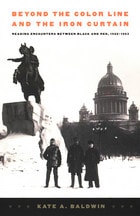
Examining the significant influence of the Soviet Union on the work of four major African American authors—and on twentieth-century American debates about race—Beyond the Color Line and the Iron Curtain remaps black modernism, revealing the importance of the Soviet experience in the formation of a black transnationalism.
Langston Hughes, W. E. B. Du Bois, Claude McKay, and Paul Robeson each lived or traveled extensively in the Soviet Union between the 1920s and the 1960s, and each reflected on Communism and Soviet life in works that have been largely unavailable, overlooked, or understudied. Kate A. Baldwin takes up these writings, as well as considerable material from Soviet sources—including articles in Pravda and Ogonek, political cartoons, Russian translations of unpublished manuscripts now lost, and mistranslations of major texts—to consider how these writers influenced and were influenced by both Soviet and American culture. Her work demonstrates how the construction of a new Soviet citizen attracted African Americans to the Soviet Union, where they could explore a national identity putatively free of class, gender, and racial biases. While Hughes and McKay later renounced their affiliations with the Soviet Union, Baldwin shows how, in different ways, both Hughes and McKay, as well as Du Bois and Robeson, used their encounters with the U. S. S. R. and Soviet models to rethink the exclusionary practices of citizenship and national belonging in the United States, and to move toward an internationalism that was a dynamic mix of antiracism, anticolonialism, social democracy, and international socialism.
Recovering what Baldwin terms the "Soviet archive of Black America," this book forces a rereading of some of the most important African American writers and of the transnational circuits of black modernism.
[more]
cover of Czech Action Art: Happenings, Actions, Events, Land Art, Body Art and Performance Art Behind the Iron Curtain

Czech Action Art

Happenings, Actions, Events, Land Art, Body Art and Performance Art Behind the Iron Curtain

Pavlína Morganová

Karolinum Press, 2014

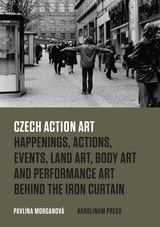
Czech action art—a medium similar to performance art that does not require an audience—emerged out of the political and social turmoil of the 1960s. This movement has received little critical attention, however, as the Iron Curtain prevented its dissemination to an international audience. Here theorist and art historian Pavlína Morganová gives this art scene its due, chronicling its inception and tracing its evolution through to the present.
           
Morganová explains the various forms of action art, from the “actions” and “happenings” of the 1960s; to the actions of land art that encompass stones, trees, water, or fire; to recent displays of body art; to the actions of the latest generation of artists, who are using the principles of action art in contemporary postconceptual and participative art. Along the way, she introduces the most prominent Czech artists of each specific niche, including Milan Knížák, Zorka Ságlová, Ivan Kafka, Petr Štembera, Karel Miler, Jirí Kovanda, and Katerina Šedá, and demonstrates not only the changes in the art forms themselves but also the shifting roles of artists and spectators after World War II.
           
With over one hundred illustrations, Czech Action Art introduces this heretofore overlooked but fascinating art form to a global readership.
[more]
cover of Drawing the Iron Curtain: Jews and the Golden Age of Soviet Animation

Drawing the Iron Curtain

Jews and the Golden Age of Soviet Animation

Maya Balakirsky Katz

Rutgers University Press, 2016
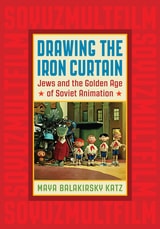
In the American imagination, the Soviet Union was a drab cultural wasteland, a place where playful creative work and individualism was heavily regulated and censored. Yet despite state control, some cultural industries flourished in the Soviet era, including animation. Drawing the Iron Curtain tells the story of the golden age of Soviet animation and the Jewish artists who enabled it to thrive. 
 
Art historian Maya Balakirsky Katz reveals how the state-run animation studio Soyuzmultfilm brought together Jewish creative personnel from every corner of the Soviet Union and served as an unlikely haven for dissidents who were banned from working in other industries. Surveying a wide range of Soviet animation produced between 1919 and 1989, from cutting-edge art films like Tale of Tales to cartoons featuring “Soviet Mickey Mouse” Cheburashka, she finds that these works played a key role in articulating a cosmopolitan sensibility and a multicultural vision for the Soviet Union. Furthermore, she considers how Jewish filmmakers used animation to depict distinctive elements of their heritage and ethnic identity, whether producing films about the Holocaust or using fellow Jews as models for character drawings.  
 
Providing a copiously illustrated introduction to many of Soyuzmultfilm’s key artistic achievements, while revealing the tumultuous social and political conditions in which these films were produced, Drawing the Iron Curtain has something to offer animation fans and students of Cold War history alike. 
 
[more]
cover of Hacking the Iron Curtain: A Media Archaeology of the Russian Internet

Hacking the Iron Curtain

A Media Archaeology of the Russian Internet

Natalia Konradova

University of Wisconsin Press, 2026

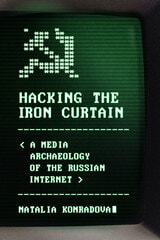
For decades before the internet existed, scientists, technologists, novelists, and enthusiasts of all descriptions dreamed of instantaneous, worldwide communication systems. What forms such systems might take and what technologies could be used to accomplish this goal were open questions—questions asked by people around the world, including in the Cold War–era superpowers of the United States and the Soviet Union. 

Media archaeologist Natalia Konradova examines the history of the internet in Russia and its predecessor state, cutting through layers of technological history and dusting off conceptual artifacts of the past. Inspired by the fundamental question of how Soviets imagined future technologies, she investigates experiments with telepathy alongside the (then equally improbable) dream of a global, digitally connected computer network. Since the story of the Russian internet is inextricably wound up with Soviet society and the history of the Cold War, Hacking the Iron Curtain is as much a cultural and political history as it is a technological one—a history that illustrates how collective dreams can challenge geopolitical ambitions and inspire world-changing technologies.
[more]
cover of Paradise from behind the Iron Curtain: Reading, Translating and Staging Milton in Communist Hungary

Paradise from behind the Iron Curtain

Reading, Translating and Staging Milton in Communist Hungary

Miklós Péti

University College London, 2022

The role and reception of Milton’s work in Communist Hungary.

This book provides a detailed survey of the key responses to Milton’s work in Hungarian state socialism. The four decades between 1948 and 1989 saw a radical revision of previous critical and artistic positions and resulted in the emergence of some characteristically Eastern European responses to Milton’s works. Appraisals of Milton’s works in the communist era proved more controversial than receptions of other major Western authors: on the one hand, Milton’s participation in the Civil War earned him the title of a “revolutionary hero,” on the other hand, religious aspects of his works were often disregarded and sometimes proactively suppressed. This book highlights these diverging responses and places them in the wider context of socialist cultural policy. In addition, it presents the full Hungarian script of the 1970 theatrical performance of Milton’s Paradise Lost, the first of its kind since the work’s publication, alongside a parallel English translation, enabling a deeper reflection on Milton’s original theodicy and its possible interpretations in communist Hungary.
[more]
cover of Vatican II Behind the Iron Curtain

Vatican II Behind the Iron Curtain

Piotr H. Kosicki

Catholic University of America Press, 2016
The goal of this volume is to begin writing Central and Eastern Europe back into the story of the Second Vatican Council, its origins, and its consequences. This volume assembles - for the first time in any language - a broad overview of the place of four different Communist-run countries - Czechoslovakia, Hungary, Poland, and Yugoslavia - in the story of the Council. Framing these is an account of how the Cold War impacted the Council and its reception. The book engages with both English-language scholarship and the national historiographies of the countries that it examines, offering a global lens on the present state of research (covering all relevant languages) and seeking to propel that research forward. All of the chapters draw on both non-English secondary literature and original primary sources - some published, some archival.
[more]
cover of Written Here, Published There: How Underground Literature Crossed the Iron Curtain

Written Here, Published There

How Underground Literature Crossed the Iron Curtain

Friederike Kind-Kovács

Central European University Press, 2015

Written Here, Published There offers a new perspective on the role of underground literature in the Cold War and challenges us to recognize gaps in the Iron Curtain. The book identifies a transnational undertaking that reinforced détente, dialogue, and cultural transfer, and thus counterbalanced the persistent belief in Europe's irreversible division.

It analyzes a cultural practice that attracted extensive attention during the Cold War but has largely been ignored in recent scholarship: tamizdat, or the unauthorized migration of underground literature across the Iron Curtain. Through this cultural practice, I offer a new reading of Cold War Europe's history. Investigating the transfer of underground literature from the 'Other Europe' to Western Europe, the United States, and back illuminates the intertwined fabrics of Cold War literary cultures. Perceiving tamizdat as both a literary and a social phenomenon, the book focuses on how individuals participated in this border-crossing activity and used secretive channels to guarantee the free flow of literature.

[more]