Results by title
15 books match the query 'Iroquois Indians'
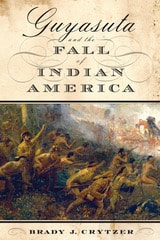
Guyasuta and the Fall of Indian America
Brady J. Crytzer
Westholme Publishing, 2013
Nearly a century before the United States declared the end of the Indian Wars, the fate of Native Americans was revealed in the battle of Fallen Timbers. In 1794, General Anthony Wayne led the first American army— the Legion of the United States—against a unified Indian force in the Ohio country. The Indians were routed and forced to vacate their lands. It was the last of a series of Indian attempts in the East to retain their sovereignty and foreshadowed what would occur across the rest of the continent. In Guyasuta and the Fall of Indian America, historian Brady J. Crytzer traces how American Indians were affected by the wars leading to American Independence through the life of one of the period’s most influential figures. Born in 1724, Guyasuta is perfectly positioned to understand the emerging political landscape of America in the tumultuous eighteenth century. As a sachem of the vaunted Iroquois Confederacy, for nearly fifty years Guyasuta dedicated his life to the preservation and survival of Indian order in a rapidly changing world, whether it was on the battlefield, in the face of powerful imperial armies, or around a campfire negotiating with his French, British, and American counterparts. Guyasuta was present at many significant events in the century, including George Washington’s expedition to Fort Le Boeuf, the Braddock disaster of 1755, Pontiac’s Rebellion and the Battle of Bushy Run in 1763, and the Battle of Oriskany during the American Revolution. Guyasuta’s involvement in the French and British wars and the American War for Independence were all motivated by a desire to retain relevance for Indian society. It was only upon the birth of the United States of America that Guyasuta finally laid his rifle down and watched as his Indian world crumbled beneath his feet. A broken man, debilitated by alcoholism, he died near Pittsburgh in 1794.
Supported by extensive research and full of compelling drama, Guyasuta and the Fall of Indian America unravels the tangled web of alliances, both white and native, and explains how the world of the American Indians could not survive alongside the emergent United States.
Haudenosaunee Women Lacrosse Players
Making Meaning through RematriationSharity L. Bassett
Michigan State University Press, 2024
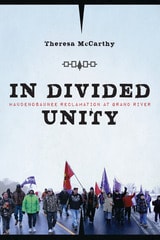
In Divided Unity
Haudenosaunee Reclamation at Grand RiverTheresa McCarthy
University of Arizona Press, 2016
In February 2006, the Six Nations occupation of a 132-acre construction site in Caledonia, Ontario, reignited a 200-year-long struggle to reclaim land and rights in the Grand River region. Framed by this ongoing reclamation, In Divided Unity explores community-based initiatives that promote Haudenosaunee traditionalism and languages at Six Nations of the Grand River as crucial enactments of sovereignty both historically and in the present.
Drawing from Haudenosaunee oral traditions, languages, and community-based theorists, In Divided Unity engages the intersecting themes of knowledge production and resistance against the backdrop of the complicated dynamics of the Six Nations community, which has the largest population of all First Nations in Canada. Comprising the Mohawk, Oneida, Onondaga, Cayuga, Seneca, and Tuscarora nations, citizens of the Six Nations Confederacy collectively refer to themselves as Haudenosaunee, which means “we build the house.”
Theresa McCarthy critiques settler colonial narratives of Haudenosaunee decline used to rationalize land theft and political subjugation. In particular, McCarthy illustrates that current efforts to discredit the reclamation continue to draw on the flawed characterizations of Haudenosaunee tradition, factionalism, and “failed” self-government popularized by conventional scholarship about the Iroquois. Countering these narratives of decline and failure, McCarthy argues that the 2006 reclamation ushered in an era of profound intellectual and political resurgence at Six Nations, propelled by the contributions of Haudenosaunee women.
Centering Haudenosaunee intellectual traditions, In Divided Unity provides an important new model for community-based activism and scholarship. Through the active practice and adaptation of ancient teachings and philosophies, McCarthy shows that the Grand River Haudenosaunee are continuing to successfully meet the challenges of reclaiming their land, political autonomy, and control of their future.

Kayanerenkó
wa: The Great Law of PeaceKayanesenh Paul Williams
University of Manitoba Press, 2018
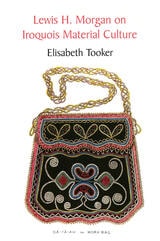
Lewis H. Morgan on Iroquois Material Culture
Elisabeth Tooker
University of Arizona Press, 1994
Northern Iroquoian Texts
Marianne Mithun and Hanni Woodbury
University of Chicago Press Journals, 1980
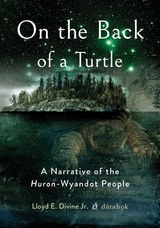
On the Back of a Turtle
A Narrative of the Huron-Wyandot PeopleLloyd Divine Jr.
The Ohio State University Press, 2019
As characters and tribes emerge in the Huron-Wyandot’s oral tradition of creation, and take their respective places upon the Great Island, the author reveals the most difficult element of the Huron-Wyandot’s history: how the tribal name was obtained. With the knowledge of how both Huron and Wyandot are relevant names for one tribe of people, the author then shares his tribe’s amazing history. The reader will be fascinated to learn how one of the smallest tribes, birthed amid the Iroquois Wars, rose to become one of the most respected and influential tribes of North America.
Process and Meaning in Spatial Archaeology
Investigations into Pre-Columbian Iroquoian Space and PlaceEric Jones
University Press of Colorado, 2017
The research in this volume represents a new wave of spatial research—exploring beyond settlement patterning to the process and the meaning behind spatial arrangement of past communities and people—and describes new approaches being used for better understanding of past Northern Iroquoian societies. Addressing topics ranging from household task-scapes and gender relations to bioarchaeology and social network analysis, Process and Meaning in Spatial Archaeology demonstrates the vitality of current archaeological research into ancestral Northern Iroquoian societies and its growing contribution to wider debates in North American archaeology.
This cutting-edge research will be of interest to archaeologists globally, as well as academics and graduate students studying Northern Iroquoian societies and cultures, geography, and spatial analysis.
Contributors: Kathleen M. S. Allen, Jennifer A. Birch, William Engelbrecht, Crystal Forrest, John P. Hart, Sandra Katz, Robert H. Pihl, Aleksandra Pradzynski, Erin C. Rodriguez, Dean R. Snow, Ronald F. Williamson, Rob Wojtowicz
Rekindling the Sacred Fire
Métis Ancestry and Anishinaabe SpiritualityChantal Fiola
University of Manitoba Press, 2015
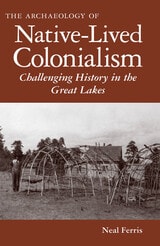
The Archaeology of Native-Lived Colonialism
Challenging History in the Great LakesNeal Ferris
University of Arizona Press, 2009
In reconsidering Native adaptation and resistance to colonial British rule, Ferris reviews five centuries of interaction that are usually read as a single event viewed through the lens of historical bias. He first examines patterns of traditional lifeway continuity among the Ojibwa, demonstrating their ability to maintain seasonal mobility up to the mid-nineteenth century and their adaptive response to its loss. He then looks at the experience of refugee Delawares, who settled among the Ojibwa as a missionary-sponsored community yet managed to maintain an identity distinct from missionary influences. And he shows how the archaeological history of the Six Nations Iroquois reflected patterns of negotiating emergent colonialism when they returned to the region in the 1780s, exploring how families managed tradition and the contemporary colonial world to develop innovative ways of revising and maintaining identity.
The Archaeology of Native-Lived Colonialism convincingly utilizes historical archaeology to link the Native experience of the eighteenth and nineteenth centuries to the deeper history of sixteenth- and seventeenth-century interactions and with pre-European times. It shows how these Native communities succeeded in retaining cohesiveness through centuries of foreign influence and material innovations by maintaining ancient, adaptive social processes that both incorporated European ideas and reinforced historically understood notions of self and community.
The Clay We Are Made Of
Haudenosaunee Land Tenure on the Grand RiverSusan M. Hill
University of Manitoba Press, 2017
The Edge of the Woods
Iroquoia, 1534-1701Jon Parmenter
Michigan State University Press, 2010
Unsettling Scripture
Iroquois and the Book of MormonThomas W Murphy
University of Utah Press, 2025
In Unsettling Scripture: Iroquois and the Book of Mormon, anthropologist Thomas W Murphy delves into the visions of Seneca prophet Handsome Lake, the epic narratives of the Iroquois Confederacy, and the origin story of the Book of Mormon, revealing surprising parallels between Indigenous and Mormon traditions.
Through ethnohistorical research and decolonizing methodologies, Murphy reexamines how both communities understand their origins, faith, and prophecy. From Handsome Lake’s revelations to Joseph Smith’s seer stone, from ancient sibling rivalries to the Great Peace, this book unsettles traditional narratives while opening new conversations on scripture, identity, and cultural exchange. Drawing from living Indigenous voices, Unsettling Scripture challenges readers to rethink sacred texts and the histories they tell.
We Share Our Matters
Two Centuries of Writing and Resistance at Six Nations of the Grand RiverRick Monture
University of Manitoba Press, 2014
Year of the Hangman
George Washington's Campaign Against the IroquoisGlenn F. Williams
Westholme Publishing, 2007
Winner of the 2005 Thomas Fleming Award for the Best Book in American Revolutionary War History
Finalist for the Army Historical Foundation Distinguished Writing Award
After two years of fighting, Great Britain felt confident that the American rebellion would be crushed in 1777, the "Year of the Hangman." Britain devised a bold new strategy. Turning its attention to the colonial frontiers, especially those of western New York, Pennsylvania, and Virginia, Britain enlisted its provincial rangers, Tories, and allied warriors, principally from the Iroquois Confederacy, to wage a brutal backwoods war in support of General John Burgoyne's offensive as it swept southward from Canada in an attempt to cut the colonies in half, divert the Continental Army, and weaken its presence around British-occupied New York City and Philadelphia.
Burgoyne's defeat at Saratoga sent shock waves through the British command. But the efforts along the frontier under the direction of Sir John Johnson, Colonel John Butler, and the charismatic Mohawk leader, Joseph Brant, appeared to be impairing the American ability to conduct the war. Destroying Patriot settlements and farms across hundreds of miles of frontier, the British and Indian forces threatened to reduce Continental army enlistment, and more importantly, precious food supplies. Following the massacres at the well-established colonial settlements of Wyoming, Pennsylvania, and Cherry Valley, New York, the Continental Congress persuaded General George Washington to conduct a decisive offensive to end the threat once and for all. Brewing for years, the conflict between the Iroquois and colonists would now reach its deadly climax.
Charging his troops "to not merely overrun, but destroy," Washington devised a two-prong attack to exact American revenge. The largest coordinated American military action against American Indians in the war, the campaign shifted the power in the east, ending the political and military influence of the Iroquois, forcing large numbers of loyalist to flee to Canada, and sealing Britain's fateful decision to seek victory in the south. In Year of the Hangman: George Washington's Campaign Against the Iroquois, historian Glenn F. Williams recreates the riveting events surrounding the action, including the checkered story of European and Indian alliances, the bitter frontier wars, and the bloody battles of Oriskany and Newtown.