Results by title
12 books match the query 'Irrigation'
Arid Lands in Perspective
Edited by William G. McGinnies and Bram J. Goldman
University of Arizona Press, 1969
Contributors:
Michel Batisse
William A. Dick-Peddie
Carl N. Hodges
Richard F. Logan
Roy E. Cameron
Clifford S. Christian
Klaus W. Flach
Ronald L. Heathcote
Douglas H. K. Lee
Lawrence K. Lustig
William G. McGinnies
Peveril Meigs
James T. Neal
Daniel A. Okun
Harland I. Padfield
Patricia Paylore
Rayden A. Perry
Roald A. Peterson
Robert L. Raikes
Courtland L. Smith
Guy D. Smith
Andrew Warren
John C. York
Canal Irrigation in Prehistoric Mexico
The Sequence of Technological ChangeBy William E. Doolittle
University of Texas Press, 1990
Prehistoric farmers in Mexico invented irrigation, developed it into a science, and used it widely. Indeed, many of the canal systems still in use in Mexico today were originally begun well before the discovery of the New World. In this comprehensive study, William E. Doolittle synthesizes and extensively analyzes all that is currently known about the development and use of irrigation technology in prehistoric Mexico from about 1200 B.C. until the Spanish conquest in the sixteenth century A.D.
Unlike authors of previous studies who have focused on the political, economic, and social implications of irrigation, Doolittle considers it in a developmental context. He examines virtually all the known systems, from small canals that diverted runoff from ephemeral mountain streams to elaborate networks that involved numerous large canals to irrigate broad valley floors with water from perennial rivers. Throughout the discussion, he gives special emphasis to the technological elaborations that distinguish each system from its predecessors. He also traces the spread of canal technology into and through different ecological settings.
This research substantially clarifies the relationship between irrigation technology in Mexico and the American Southwest and argues persuasively that much of the technology that has been attributed to the Spaniards was actually developed in Mexico by indigenous people. These findings will be important not only for archaeologists working in this area but also for geographers, historians, and engineers interested in agriculture, technology, and arid lands.
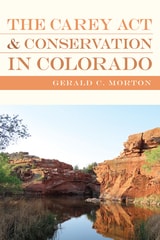
Carey Act and Conservation in Colorado
Gerald C. Morton
University Press of Colorado, 2024
Morton contextualizes the Carey Act’s significance in Colorado through a study of the Two Buttes and Muddy Creek projects in the state’s southeastern corner—tragic examples of the disconnect among developers seeking windfall profits in the face of financial rollercoasters, the challenge of reclaiming remote sagebrush country, and settlers seeking viable livelihoods that eventually led conservationists to reimagine the failures as public wildlife refuges. A collision of values between developers and settlers lay at the center of those wildlife habitat conservation efforts, forcing people to rethink their relationship with the land and ephemeral streams—an awareness that correlated with the advent of modern ecology.
The Carey Act and Conservation in Colorado is the untold story of the manipulation of nature and the reconceived use of land for public wildlife areas on the southern plains of the American West. Offering original research on arid lands policy, federal and state agency oversight, irrigation bond financing, heartbroken settlers’ grievances, individual developers’ motives, and the rise of wildlife conservation, this compelling tale of misfortune will appeal to scholars and general readers interested in conservationist and environmental history in the American West.
Early Settlement and Irrigation on the Deh Luran Plain
Village and Early State Societies in Southwestern IranJames A. Neely and Henry T. Wright with a foreword by Kent V. Flannery and contributions by Robert E. Dewar and Pierre de Miroschedji
University of Michigan Press, 1994
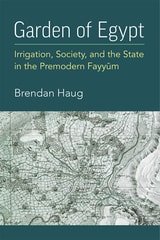
Garden of Egypt
Irrigation, Society, and the State in the Premodern FayyumBrendan Haug
University of Michigan Press, 2024
2025 American Society of Papyrologists Book Prize Winner
Garden of Egypt: Irrigation, Society, and the State in the Premodern Fayyūm is the first environmental history of Egypt’s Fayyūm depression. The volume studies human relationships with flowing water, from the third century BCE to the thirteenth century CE. Until the arrival of modern perennial irrigation in the nineteenth century, the Fayyūm was the only region of premodern Egypt to be irrigated by a network of artificial canals. By linking large numbers of rural communities together in shared dependence on this public irrigation infrastructure, canalization introduced to Egypt a radically new way of interacting both with the water of the Nile and with fellow farmers. Drawing upon ancient Greek papyri, medieval Arabic literature, and modern comparative evidence, this book explores the ways in which the Nile’s water, local farmers, and state power together continually reshaped this irrigated landscape over more than thirteen centuries. Following human/water relationships through both space and time further helps to erode disciplinary boundaries and bring multiple periods of Egyptian history into contact with one another.
Irrigation and the Cuicatec Ecosystem
A Study of Agriculture and Civilization in North Central OaxacaJoseph W. Hopkins III
University of Michigan Press, 1984
Irrigation's Impact on Society
Edited by Theodore E. Downing and McGuire Gibson
University of Arizona Press, 1974
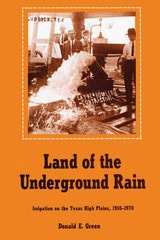
Land of the Underground Rain
Irrigation on the Texas High Plains, 1910-1970By Donald E. Green
University of Texas Press, 1973
The scarcity of surface water which has so marked the Great Plains is even more characteristic of its subdivision, the Texas High Plains. Settlers on the plateau were forced to use pump technology to tap the vast ground water resources—the underground rain—beneath its flat surface.
The evolution from windmills to the modern high-speed irrigation pumps took place over several decades. Three phases characterized the movement toward irrigation. In the period from 1910 to 1920, large-volume pumping plants first appeared in the region, but, due to national and regional circumstances, these premature efforts were largely abortive. The second phase began as a response to the drouth of the Dust Bowl and continued into the 1950s. By 1959, irrigation had become an important aspect of the flourishing High Plains economy. The decade of the 1960s was characterized chiefly by a growing alarm over the declining ground water table caused by massive pumping, and by investigations of other water sources.
Land of the Underground Rain is a study in human use and threatened exhaustion of the High Plains' most valuable natural resource. Ground water was so plentiful that settlers believed it flowed inexhaustibly from some faraway place or mysteriously from a giant underground river. Whatever the source, they believed that it was being constantly replenished, and until the 1950s they generally opposed effective conservation of ground water. A growing number of weak and dry wells then made it apparent that Plains residents were "mining" an exhaustible resource.
The Texas High Plains region has been far more successful in exploiting its resource than in conserving it. The very success of its pump technology has produced its environmental crisis. The problem brought about by the threatened exhaustion of this resource still awaits a solution.
This study is the first comprehensive history of irrigation on the Texas High Plains, and it is the first comprehensive treatment of the development of twentieth-century pump irrigation in any area of the United States.
The Keepers of Water and Earth
Mexican Rural Social Organization and IrrigationBy Kjell I. Enge and Scott Whiteford
University of Texas Press, 1989
Agrarian reforms transformed the Mexican countryside in the late twentieth century but without, in many cases, altering fundamental power relationships. This study of the Tehuacán Valley in the state of Puebla highlights different strategies to manipulate the local implementation of federal government programs. With their very differing successes in the struggle to regain and maintain control of land and water rights, these strategies raise important questions about the meaning of the phrase "locally controlled development."
Because Mexico is dependent on irrigation for 45 percent of its cash crop production, national policy has focused on developing vast government controlled and financed irrigation systems. In the Tehuacán Valley, however, the inhabitants have developed a complex irrigation system without government aid or supervision. Yet, in contrast to most parts of Mexico, water rights can be bought and sold as a commodity, leading to accumulation, stratification, and emergence of a regional elite whose power is based on ownership of land and water. The analysis provides an important contribution to the understanding of local control.
The findings of this study will be important to a wide audience involved in the study of irrigation, local agricultural systems, and the interplay between local power structures and the national government in developing countries. The book also presents unique material on gravity-fed, horizontal wells, known as qanat in the Middle East, which had been unknown in the literature on Latin America before this book.
The Marana Community in the Hohokam World
Suzanne K. Fish
University of Arizona Press, 1992
The Yuma Reclamation Project
Irrigation, Indian Allotment, and Settlement Along the Lower Colorado RiverRobert Sauder
University of Nevada Press, 2009
In the arid American West, settlement was generally contingent on the availability of water to irrigate crops and maintain livestock and human residents. Early irrigation projects were usually the cooperative efforts of pioneer farmers, but by the early twentieth century they largely reflected federal intentions to create new farms out of the western public domain. The Yuma Reclamation Project, authorized in 1904, was one of the earliest federal irrigation projects initiated in the western United States and the first authorized on the Colorado River. Its story exemplifies the range of difficulties associated with settling the nation’s final frontier—the remaining irrigable lands in the arid West, including Indian lands—and illuminates some of the current issues and conflicts concerning the Colorado River. Author Robert Sauder’s detailed, meticulously researched examination of the Yuma Project illustrates the complex multiplicity of problems and challenges associated with the federal government’s attempt to facilitate homesteading in the arid West. He examines the history of settlement along the lower Colorado River from earliest times, including the farming of the local Quechan people and the impact of Spanish colonization, and he reviews the engineering problems that had to be resolved before an industrial irrigation scheme could be accomplished. The study also sheds light on myriad unanticipated environmental, economic, and social challenges that the government had to confront in bringing arid lands under irrigation, including the impact on the Native American population of the region.The Yuma Reclamation Project is an original and significant contribution to our understanding of federal reclamation endeavors in the West. It provides new and fascinating information about the history of the Yuma Valley and, as a case study of irrigation policy, it offers compelling insights into the history and consequences of water manipulation in the arid West.
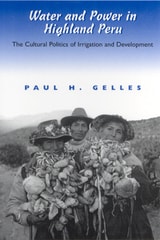
Water and Power in Highland Peru
The Cultural Politics of Irrigation and DevelopmentPaul H Gelles
Rutgers University Press, 2000
Cabanaconde, a town of 5,000 people, is located in the arid Andean highlands. It is dominated by the foreboding Hualca Hualca mountain peak that is the source of this town’s much-needed water. How the villagers obtain this water, Paul Gelles writes, is not a simple process: the politics of irrigation in this area reflect a struggle for control of vital resources, deeply rooted in the clash between local, ritualized models of water distribution and the secular model put forth by the Peruvian state. Water and Power in Highland Peru provides an insightful case study on the intense conflicts over water rights, and a framework for studying ethnic conflict and the effects of “development,” not only in Peru, but in other areas as well.
Most of the inhabitants of Cabanaconde do not identify themselves with the dominant Spanish-speaking culture found in Peru. And the Peruvian state, grounded in a racist, post-Colonial ethos, challenges the village’s long-standing, non-Western framework for organizing water management.
Gelles demonstrates that Andean culture is dynamic and adaptive, and it is a powerful source of ethnic identity, even for those who leave the village to live elsewhere. Indigenous rituals developed in this part of the world, he states, have become powerful tools of resistance against interference by local elites and the present-day Peruvian state. Most importantly, the micropolitics of Cabanaconde provide a window into a struggle that is taking place around the world.