Results by title
9 books match the query 'Is'
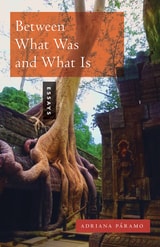
Between What Was and What Is
EssaysAdriana Páramo
University of Massachusetts Press, 2027
A collection that explores the space between personal loss and collective crisis
The essays in Between What Was and What Is address timely questions of power, identity, history, and resilience. Ranging from intimate personal reflection to global crisis, Adriana Páramo examines the contradictions and tensions that define how we live—and how we make sense of what we’ve lived through.
Grounded in the present moment, Páramo engages directly with current events: the death of Pope Francis and the debates about reform his passing has reopened, and the ongoing devastation of the war in Ukraine. She grapples with the lasting weight of colonial, familial, and national trauma, and with the experience of returning to a homeland that no longer matches memory. These essays enter a broader conversation about the liberation of brown and Latina women—voices frequently pushed to the margins of predominantly white feminist spaces. She asks what drives people to persist in the face of systemic inequality. An encounter with a Kumari Devi in Nepal becomes an occasion to examine faith, ritual, and the assumptions we bring to spiritual experience. Throughout, Páramo moves between the everyday and the sacred to interrogate how culture and identity are lived and inherited.
From personal reflections on age, feminism, and rebuilding after failure to larger examinations of race and systemic oppression, Between What Was and What Is asks readers to engage seriously with difficult realities. It takes stock of what we inherit, what we survive, and what we carry forward.
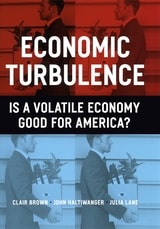
Economic Turbulence
Is a Volatile Economy Good for America?Clair Brown, John Haltiwanger, and Julia Lane
University of Chicago Press, 2006
Every day, in every sector of our economy, a business shuts down while another starts up, jobs are created while others are cut, and workers are hired while others are laid off. This constant flux, or turbulence, is a defining characteristic of our free market system, yet it mostly inspires angst about unemployment, loss of earnings, and the overall competitiveness of corporations. But is this endless cycle of fluctuation really so bad for America? Might something positive be going on in the economy as a result of it?
In this penetrating work, three esteemed economists seek to answer these questions by exploring the real impact of volatility on American workers and businesses alike. According to the authors, while any number of events--shifts in consumer demand, changes in technology, mergers and acquisitions, or increased competition--can contribute to economic turbulence, our economy as a whole is, by and large, stronger for it, because these processes of creation and destruction make it more flexible and adaptable. The authors also acknowledge and document the adverse consequences of this turbulence on different groups of workers and firms and discuss the resulting policy challenges. Basing their argument on an up-close look into the dealings and practices of five key industries—financial services, retail food services, trucking, semiconductors, and software—the authors demonstrate the positive effects of turbulence on career paths, employee earnings, and firm performance.
The first substantial attempt to disentangle and make clear the complexities of this phenomenon in the United States, Economic Turbulence will be viewed as a major achievement and the centerpiece of any discussion on the subject for years to come.

Is a Single Teachable Indian Past Possible Today?
Janaki Nair
Seagull Books, 2024
More than ever before, the school history textbook in India has become an embattled object and the subject of many contestations from both above and below. It is vulnerable not only to the political vagaries of governments but also to the exclusive claims of myriad communities and groups to their sense of the past. What is the future of India’s textbook, arguably the most important repository of the country’s national past? Is a single teachable past even possible any longer?
In this essay, Janaki Nair uses the Indian predicament to discuss the possibility of building up a “historical temper” in the Indian classroom. Sharing examples from her unique position as a professional historian with sustained experience in the field of pedagogy, Nair invites reflections on the prospect of cultivating a historical temper that can help the teacher equip students to grapple with history.
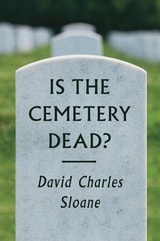
Is the Cemetery Dead?
David Charles Sloane
University of Chicago Press, 2018
Is the Cemetery Dead? gets to the heart of the tragedy of death, chronicling how Americans are inventing new or adapting old traditions, burial places, and memorials. In illustrative prose, David Charles Sloane shows how people are taking control of their grief by bringing their relatives home to die, interring them in natural burial grounds, mourning them online, or memorializing them streetside with a shrine, ghost bike, or RIP mural. Today’s mourners are increasingly breaking free of conventions to better embrace the person they want to remember. As Sloane shows, these changes threaten the future of the cemetery, causing cemeteries to seek to become more responsive institutions.
A trained historian, Sloane is also descendent from multiple generations of cemetery managers and he grew up in Syracuse’s Oakwood Cemetery. Enriched by these experiences, as well as his personal struggles with overwhelming grief, Sloane presents a remarkable and accessible tour of our new American way of death.
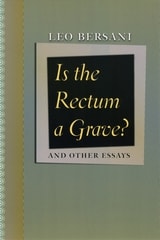
Is the Rectum a Grave?
and Other EssaysLeo Bersani
University of Chicago Press, 2009
Over the course of a distinguished career, critic Leo Bersani has tackled a range of issues in his writing, and this collection gathers together some of his finest work. Beginning with one of the foundations of queer theory—his famous meditation on how sex leads to a shattering of the self, “Is the Rectum a Grave?”—this volume charts the inspired connections Bersani has made between sexuality, psychoanalysis, and aesthetics.
Over the course of these essays, Bersani grapples with thinkers ranging from Plato to Descartes to Georg Simmel. Foucault and Freud recur as key figures, and although Foucault rejected psychoanalysis, Bersani contends that by considering his ideas alongside Freud’s, one gains a clearer understanding of human identity and how we relate to one another. For Bersani, art represents a crucial guide for conceiving new ways of connecting to the world, and so, in many of these essays, he stresses the importance of aesthetics, analyzing works by Genet, Caravaggio, Proust, Almodóvar, and Godard.
Documenting over two decades in the life of one of the best minds working in the humanities today, Is the Rectum a Grave? and Other Essays is a unique opportunity to explore the fruitful career of a formidable intellect.
Privatization in Eastern Europe
Is the State Withering Away?Roman Frydman
Central European University Press, 1994
Rhetoric of Health and Medicine As/Is
Theories and Approaches for the FieldEdited by Lisa Melonçon, S. Scott Graham, Jenell Johnson, John A. Lynch, and Cynthia Ryan
The Ohio State University Press, 2020
With a foreword by Judy Segal and in sections that address interdisciplinary perspectives, representations of health and illness in online spaces, and health activism and advocacy, this volume proceeds in a unique format: essays tackle these key topic areas through case studies ranging from food and its relation to public health, to apps that track fertility, to mental health and disability, to racial disparities that exist in public health campaigns about sudden infant death syndrome (SIDS). The essays within each section are then followed by responses from prominent scholars in the rhetoric of health and medicine—including John Lyne, J. Blake Scott, and Lisa Keränen—who take on the central theme and discuss how the theory or concept under study can and should evolve in the next stages of research. Unifying the essays is a consideration of RHM as a theoretical construct guiding research and thinking alongside the conceptual parameters that constitute what RHM is and can be in practice. In asking questions about the role of rhetoric—both as analytic and productive framework—in health and medicine, this volume engages with broader theoretical and ethical concerns about our current healthcare system and how healthcare and medical issues circulate in all the social, cultural, economic, and political aspects of our world.
The Corporate Contract in Changing Times
Is the Law Keeping Up?Edited by Steven Davidoff Solomon and Randall Stuart Thomas
University of Chicago Press, 2019
With The Corporate Contract in Changing Times, Steven Davidoff Solomon and Randall Stuart Thomas bring together leading corporate law scholars, judges, and lawyers from top corporate law firms to explore what needs to change and what has prevented reform thus far. Among the topics addressed are how the law could be adapted to the reality that activist hedge funds pose a more serious threat to corporations than the hostile takeovers and how statutory laws, such as the rules governing appraisal rights, could be reviewed in the wake of appraisal arbitrage. Together, the contributors surface promising paths forward for future corporate law and public policy.
The Music between Us
Is Music a Universal Language?Kathleen Marie Higgins
University of Chicago Press, 2012