Results by title
3 books match the query 'Islamic courts'
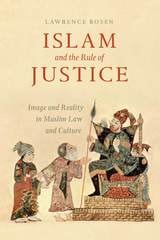
Islam and the Rule of Justice
Image and Reality in Muslim Law and CultureLawrence Rosen
University of Chicago Press, 2018
In the West, we tend to think of Islamic law as an arcane and rigid legal system, bound by formulaic texts yet suffused by unfettered discretion. While judges may indeed refer to passages in the classical texts or have recourse to their own orientations, images of binding doctrine and unbounded choice do not reflect the full reality of the Islamic law in its everyday practice. Whether in the Arabic-speaking world, the Muslim portions of South and Southeast Asia, or the countries to which many Muslims have migrated, Islamic law works is readily misunderstood if the local cultures in which it is embedded are not taken into account.
With Islam and the Rule of Justice, Lawrence Rosen analyzes a number of these misperceptions. Drawing on specific cases, he explores the application of Islamic law to the treatment of women (who win most of their cases), the relations between Muslims and Jews (which frequently involve close personal and financial ties), and the structure of widespread corruption (which played a key role in prompting the Arab Spring). From these case studie the role of informal mechanisms in the resolution of local disputes. The author also provides a close reading of the trial of Zacarias Moussaoui, who was charged in an American court with helping to carry out the 9/11 attacks, using insights into how Islamic justice works to explain the defendant’s actions during the trial. The book closes with an examination of how Islamic cultural concepts may come to bear on the constitutional structure and legal reforms many Muslim countries have been undertaking.
With Islam and the Rule of Justice, Lawrence Rosen analyzes a number of these misperceptions. Drawing on specific cases, he explores the application of Islamic law to the treatment of women (who win most of their cases), the relations between Muslims and Jews (which frequently involve close personal and financial ties), and the structure of widespread corruption (which played a key role in prompting the Arab Spring). From these case studie the role of informal mechanisms in the resolution of local disputes. The author also provides a close reading of the trial of Zacarias Moussaoui, who was charged in an American court with helping to carry out the 9/11 attacks, using insights into how Islamic justice works to explain the defendant’s actions during the trial. The book closes with an examination of how Islamic cultural concepts may come to bear on the constitutional structure and legal reforms many Muslim countries have been undertaking.
[more]
Pronouncing and Persevering
Gender and the Discourses of Disputing in an African Islamic CourtSusan F. Hirsch
University of Chicago Press, 1998
The title of Susan Hirsch's study of disputes involving Swahili Muslims in coastal Kenya reflects the image of gender relations most commonly associated with Islamic law. Men need only "pronounce" divorce to resolve marital conflicts, while embattled and embittered wives must persevere by silently enduring marital hardships. But Hirsch's observations of Islamic courts uncover how Muslim women actively use legal processes to transform their domestic lives, achieving victories on some fronts but reinforcing their image as subordinate to men through the speech they produce in court.
Pronouncing and Persevering focuses closely on the language used in disputes, particularly how men and women narrate their claims and how their speech shapes and is shaped by gender hierarchy in postcolonial Swahili society. Based on field research and court testimony, Hirsch's book debunks the conventional view that women are powerless under Islamic law and challenges the dichotomies through which Islam and gender relations are currently understood.
Pronouncing and Persevering focuses closely on the language used in disputes, particularly how men and women narrate their claims and how their speech shapes and is shaped by gender hierarchy in postcolonial Swahili society. Based on field research and court testimony, Hirsch's book debunks the conventional view that women are powerless under Islamic law and challenges the dichotomies through which Islam and gender relations are currently understood.
[more]
The Expert Witness in Islamic Courts
Medicine and Crafts in the Service of LawRon Shaham
University of Chicago Press, 2010
Islam’s tense relationship with modernity is one of the most crucial issues of our time. Within Islamic legal systems, with their traditional preference for eyewitness testimony, this struggle has played a significant role in attitudes toward expert witnesses. Utilizing a uniquely comparative approach, Ron Shaham here examines the evolution of the role of such witnesses in a number of Arab countries from the premodern period to the present.
Shaham begins with a history of expert testimony in medieval Islamic culture, analyzing the different roles played by male experts, especially physicians and architects, and females, particularly midwives. From there, he focuses on the case of Egypt, tracing the country’s reform of its traditional legal system along European lines beginning in the late nineteenth century. Returning to a broader perspective, Shaham draws on a variety of legal and historical sources to place the phenomenon of expert testimony in cultural context. A truly comprehensive resource, The Expert Witness in Islamic Courts will be sought out by a broad spectrum of scholars working in history, religion, gender studies, and law.
Shaham begins with a history of expert testimony in medieval Islamic culture, analyzing the different roles played by male experts, especially physicians and architects, and females, particularly midwives. From there, he focuses on the case of Egypt, tracing the country’s reform of its traditional legal system along European lines beginning in the late nineteenth century. Returning to a broader perspective, Shaham draws on a variety of legal and historical sources to place the phenomenon of expert testimony in cultural context. A truly comprehensive resource, The Expert Witness in Islamic Courts will be sought out by a broad spectrum of scholars working in history, religion, gender studies, and law.
[more]