Results by title
3 books match the query 'Islamic education'
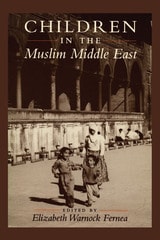
Children in the Muslim Middle East
Edited by Elizabeth Warnock Fernea
University of Texas Press, 1995
Today nearly half of all people in the Middle East are under the age of fifteen. Yet little is known about the new generation of boys and girls who are growing up in a world vastly different from that of their parents, a generation who will be the leaders of tomorrow. This groundbreaking anthology is an attempt to look at the current situation of children by presenting materials by both Middle Eastern and Western scholars. Many of the works have been translated from Arabic, Persian, and French.
The forty-one pieces are organized into sections on the history of childhood, growing up, health, work, education, politics and war, and play and the arts. They are presented in many forms: essays in history and social science, poems, proverbs, lullabies, games, and short stories. Countries represented are Egypt, Jordan, Morocco, Tunisia, Israel/West Bank, Kuwait, Saudi Arabia, Iran, Iraq, Syria, Sudan, Lebanon, Turkey, Yemen, and Afghanistan.
This book complements Elizabeth Fernea's earlier works, Women and the Family in the Middle East and Middle Eastern Muslim Women Speak (coedited with Basima Bezirgan). Like them, it will be important reading for everyone interested in the Middle East and in women's and children's issues.
Islam and Education
Myths and TruthsEdited by Wadad Kadi and Victor Billeh
University of Chicago Press, 2007
In this timely volume based on a special issue of Comparative Education Review, leading comparative education scholars explore the world of education in Islam from the medieval era to today, illuminating the continuing struggle among Islamic scholars and educators over whether to reform or resist as a way of preserving identity. Islam and Education offers a rare overview of the great diversity in forms of Islamic education, dispelling misinterpretations and documenting the ever-evolving relationship of Islamic education to the West. It should be necessary reading for all humanists and social scientists wishing to understand the nexus between schools and societies, the spiritual dimensions of learning, and the social configuration of educational institutions.
Islam and Modernity
Transformation of an Intellectual TraditionFazlur Rahman
University of Chicago Press, 1984
"In this work, Professor Fazlur Rahman presents a positively ambitious blueprint for the transformation of the intellectual tradition of Islam: theology, ethics, philosophy and jurisprudence. Over the voices advocating a return to Islam or the reestablishment of the Sharia, the guide for action, he astutely and soberly asks: What and which Islam? More importantly, how does one get to 'normative' Islam? The author counsels, and passionately demonstrates, that for Islam to be actually what Muslims claim it to be—comprehensive in scope and efficacious for every age and place—Muslim scholars and educationists must reevaluate their methodology and hermeneutics. In spelling out the necessary and sound methodology, he is at once courageous, serious and profound."—Wadi Z. Haddad, American-Arab Affairs