Results by title
110 books match the query 'Italian' and 12 start with a

A Ghost in Trieste
Joseph Cary
University of Chicago Press, 1993
Gem of the Adriatic, Trieste sparkled and beckoned through the pages of poets and novelists. Drawn there in search of literary ghosts, of the poet Umberto Saba and the novelists Italo Svevo and James Joyce, Joseph Cary found instead a city with an imaginative life of its own, the one that rises, tantalizing from the pages of this book. The story of Cary's travels, A Ghost in Trieste, is also a tale of discovery and transformation, as the bustling world of port and airplane, baggage and trams and trains becomes the landscape of history and literature, language and art, psychoanalysis and the self.
Here is the crossroads of East and West. A port held in turn by the Romans, the Venetians, the Austrians, the Germans, the Slavs, and finally the Italians, Trieste is the capital of nowhere, fertile source of a unique literary florescence before the First World War. At times an exile home and an exiled city. "I cannot claim to have walked across it all,:" wrote Saba, the poet of Trieste in 1910 of the city Cary crosses and recrosses, seeking the poetry of the place that inspired its literary giants. Trieste's cultural and historical riches, its geographical splendor of hills and sea and mysterious presence unfold in a series of stories, monologues and literary juxtapositions that reveal the city's charms as well as its seductive hold on the writer's imagination. Throughout, literary and immediate impressions alike are elaborated in paintings and maps, and in handsome line drawings by Nicholas Read.
This "clownish and adolescent Parsifal," this Trieste of the "prickly grace," this place "impaled in my heart like a permanent point," this symbol of the Adriatic, this "city made of books" — here the book remakes the city. The Trieste of allusions magically becomes a city of palpable allure, of warmth and trying contradictions and gritty beauty. Part travel diary, part guide book, part literary history, A Ghost in Trieste is a brilliant introduction to an extraordinary time and place. In Joseph Cary, Trieste has found a new poet, and readers, a remarkably captivating companion and guide.
[more]
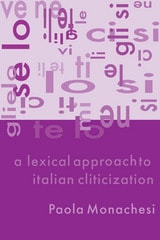
A Lexical Approach to Italian Cliticization
Paola Monachesi
CSLI, 1999
This volume examines the behavior of clitics both in Italian and in certain southern Italian dialects in order to show that, even within a single language, clitics exhibit different properties. Monachesi argues against the existence of a special class 'clitics' whose elements exhibit variable behavior. Instead, she decomposes and assimilates their properties to those of well established categories. Motivations are thus provided for treating Italian object clitics as affixes. It is shown that both their morphosyntactic and their phonological behavior argue in favor of this assumption. Under this view, a lexicalist analysis is proposed which takes into account the phonological, morphological, and syntactic properties of Italian clitics.
[more]
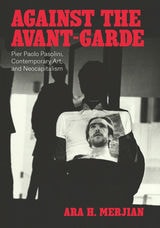
Against the Avant-Garde
Pier Paolo Pasolini, Contemporary Art, and NeocapitalismAra H. Merjian
University of Chicago Press, 2020
Recognized in America chiefly for his films, Pier Paolo Pasolini (1922–1975) in fact reinvented interdisciplinarity in postwar Europe. Pasolini self-confessedly approached the cinematic image through painting, and the numerous allusions to early modern frescoes and altarpieces in his films have been extensively documented. Far less understood, however, is Pasolini’s fraught relationship to the aesthetic experiments of his own age. In Against the Avant-Garde, Ara H. Merjian demonstrates how Pasolini’s campaign against neocapitalist culture fueled his hostility to the avant-garde. An atheist indebted to Catholic ritual; a revolutionary communist inimical to the creed of 1968; a homosexual hostile to the project of gay liberation: Pasolini refused the politics of identity in favor of a scandalously paradoxical practice, one vital to any understanding of his legacy. Against the Avant-Garde examines these paradoxes through case studies from the 1960s and 1970s, concluding with a reflection on Pasolini’s far-reaching influence on post-1970s art. Merjian not only reconsiders the multifaceted work of Italy’s most prominent postwar intellectual, but also the fraught politics of a European neo-avant-garde grappling with a new capitalist hegemony.
[more]
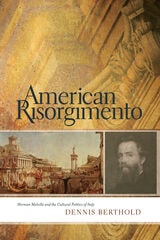
American Risorgimento
Herman Melville and the Cultural Politics of ItalyDennis Berthold
The Ohio State University Press, 2009
Although Herman Melville is typically considered one of America’s earliest cosmopolitan writers, scholarship has focused primarily on his involvement with the South Seas, England, and the Holy Land. In American Risorgimento: Herman Melville and the Cultural Politics of Italy, Dennis Berthold extends Melville’s transnational vision both geographically and historically by examining his many references to Italy and Rome in the context of the Risorgimento, Italy’s long quest for independence and political unity.
Melville’s contemporaries, notably Margaret Fuller and Henry T. Tuckerman, recognized the similarities between the Risorgimento and America’s struggle for national identity, and the influx of exiles from the failed Italian revolutions of 1820 and 1831 made Melville’s New York a hotbed of Risorgimento sympathies. Literary and political expostulations on Italy’s plight combined to create a distinctively American view of the Risorgimento that Melville elaborated in his fiction through allusions, characterizations, and direct commentary on Roman history, Dante, Machiavelli, Pope Pius IX, and Giuseppe Mazzini.
Melville followed the unfolding drama of Italian nationalism more closely than any other major American writer and found in it tropes and themes that fueled his turn to poetry, particularly after his visit to Italy in 1857. The Civil War, a crisis for American nationalism as urgent and profound as the Risorgimento, reinforced the symbolic parallels between the United States and Italy and led Melville to meditate on Giuseppe Garibaldi and other Italian patriots in one of his longest poems.
Melville’s literary appropriations of Italian history, art, and politics demonstrate that transnational cultural exchanges are not confined to later American writing but originate with the country’s earliest authors and their recognition that any national literature worthy of the name must incorporate a broad international frame of reference.
Dennis Berthold is professor of English at Texas A&M University, College Station.
[more]
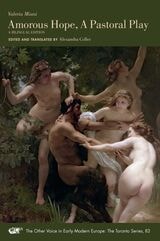
Amorous Hope, A Pastoral Play
A Bilingual EditionValeria Miani
Iter Press, 2020
A seventeenth-century play showing the reality of life for women.
Valeria Miani’s Amorous Hope is a play of remarkable richness, subtlety, and verve. It presents a scathing exposure of society’s double-standards and it champions women’s dramatic agency by centering on the bleak reality they often faced, a reality that attempted to harm and silence its victims. The play’s salient episodes reflect realities modern women still face today.
Miani’s literary achievements attest to her emergence as a cultural protagonist alongside Europe’s most talented women writers, such as Isabella Andreini, and she challenged the premodern notion that a woman’s eloquence is an indication of her sexual promiscuity.
[more]

An Essay on Negation
For a Linguistic AnthropologyPaolo Virno
Seagull Books, 2018
A vital addition to Seagull’s growing Italian List that focuses on leftist Italian thought, bringing famous as well as little-known yet crucial voices into the English language.
As speaking animals, we continuously make use of an unassuming grammatical particle, without suspecting that what is at work in its inconspicuousness is a powerful apparatus, which orchestrates language, signification, and the world at large. What particle might this be? The word not.
In Essay on Negation, Paolo Virno argues that the importance of the not is perhaps comparable only to that of money—that is, the universality of exchange. Negation is what separates verbal thought from silent cognitive operations, such as feelings and mental images. Speaking about what is not happening here and now, or about properties that are not referable to a given object, the human animal deactivates its original neuronal empathy, which is prelinguistic; it distances itself from the prescriptions of its own instinctual endowment and accesses a higher sociality, negotiated and unstable, which establishes the public sphere. In fact, the speaking animal soon learns that the negative statement does not amount to the linguistic double of unpleasant realities or destructive emotions: while it rejects them, negation also names them and thus includes them in social life. Virno sees negation as a crucial effect of civilization, one that is, however, also always exposed to further regressions. Taking his cue from a humble word, the author is capable of unfolding the unexpected phenomenology of the negating consciousness.
[more]
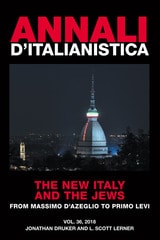
Annali d'Italianistica
The New Italy and the Jews from Massimo d'Azeglio to Primo Levidruker
Arizona Center for Medieval and Renaissance Studies, 2018
Founded in 1983, Annali d’italianistica has become synonymous with timely and fundamental scholarship on Italy’s literary culture, employing broad historical, cultural, and literary perspectives that are of interest to a wide variety of scholars. Published annually and monographic in nature, the journal uses as its point of departure the study of Italian literature and the Humanities more generally to foster scholarly excellence at all levels. Annali d’italianistica is receptive to a variety of topics, critical approaches, and theoretical perspectives that cross disciplinary boundaries and span several centuries, from the beginning of Italy’s cultural history to the present.
[more]
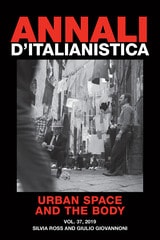
Annali d'italianistica
Urban Space and the BodyEdited by Silvia Ross and Giulio Giovannoni
Arizona Center for Medieval and Renaissance Studies, 2019
Founded in 1983, Annali d’Italianistica has become synonymous with timely and fundamental scholarship on Italy’s literary culture, employing broad historical, cultural, and literary perspectives that are of interest to a wide variety of scholars. Published annually and monographic in nature, the journal uses as its point of departure the study of Italian literature and the Humanities more generally to foster scholarly excellence at all levels. Annali d’Italianistica is receptive to a variety of topics, critical approaches, and theoretical perspectives that cross disciplinary boundaries and span several centuries, from the beginning of Italy’s cultural history to the present.
[more]
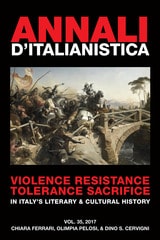
Annali d’Italianistica
Violence Resistance Tolerance Sacrifice in Italy's Literary & Cultural HistoryChiara Ferrari
Arizona Center for Medieval and Renaissance Studies, 2017
[more]
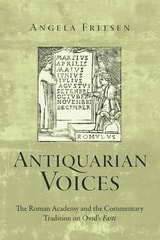
Antiquarian Voices
The Roman Academy and the Commentary Tradition on Ovid's FastiAngela Fritsen
The Ohio State University Press, 2015
Ovid’s Fasti, his poem on the Roman calendar, became especially influential during the fifteenth century as a guide to classical Roman culture. Ovid’s treatment of mythological and astronomical lore, his investigation of anniversaries and customs, and his charting of monuments and history offered humanist poets and intellectuals an abundance of material to unravel. They could identify with Ovid as vates operosus, or hard-working seer–poet, suggesting both researcher and inspired authority.
Angela Fritsen’s Antiquarian Voices:The Roman Academy and the Commentary Tradition on Ovid’s Fasti offers the first study of the Renaissance exegesis and imitation of Ovid as antiquarian. Fritsen analyzes the Fasti commentaries by Paolo Marsi (1440–1484) and Antonio Costanzi (1436–1490) as well as the connections between the two works. It situates Ovidian Fasti studies in the Roman Academy under the mentorship of Pomponio Leto. Nowhere could the investigation of the Fasti be carried out better than in Rome. The humanists had a guide to the City in Ovid. They also regarded the Fasti as well suited to the ideology of the ancient Roman imperium’s renewal in modern papal Rome.
Antiquarian Voices illustrates how in reviving the Fasti, the humanists returned Rome to its original splendor. The book demonstrates that the humanists were eager to relate the Fasti to their antiquarian pursuits—as well as to their rising personal fame.
[more]

Antisatire
In Defense of Women, against Francesco BuoninsegniArcangela Tarabotti
Iter Press, 2020
Arcangela Tarabotti (1604–1652), Venetian nun and polemicist, was known for her protest against forced monachization and her advocacy for the education of women and their participation in public life. She responded to Francesco Buoninsegni’s Against the Vanities of Women (1638) with the Antisatire (1644), a defense of women’s fashions and a denunciation of men, but also a strong condemnation of men’s treatment of women and of the subordination of women in society. Both Buoninsegni and Tarabotti write with the exaggeration and absurd arguments typical of Menippean satire; they flaunt their knowledge of ancient and contemporary literature in a prose interspersed with poetry and replete with the astonishing Baroque conceits that delighted their contemporaries.
The Other Voice in Early Modern Women: The Toronto Series volume 70
The Other Voice in Early Modern Women: The Toronto Series volume 70
[more]

Arms and the Woman
Classical Tradition and Women Writers in the Venetian RenaissanceFrancesca D'Alessandro Behr
The Ohio State University Press, 2018
Arms and the Woman: Classical Tradition and Women Writers in the Venetian Renaissance by Francesca D’Alessandro Behr focuses on the classical reception in the works of female authors active in Venice during the Early Modern Age. Even in this relatively liberal city, women had restricted access to education and were subject to deep-seated cultural prejudices, but those who read and wrote were able, in part, to overcome those limitations.
In this study, Behr explores the work of Moderata Fonte and Lucrezia Marinella and demonstrates how they used knowledge of texts by Virgil, Ovid, and Aristotle to systematically reanalyze the biased patterns apparent both in the romance epic genre and contemporary society. Whereas these classical texts were normally used to bolster the belief in female inferiority and the status quo, Fonte and Marinella used them to envision societies structured according to new, egalitarian ethics. Reflecting on the humanist representation of virtue, Fonte and Marinella insisted on the importance of peace, mercy, and education for women. These authors took up the theme of the equality of genders and participated in the Renaissance querelle des femmes, promoting women’s capabilities and nature.
[more]