Results by title

11 books match the query 'Italian Renaissance'
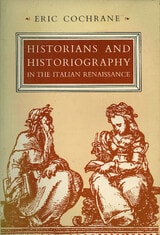
cover of Historians and Historiography in the Italian Renaissance

Historians and Historiography in the Italian Renaissance

Eric Cochrane

University of Chicago Press, 1981

Second edition. A comprehensive survey of historical literature produced in Italy during the Renaissance; a major contribution which discusses hundreds of authors who wrote in Latin or Italian in all parts of Italy during the fifteenth and sixteenth centuries. 
[more]
cover of I Tatti Studies in the Italian Renaissance, volume 24 number 1 (Spring 2021)

I Tatti Studies in the Italian Renaissance, volume 24 number 1 (Spring 2021)

The University of Chicago Press

University of Chicago Press Journals, 2021
[more]
cover of I Tatti Studies in the Italian Renaissance, volume 24 number 2 (Fall 2021)

I Tatti Studies in the Italian Renaissance, volume 24 number 2 (Fall 2021)

The University of Chicago Press

University of Chicago Press Journals, 2021
This is volume 24 issue 2 of I Tatti Studies in the Italian Renaissance. Published twice a year, I Tatti Studies in the Italian Renaissance features groundbreaking work written in Italian and in English on every aspect of the literary, religious, artistic, historical, and scientific dimensions of Renaissance Italy. Articles offer pioneering work in a number of areas, ranging from Botticelli’s illustrations for Dante’s Commedia to Florentine sermons on the Dives and Lazarus story to images of Ottoman culture in Mantua. The journal regularly publishes clusters of essays and other special sections.
[more]
cover of I Tatti Studies in the Italian Renaissance, volume 25 number 1 (Spring 2022)

I Tatti Studies in the Italian Renaissance, volume 25 number 1 (Spring 2022)

The University of Chicago Press

University of Chicago Press Journals, 2022
This is volume 25 issue 1 of I Tatti Studies in the Italian Renaissance. Published twice a year, I Tatti Studies in the Italian Renaissance features groundbreaking work written in Italian and in English on every aspect of the literary, religious, artistic, historical, and scientific dimensions of Renaissance Italy. Articles offer pioneering work in a number of areas, ranging from Botticelli’s illustrations for Dante’s Commedia to Florentine sermons on the Dives and Lazarus story to images of Ottoman culture in Mantua. The journal regularly publishes clusters of essays and other special sections.
[more]
cover of I Tatti Studies in the Italian Renaissance, volume 25 number 2 (Fall 2022)

I Tatti Studies in the Italian Renaissance, volume 25 number 2 (Fall 2022)

The University of Chicago Press

University of Chicago Press Journals, 2022
This is volume 25 issue 2 of I Tatti Studies in the Italian Renaissance. Published twice a year, I Tatti Studies in the Italian Renaissance features groundbreaking work written in Italian and in English on every aspect of the literary, religious, artistic, historical, and scientific dimensions of Renaissance Italy. Articles offer pioneering work in a number of areas, ranging from Botticelli’s illustrations for Dante’s Commedia to Florentine sermons on the Dives and Lazarus story to images of Ottoman culture in Mantua. The journal regularly publishes clusters of essays and other special sections.
[more]
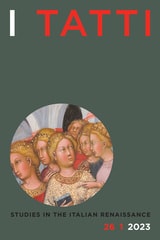
cover of I Tatti Studies in the Italian Renaissance, volume 26 number 1 (Spring 2023)

I Tatti Studies in the Italian Renaissance, volume 26 number 1 (Spring 2023)

The University of Chicago Press

University of Chicago Press Journals, 2023
This is volume 26 issue 1 of I Tatti Studies in the Italian Renaissance. Published twice a year, I Tatti Studies in the Italian Renaissance features groundbreaking work written in Italian and in English on every aspect of the literary, religious, artistic, historical, and scientific dimensions of Renaissance Italy. Articles offer pioneering work in a number of areas, ranging from Botticelli’s illustrations for Dante’s Commedia to Florentine sermons on the Dives and Lazarus story to images of Ottoman culture in Mantua. The journal regularly publishes clusters of essays and other special sections.
[more]
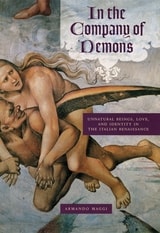
cover of In the Company of Demons: Unnatural Beings, Love, and Identity in the Italian Renaissance

In the Company of Demons

Unnatural Beings, Love, and Identity in the Italian Renaissance

Armando Maggi

University of Chicago Press, 2006

Who are the familiar spirits of classical culture and what is their relationship to Christian demons? In its interpretation of Latin and Greek culture, Christianity contends that Satan is behind all classical deities, semi-gods, and spiritual creatures, including the gods of the household, the lares and penates.But with In the Company of Demons, the world’s leading demonologist Armando Maggi argues that the great thinkers of the Italian Renaissance had a more nuanced and perhaps less sinister interpretation of these creatures or spiritual bodies.

Maggi leads us straight to the heart of what Italian Renaissance culture thought familiar spirits were. Through close readings of Giovan Francesco Pico della Mirandola, Strozzi Cigogna, Pompeo della Barba, Ludovico Sinistrari, and others, we find that these spirits or demons speak through their sudden and striking appearances—their very bodies seen as metaphors to be interpreted. The form of the body, Maggi explains, relies on the spirits’ knowledge of their human interlocutors’ pasts. But their core trait is compassion, and sometimes their odd, eerie arrivals are seen as harbingers or warnings to protect us. It comes as no surprise then that when spiritual beings distort the natural world to communicate, it is vital that we begin to listen.
[more]
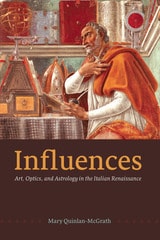
cover of Influences: Art, Optics, and Astrology in the Italian Renaissance

Influences

Art, Optics, and Astrology in the Italian Renaissance

Mary Quinlan-McGrath

University of Chicago Press, 2013
Today few would think of astronomy and astrology as fields related to theology. Fewer still would know that physically absorbing planetary rays was once considered to have medical and psychological effects. But this was the understanding of light radiation held by certain natural philosophers of early modern Europe, and that, argues Mary Quinlan-McGrath, was why educated people of the Renaissance commissioned artworks centered on astrological themes and practices.
 
Influences is the first book to reveal how important Renaissance artworks were designed to be not only beautiful but also—perhaps even primarily—functional. From the fresco cycles at Caprarola, to the Vatican’s Sala dei Pontefici, to the Villa Farnesina, these great works were commissioned to selectively capture and then transmit celestial radiation, influencing the bodies and minds of their audiences. Quinlan-McGrath examines the sophisticated logic behind these theories and practices and, along the way, sheds light on early creation theory; the relationship between astrology and natural theology; and the protochemistry, physics, and mathematics of rays.
 
An original and intellectually stimulating study, Influences adds a new dimension to the understanding of aesthetics among Renaissance patrons and a new meaning to the seductive powers of art.  
[more]
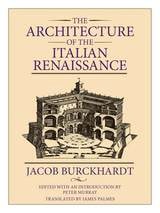
cover of The Architecture of the Italian Renaissance

The Architecture of the Italian Renaissance

Jacob Burckhardt

University of Chicago Press, 1984
"There may not be any book on architecture so delightful to dip into; one wishes there were a pocket edition to take on an Italian vacation—not only for its information and vision but for such pleasant reminders as that the citizens of Treviso carried Tullio Lombardo's friezes through the town in triumph before they were attached to a building."—D. J. R. Bruckner, New York Times Book Review
[more]
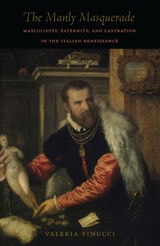
cover of The Manly Masquerade: Masculinity, Paternity, and Castration in the Italian Renaissance

The Manly Masquerade

Masculinity, Paternity, and Castration in the Italian Renaissance

Valeria Finucci

Duke University Press, 2003

The Manly Masquerade unravels the complex ways men were defined as men in Renaissance Italy through readings of a vast array of sixteenth- and seventeenth-century evidence: medical and travel literature; theology; law; myth; conduct books; and plays, chivalric romances, and novellas by authors including Machiavelli, Tasso, and Ariosto. Valeria Finucci shows how ideas of masculinity were formed in the midst of acute anxiety about paternity by highlighting the beliefs—widely held at the time—that conception could occur without a paternal imprimatur or through a woman’s encounter with an animal, or even that a pregnant woman’s imagination could erase the father’s "signature" from the fetus. Against these visions of reproduction gone awry, Finucci looks at how concepts of masculinity were tied to issues of paternity through social standing, legal matters, and inheritance practices.

Highlighting the fissures running through Italian Renaissance ideas of manliness, Finucci describes how, alongside pervasive images of the virile, sexually active man, early modern Italian culture recognized the existence of hermaphrodites and started to experiment with a new kind of sexuality by manufacturing a non-man: the castrato. Following the creation of castrati, the Church forbade the marriage of all non-procreative men, and, in this move, Finucci identifies a powerful legitimation of the view that what makes men is not the possession of male organs or the ability to have sex, but the capability to father. Through analysis, anecdote, and rich cultural description, The Manly Masquerade exposes the "real" early modern man: the paterfamilias.
[more]
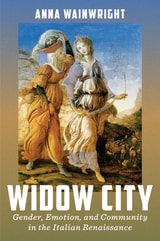
cover of Widow City: Gender, Emotion, and Community in the Italian Renaissance

Widow City

Gender, Emotion, and Community in the Italian Renaissance

Anna Wainwright

University of Delaware Press, 2025

Widow City: Gender, Emotion, and Community in the Italian Renaissance investigates the ever-evolving role of the widow in medieval and early modern Italian literature, from canonical authors such as Dante, Petrarch, and Boccaccio, to the numerous widowed writers who rose to prominence in the sixteenth century—including Vittoria Colonna, Veronica Gambara, and Francesca Turina—and radically changed the conversation on public mourning. Engaging with broader intellectual discussions around gender, the history of emotions, the politics of mourning, and the construction of community, Widow City argues that widows served as key models demonstrating to readers not just how to mourn, but how to live well after devastating loss. At the same time, widows were figures of great anxiety: their status as unattached women, and the public performance of their grief, were viewed as very real threats to the stability of the social order. They are thus key to broader intellectual understandings of community and civic life in the Italian Middle Ages and Renaissance.
[more]