Results by title
6 books match the query 'Italy, Southern'
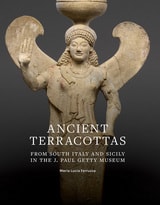
Ancient Terracottas from South Italy and Sicily in the J. Paul Getty Museum
Maria Lucia Ferruzza
J. Paul Getty Trust, The, 2016
Reflecting the Getty's commitment to open content, Ancient Terracottas from South Italy and Sicily in the J. Paul Getty Museum is available online at www.getty.edu/publications/terracottas and may be downloaded for free.
Global Tarantella
Reinventing Southern Italian Folk Music and DancesIncoronata Inserra
University of Illinois Press, 2017

Magic
A Theory from the SouthErnesto de Martino
HAU, 2015
Though his work was little known outside Italian intellectual circles for most of the twentieth century, anthropologist and historian of religions Ernesto de Martino is now recognized as one of the most original thinkers in the field. This book is testament to de Martino’s innovation and engagement with Hegelian historicism and phenomenology—a work of ethnographic theory way ahead of its time.
This new translation of Sud e Magia, his 1959 study of ceremonial magic and witchcraft in southern Italy, shows how De Martino is not interested in the question of whether magic is rational or irrational but rather in why it came to be perceived as a problem of knowledge in the first place. Setting his exploration within his wider, pathbreaking theorization of ritual, as well as in the context of his politically sensitive analysis of the global south’s historical encounters with Western science, he presents the development of magic and ritual in Enlightenment Naples as a paradigmatic example of the complex dynamics between dominant and subaltern cultures. Far ahead of its time, Magic is still relevant as anthropologists continue to wrestle with modernity’s relationship with magical thinking.
The Divine Spark of Syracuse
Ingrid D. Rowland
Brandeis University Press, 2018
The Real Life of the Parthenon
Patricia Vigderman
The Ohio State University Press, 2018
Ownership battles over the marbles removed from the Parthenon by Lord Elgin have been rumbling into invective, pleading, and counterclaims for two centuries. The emotional temperature around them is high, and steering across the vast past to safe anchor in a brilliant heritage is tricky. The stories around antiquities become distorted by the pull of ownership, and it is these stories that urge Patricia Vigderman into her own exploration of their inspiring legacy in her compelling extended essay, The Real Life of the Parthenon.
Vigderman’s own journey began at the Parthenon, but curiosity edged her further onto the sea between antiquity and the present. She set out to seek the broken temples and amphorae, the mysterious smiles of archaic sculpture, and the finely hammered gold of a funeral wreath among the jumbled streets of modern Athens, the fertile fields of Sicily, the mozzarella buffalo of Paestum. Guided along the way toward the enduring landscapes and fractured history by archeologists, classicists, historians, and artists—and by the desire they inspire—she was caught by ongoing, contemporary local life among the ruins. Gathering present meaning and resonance for the once and future remains of vanished glory, The Real Life of the Parthenon illuminates an important but shadowy element of our common cultural life: the living dynamic between loss and delight.
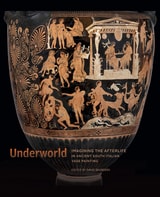
Underworld
Imagining the Afterlife in Ancient South Italian Vase PaintingDavid Saunders
J. Paul Getty Trust, The, 2022
What happens to us when we die? What might the afterlife look like? For the ancient Greeks, the dead lived on, overseen by Hades in the Underworld. We read of famous sinners, such as Sisyphus, forever rolling his rock, and the fierce guard dog Kerberos, who was captured by Herakles. For mere mortals, ritual and religion offered possibilities for ensuring a happy existence in the beyond, and some of the richest evidence for beliefs about death comes from southern Italy, where the local Italic peoples engaged with Greek beliefs. Monumental funerary vases that accompanied the deceased were decorated with consolatory scenes from myth, and around forty preserve elaborate depictions of Hades’s domain.
For the first time in over four decades, these compelling vase paintings are brought together in one volume, with detailed commentaries and ample illustrations. The catalogue is accompanied by a series of essays by leading experts in the field, which provides a framework for understanding these intriguing scenes and their contexts. Topics include attitudes toward the afterlife in Greek ritual and myth, inscriptions on leaves of gold that provided guidance for the deceased, funerary practices and religious beliefs in Apulia, and the importance accorded to Orpheus and Dionysos. Drawing from a variety of textual and archaeological sources, this volume is an essential source for anyone interested in religion and belief in the ancient Mediterranean.