Results by title
4 books match the query 'Itineraries'
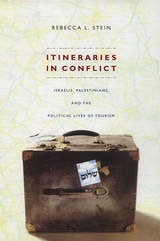
Itineraries in Conflict
Israelis, Palestinians, and the Political Lives of TourismRebecca L. Stein
Duke University Press, 2008
Combining vivid ethnographic detail, postcolonial theory, and readings of Israeli and Palestinian popular texts, Stein considers a broad range of Israeli leisure cultures of the Oslo period with a focus on the Jewish desires for Arab things, landscapes, and people that regional diplomacy catalyzed. Moving beyond conventional accounts, she situates tourism within a broader field of “discrepant mobility,” foregrounding the relationship between histories of mobility and immobility, leisure and exile, consumption and militarism. She contends that the study of Israeli tourism must open into broader interrogations of the Israeli occupation, the history of Palestinian dispossession, and Israel’s future in the Arab Middle East. Itineraries in Conflict is both a cultural history of the Oslo process and a call to fellow scholars to rethink the contours of the Arab-Israeli conflict by considering the politics of popular culture in everyday Israeli and Palestinian lives.
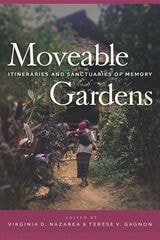
Moveable Gardens
Itineraries and Sanctuaries of MemoryEdited by Virginia D. Nazarea and Terese V. Gagnon
University of Arizona Press, 2021
Moveable Gardens highlights itineraries and sanctuaries in an era of massive dislocation, addressing concerns about finding comforting and familiar refuges in the Anthropocene. The worlds of marginalized individuals who live in impoverished rural communities, many Indigenous peoples, and refugees are constantly under threat of fracturing. Yet, in every case, there is resilience and regeneration as these individuals re-create their worlds through the foods, traditions, and plants they carry with them into their new realities.
This volume offers a new understanding of the performances and routines of sociality in the face of daunting market forces and perilous climate transformations. These traditions sustained our ancestors, and they may suffice to secure a more meaningful, diverse future. By delving into the nature of nostalgia, burrowing into memory and knowledge, and embracing the specific wonders of each deeply rooted or newly displaced community, endlessly valuable ways of being and understanding can be preserved.
Contributors: Guntra A. Aistara, Aida Curtis, Terese V. Gagnon, John Hartigan Jr., Tracey Heatherington, Taylor Hosmer, Hayden S. Kantor, Melanie Narciso, Virginia D. Nazarea, Emily F. Ramsey, Krishnendu Ray, David Sutton, James R. Veteto, Marc N. Williams
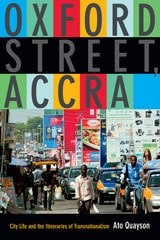
Oxford Street, Accra
City Life and the Itineraries of TransnationalismAto Quayson
Duke University Press, 2014
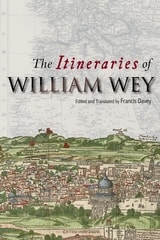
The Itineraries of William Wey
Translated and Edited by Francis Davey
Bodleian Library Publishing, 2010
In 1456 and again in 1458, William Wey (1405/6–76) set out on journeys across a Europe in turmoil from local conflicts and cross-border expansions. Wey, a Devon priest and bursar of Eton College, had been granted special dispensation by Henry VI to undertake pilgrimages, and he was prompted by his friends to write an account of his itinerant adventures. He collected his stories from his travels to the Cathedral of Santiago de Compostela in Spain and later Jerusalem in the fifteen chapters that comprise The Itineraries.
The Itineraries contains practical travel advice for the period on conduct and currency, alongside comparative English, Latin, Greek and Hebrew vocabularies, in addition to a remarkable scrapbook compendium of places, roads, and distances. Originally written in English and Latin, Wey’s fascinating observations of a changing Europe are for for first time available in a modern English edition. The pilgrimage was an idea essential to medieval and early modern Christianity, and Wey’s work adds a new dimension to our understanding of its importance and practice. Wey is at once adventurous and highly observant, and The Itineraries will be of interest to scholars of early modern history and armchair pilgrims alike.