Results by title

5 books match the query 'Its Enemies'
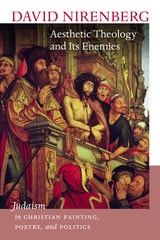
cover of Aesthetic Theology and Its Enemies: Judaism in Christian Painting, Poetry, and Politics

Aesthetic Theology and Its Enemies

Judaism in Christian Painting, Poetry, and Politics

David Nirenberg

Brandeis University Press, 2015
Through most of Western European history, Jews have been a numerically tiny or entirely absent minority, but across that history Europeans have nonetheless worried a great deal about Judaism. Why should that be so? This short but powerfully argued book suggests that Christian anxieties about their own transcendent ideals made Judaism an important tool for Christianity, as an apocalyptic religion—characterized by prizing soul over flesh, the spiritual over the literal, the heavenly over the physical world—came to terms with the inescapable importance of body, language, and material things in this world. Nirenberg shows how turning the Jew into a personification of worldly over spiritual concerns, surface over inner meaning, allowed cultures inclined toward transcendence to understand even their most materialistic practices as spiritual. Focusing on art, poetry, and politics—three activities especially condemned as worldly in early Christian culture—he reveals how, over the past two thousand years, these activities nevertheless expanded the potential for their own existence within Christian culture because they were used to represent Judaism. Nirenberg draws on an astonishingly diverse collection of poets, painters, preachers, philosophers, and politicians to reconstruct the roles played by representations of Jewish “enemies” in the creation of Western art, culture, and politics, from the ancient world to the present day. This erudite and tightly argued survey of the ways in which Christian cultures have created themselves by thinking about Judaism will appeal to the broadest range of scholars of religion, art, literature, political theory, media theory, and the history of Western civilization more generally.
[more]
cover of Dynamism and Its Enemies: Proceedings from the 2024 Austin Symposium

Dynamism and Its Enemies

Proceedings from the 2024 Austin Symposium

Edited by Ryan Streeter

University of Texas Press, 2025

Papers presented and discussed at the inaugural Civitas symposium on economic dynamism.

If we want more people in more places building and creating more good things, what should we do? This volume, edited by Ryan Streeter, presents perspectives on key issues of economic and societal dynamism by Ryan Decker (Federal Reserve), Ed Glaeser (Harvard University), Deirdre McCloskey (University of Illinois at Chicago), Edmund Phelps (Columbia University), Dan Shoag (Case Western Reserve University), and Cass Sunstein (Harvard Law School).

The chapters in Dynamism and Its Enemies began as presentations at the 2024 Austin Symposium, a one-day seminar on dynamism in America hosted by the Civitas Institute at the University of Texas at Austin. This first annual event, held in one of America’s most dynamic cities, was designed to bring various leading scholars of dynamism’s various aspects into one place in order to think together about how to foster a more dynamic future.

[more]
cover of Secret Power: WikiLeaks and Its Enemies

Secret Power

WikiLeaks and Its Enemies

Stefania Maurizi

Pluto Press, 2022

An uncovering of the terrifying depths of authoritarian power that hide behind the infamous story of WikiLeaks

*Winner of the European Award for Investigative And Judicial Journalism 2021*
*Winner of the Premio Alessandro Leogrande Award for Investigative Journalism 2022*
*Winner of the Premio Angelo Vassallo Award 2022*

'I want to live in a society where secret power is accountable to the law and to public opinion for its atrocities, where it is the war criminals who go to jail, not those who have the conscience and courage to expose them.'

It is 2008, and Stefania Maurizi, an investigative journalist with a growing interest in cryptography, starts looking into the little-known organisation WikiLeaks. Through hushed meetings, encrypted files and explosive documents, what she discovers sets her on a life-long journey that takes her deep into the realm of secret power.

Working closely with WikiLeaks' founder Julian Assange and his organisation for her newspaper, Maurizi has spent over a decade investigating state criminality protected by thick layers of secrecy, while also embarking on a solitary trench warfare to unearth the facts underpinning the cruel persecution of Assange and WikiLeaks.

With complex and disturbing insights, Maurizi’s tireless journalism exposes atrocities, the shameful treatment of Chelsea Manning and Edward Snowden, on up to the present persecution of WikiLeaks: a terrifying web of impunity and cover-ups.

At the heart of the book is the brutality of secret power and the unbearable price paid by Julian Assange, WikiLeaks and truthtellers.
[more]
cover of Sociability and Its Enemies: German Political Theory After 1945

Sociability and Its Enemies

German Political Theory After 1945

Jakob Norberg

Northwestern University Press, 2014
Sociability and Its Enemies contributes both to contemporary studies of political theory and to discourse on postwar Germany by reconstructing the arguments concerning the nature and value of sociability as a form of interaction and interconnection particular to modern bourgeois society. Jakob Norberg argues that the writings of Hannah Arendt, Jürgen Habermas, Carl Schmitt, and the historian Reinhart Koselleck present conflicting responses to a hitherto neglected question or point of contention: whether bourgeois sociability should serve as a therapeutic practice and politically relevant ideal for postwar Germany. The book sheds light on previously neglected historical and conceptual connections among political theorists, and it enriches established narratives of postwar intellectual history.
[more]
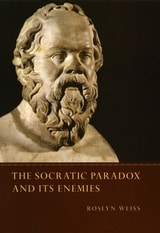
cover of The Socratic Paradox and Its Enemies

The Socratic Paradox and Its Enemies

Roslyn Weiss

University of Chicago Press, 2006

In The Socratic Paradox and Its Enemies, Roslyn Weiss argues that the Socratic paradoxes—no one does wrong willingly, virtue is knowledge, and all the virtues are one—are best understood as Socrates’ way of combating sophistic views: that no one is willingly just, those who are just and temperate are ignorant fools, and only some virtues (courage and wisdom) but not others (justice, temperance, and piety) are marks of true excellence.  
         
In Weiss’s view, the paradoxes express Socrates’ belief that wrongdoing fails to yield the happiness that all people want; it is therefore the unjust and immoderate who are the fools. The paradoxes thus emerge as Socrates’ means of championing the cause of justice in the face of those who would impugn it. Her fresh approach—ranging over six of Plato’s dialogues—is sure to spark debate in philosophy, classics, and political theory.
           
 “Regardless of whether one agrees or disagrees with Weiss, it would be hard not to admire her extraordinarily penetrating analysis of the many overlapping and interweaving arguments running through the dialogues.”—Daniel B. Gallagher, Classical Outlook
 
“Many scholars of Socratic philosophy . . . will wish they had written Weiss's book, or at least will wish that they had long ago read it.”—Douglas V. Henry, Review of Politics
[more]