Results by title
4 books match the query 'Its Legacies'
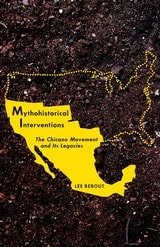
Mythohistorical Interventions
The Chicano Movement and Its LegaciesLee Bebout
University of Minnesota Press, 2010
Mythohistorical Interventions explores how myth and history impacted the social struggle of the Chicano movement and the postmovement years. Drawing on archival materials and political speeches as well as music and protest poetry, Lee Bebout scrutinizes the ideas that emerged from the effort to organize and legitimize the Chicano movement’s aims.
Examining the deployment of the Aztec eagle by the United Farm Workers union, the poem Yo Soy Joaquín, the document El Plan de Santa Barbara, and icons like La Malinche and La Virgen de Guadalupe, Bebout reveals the centrality of culture to the Chicano movement. For Bebout, the active implementation of cultural narrative was strategically significant in several ways. First, it allowed disparate movement participants to imagine themselves as part of a national, and nationalist, community of resistance. Second, Chicano use of these narratives contested the images that fostered Anglo-American hegemony.
Bringing his analysis up to the present, Bebout delineates how demographic changes have, on the one hand, encouraged the possibility of a panethnic Latino community, while, on the other hand, anti-Mexican nativists attempt to resurrect Chicano myths as a foil to restrict immigration from Mexico.
[more]

Nazi-Looted Art and Its Legacies
Andreas Huyssen, Anson Rabinbach, and Avinoam Shalem, special issue editors
Duke University Press, 2017
This issue examines the legacy of Nazi-looted art in light of the 2012 discovery of the famous Hildebrand Gurlitt collection of stolen artwork in Germany. When the German government declassified the case almost two years later, the resulting scandal raised fundamental questions about the role of art dealers in the Third Reich, the mechanics of the Nazi black market for artwork, the shortcomings of postwar denazification, the failure of courts and governments to adjudicate stolen artwork claims, and the unwillingness of museums to determine the provenance of thousands of looted pieces of art. The contributors to this issue explore the continuities of art dealerships and auction houses from the Nazi period to the Federal Republic and take stock of the present political and cultural debate over the handling of this artwork.
Special topic contributors. Konstantin Akinsha, Meike Hoffmann, Andreas Huyssen, Lawrence M. Kaye, Olaf Peters, Jonathan Petropoulos, Anson Rabinbach, Avinoam Shalem, Julia Voss, Amy Walsh
Special topic contributors. Konstantin Akinsha, Meike Hoffmann, Andreas Huyssen, Lawrence M. Kaye, Olaf Peters, Jonathan Petropoulos, Anson Rabinbach, Avinoam Shalem, Julia Voss, Amy Walsh
[more]
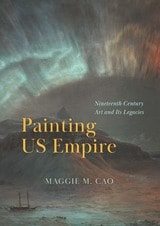
Painting US Empire
Nineteenth-Century Art and Its LegaciesMaggie M. Cao
University of Chicago Press, 2024
A fresh look at the global dimensions of US painting from the 1850s to 1898.
Painting US Empire is the first book to offer a synthetic account of art and US imperialism around the globe in the nineteenth century. In this work, art historian Maggie M. Cao crafts a nuanced portrait of nineteenth-century US painters’ complicity with and resistance to ascendant US imperialism, offering eye-opening readings of canonical works, landscapes of polar expeditions and tropical tourism, still lifes of imported goods, genre paintings, and ethnographic portraiture. Revealing how the US empire was “hidden in plain sight” in the art of this period, Cao examines artists including Frederic Edwin Church and Winslow Homer who championed and expressed ambivalence toward the colonial project. She also tackles the legacy of US imperialism, examining Euro-American painters of the past alongside global artists of the present. Pairing each chapter with reflections on works by contemporary anticolonial artists including Tavares Strachan, Nicholas Galanin, and Yuki Kihara, Cao addresses important contemporary questions around representation, colonialism, and indigeneity. This book foregrounds an underacknowledged topic in the study of nineteenth-century US art and illuminates the ongoing ecological and economic effects of the US empire.
Painting US Empire is the first book to offer a synthetic account of art and US imperialism around the globe in the nineteenth century. In this work, art historian Maggie M. Cao crafts a nuanced portrait of nineteenth-century US painters’ complicity with and resistance to ascendant US imperialism, offering eye-opening readings of canonical works, landscapes of polar expeditions and tropical tourism, still lifes of imported goods, genre paintings, and ethnographic portraiture. Revealing how the US empire was “hidden in plain sight” in the art of this period, Cao examines artists including Frederic Edwin Church and Winslow Homer who championed and expressed ambivalence toward the colonial project. She also tackles the legacy of US imperialism, examining Euro-American painters of the past alongside global artists of the present. Pairing each chapter with reflections on works by contemporary anticolonial artists including Tavares Strachan, Nicholas Galanin, and Yuki Kihara, Cao addresses important contemporary questions around representation, colonialism, and indigeneity. This book foregrounds an underacknowledged topic in the study of nineteenth-century US art and illuminates the ongoing ecological and economic effects of the US empire.
[more]

The Lausanne Moment
Reckoning with the 1923 Treaty of Peace and Its LegaciesEdited by Ozan Ozavci, Julia Secklehner, and Georgios Giannakopoulos
Gingko, 2027
Addresses the shifting interpretations of the Treaty of Lausanne across national contexts, tracing how its provisions have been legally, socially, and politically reimagined.
The 1923 Treaty of Lausanne remains one of the few interwar peace settlements that has endured into the twenty-first century. Yet, the memory of Lausanne has proved deeply contested. Celebrated by some as a triumph of state sovereignty and peacemaking, it has also come to symbolize forced displacement, the erasure of minority rights, and the codification of population transfers as instruments of international order.
Just over one hundred years after the signing of the Treaty of Lausanne, The Lausanne Moment revisits this diplomatic, legal, economic, and financial juncture that helped reshape the world and defined new norms of sovereignty, displacement, and identity. Building on a growing body of interdisciplinary scholarship and serving as a sequel to They All Made Peace—What is Peace?, also published by Gingko, this edited volume foregrounds the lived realities and long-term legacies of the treaty, critically re-examining the political, cultural, and social consequences of its provisions and aftershocks.
Rather than focusing solely on high diplomacy or legal text, The Lausanne Moment brings into view the human dimension of the Lausanne moment. Through case studies ranging from the refugee experience in Nikaia and Asia Minor orphans in Greece, to the enduring memory of loss in Pontic singing, the symbolic ethnicity of Cretan descendants, and the Kurdish experience in Turkey, the book documents the deeply personal and community-level consequences of forced migration and political rupture. These experiences are not confined to the immediate postwar period; they linger across time, informing the present-day politics of memory, migration, and identity.
This volume also interrogates the geopolitics of Lausanne through new thematic lenses. Essays explore how the treaty facilitated the continuation of imperial practices under new nationalist forms, shaped debates over public debt and cultural heritage, and affected actors and regions often overlooked in Lausanne historiography, such as Albania, Cyprus, and the Kurdish nationalist movements. Lausanne’s cultural afterlives, from its role in shaping archaeology, music, and education policy, are also covered in the book. Through its interdisciplinary and transregional approach, The Lausanne Moment breaks new ground in Lausanne studies, bringing together historians, anthropologists, archaeologists, political scientists, and cultural theorists, and introduces voices and perspectives—Kurdish, Cypriot, Pontic, Albanian, and Cretan—that have been marginal to mainstream narratives. By weaving together policy analysis, oral history, cultural production, and historical research, the volume offers an expansive and textured account of one of the twentieth century’s most consequential, yet paradoxical, peace settlements.
The Lausanne Moment situates the treaty within broader histories of state-led population engineering, colonial eugenic practices, and the moral politics of international humanitarianism. The “peace” of Lausanne, the volume suggests, was neither absolute nor apolitical—it was crafted, contested, and constantly renegotiated. The book’s contributors collectively ask not only what peace meant in 1923, but also what it means today for those still living with its consequences.
[more]