Results by title
7 books match the query 'Its Legacy'
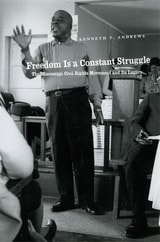
Freedom Is a Constant Struggle
The Mississippi Civil Rights Movement and Its LegacyKenneth T. Andrews
University of Chicago Press, 2004
Freedom Is a Constant Struggle is also the first book of its kind to detail the activities of white supremacists in Mississippi, revealing how white repression and intimidation sparked black activism and simultaneously undermined the movement's ability to achieve far-reaching goals. Andrews shows that the federal government's role was important but reactive as federal actors responded to the sustained struggles between local movements and their opponents. He tracks the mobilization of black activists by the NAACP, the creation of Freedom Summer, efforts to galvanize black voters, the momentous desegregation of public schools and the rise of all-white private academies, and struggles over the economic development of black communities. From this complex history, Andrews shows how the civil rights movement built innovative organizations and campaigns that empowered local leadership and had a lasting legacy in Mississippi and beyond.
Based on an original and creative research design that combines extensive archival research, interviews with activists, and quantitative historical data, Freedom Is a Constant Struggle provides many new insights into the civil rights struggle, and it presents a much broader theory to explain whether and how movements have enduring impacts on politics and society. What results is a work that will be invaluable to students of social movements, democratic politics, and the struggle for racial freedom in the U.S.
Imperialist Imagination
German Colonialism and Its LegacySara Friedrichsmeyer, Sara Lennox, and Susanne Zantop, Editors
University of Michigan Press, 1998
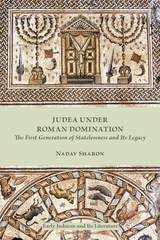
Judea under Roman Domination
The First Generation of Statelessness and Its LegacyNadav Sharon
SBL Press, 2017
Investigate a relatively neglected but momentous period in Judean history
Nadav Sharon closely examines a critical period in Judean history, which saw the end of the Hasmonean dynasty and the beginning of Roman domination of Judea leading up to the kingship of Herod (67-37 BCE). In this period renowned Roman figures such as Pompey the Great, Julius Caesar, Gaius Cassius (a conspirator against Caesar), and Mark Anthony, led the Roman Republic on the eve of its transformation into an Empire, each having his own dealings with—and holding sway over—Judea at different times. This volume explores the impact of the Roman conquest on the authors of the Dead Sea Scrolls, enhances the understanding of later Judean-Roman relations and the roots of the Great Revolt, and examines how this early period of Roman domination had on impact on later developments in Judean society and religion.
Features:
- Part one dedicating to reconstructing Judean history from the death of Alexander to the reign of King Herod
- Part two examining the effects of Roman domination on Judean society
- Maps, illustrations, and appendices
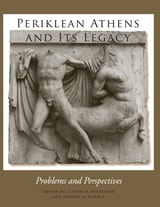
Periklean Athens and Its Legacy
Problems and PerspectivesEdited by Judith M. Barringer and Jeffrey M. Hurwit
University of Texas Press, 2005
The late fifth century BC was the golden age of ancient Athens. Under the leadership of the renowned soldier-statesman Perikles, Athenians began rebuilding the Akropolis, where they created the still awe-inspiring Parthenon. Athenians also reached a zenith of artistic achievement in sculpture, vase painting, and architecture, which provided continuing inspiration for many succeeding generations.
The specially commissioned essays in this volume offer a fresh, innovative panorama of the art, architecture, history, culture, and influence of Periklean Athens. Written by leading experts in the field, the articles cover a wide range of topics, including:
- An evaluation of Perikles' military leadership during the early stages of the Peloponnesian War.
- Iconographical and iconological studies of vase paintings, wall paintings, and sculpture.
- Explorations of the Parthenon and other monuments of the Athenian Akropolis.
- The legacy of Periklean Athens and its influence upon later art.
- Assessments of the modern reception of the Akropolis.
As a whole, this collection of essays proves that even a well-explored field such as Periklean Athens can yield new treasures when mined by perceptive and seasoned investigators.
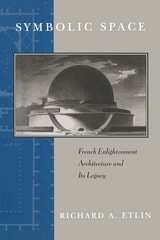
Symbolic Space
French Enlightenment Architecture and Its LegacyRichard A. Etlin
University of Chicago Press, 1994
For Etlin, the eighteenth-century city was a place in which actual physical space was subjected to a complex mental layering of conceptual spaces. He focuses on the design theory of Boullée and Durand and charts their legacy through the architecture of Paul Philippe Cret, Frank Lloyd Wright, and Louis Kahn. He defines the distinctive features of neoclassicism and outlines the new grammar for classical architecture articulated by theorists and architects such as Laugier, Leroy, and Ledoux.
After discussing the eighteenth-century hôtel, revolutionary space, and the transformation of the image of the cemetery, Etlin examines the space of absence as embodied in commemorative architecture from Boullée and Gilly to Cret, Wright, and Terragni. His book provides an accessible introduction to a century of architecture that transformed the classical forms of the Renaissance and Baroque periods into building types still familiar today.

The Great Society and Its Legacy
Twenty Years of U.S. Social PolicyMarshall Kaplan and Peggy Cuciti, eds.
Duke University Press, 1986
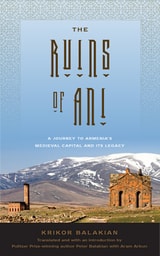
The Ruins of Ani
A Journey to Armenia's Medieval Capital and its LegacyKrikor Balakian
Rutgers University Press, 2019
From the tenth to the thirteenth centuries, the city of Ani was the jewel of the Armenian kingdom, renowned far and wide for its magnificent buildings. Known as the city of 1001 churches, Ani was a center for artistic innovation, and its architecture is a potential missing link between Byzantine and Gothic styles. By the fifteenth century, Ani was virtually abandoned, its stunning buildings left to crumble. Yet its ruins have remained a symbol of cultural accomplishment that looms large in the Armenian imagination.
The Ruins of Ani is a unique combination of history, art criticism, and travel memoir that takes readers on a thousand-year journey in search of past splendors. Today, Ani is a popular tourist site in Turkey, but the city has been falsified in its presentation by the Turkish government in order to erase Armenian history in the wake of the Armenian Genocide. This timely publication also raises questions about the preservation of major historic monuments in the face of post atrocity campaigns of cultural erasure.
Originally written by young priest Krikor Balakian in 1910, just a few years before the Armenian genocide, this book offers a powerful and poignant counterpart to Balakian’s acclaimed genocide memoir Armenian Golgotha. This new translation by the author’s great-nephew, Pulitzer Prize-winning poet Peter Balakian, eloquently renders the book’s vivid descriptions and lyrical prose into English. Including a new introduction that explores Ani’s continued relevance in the twenty-first century, The Ruins of Ani will give readers a new appreciation for this lost city’s status as a pinnacle of both Armenian civilization and human achievement.