Results by title
4 books match the query 'Izbicki, Thomas M.'
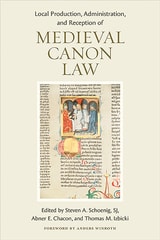
Local Production, Administration, and Reception of Medieval Canon Law
Steven A. Schoenig
Catholic University of America Press, 2026
These nine essays, written by leading experts in the field, focus on the production and application of canon law at the local level. This broad theme permits many subjects to be explored: canonical collections produced in a particular locale by key figures in that area; local manuscript copies of widespread texts; administrative usages and canonical rules for churches within a certain area; specific synodal decrees important to regional ecclesiastical activity and governance; and the reception and adaptation of canonical norms and rules in a particular diocese or other venue. These studies collectively deepen our appreciation of the importance of canon law for people in their home churches and regions. They help us understand canon law in its decentralized, non-papally administered forms, across the full temporal range of the Middle Ages. The special value of these works lies in illuminating the pragmatic role of particular circumstances in adapting the church’s tradition in order to be relevant and to meet local needs.
[more]
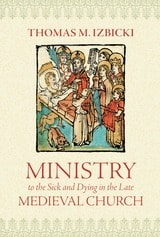
Ministry to the Sick and Dying in the Late Medieval Church
Thomas M. Izbicki
Catholic University of America Press, 2023
The focus of this volume is on ministry to the sick and dying in the later Middle Ages, especially providing them with the sacraments. Medieval writers linked illness to sin and its forgiveness. The priest, as physician of souls, was expected to heal the soul, preparing it for the hereafter. His ministry might also effect healing of bodies, when that healing did not endanger the soul. This book treats how a priest prepared to visit sick persons and went to them in procession with the Eucharist and oil of the sick. The priest was to comfort the patient and, if death was imminent, prepare the soul for the hereafter. Canon law, theology, and ritual sources are employed. Three sacraments, penance, viaticum, (final communion) and extreme unction (anointing of the sick) are treated in detail. Sickbed confession was designed to forgive the ailing person's mortal sins. A priest could absolve a dying person of all sins, even those reserved to a bishop or the pope. Viaticum was to strengthen a suffering Christian for life's last conflict, that between angels and demons for the soul of the dying person. The deathbed thus was a spiritual battlefield. Extreme unction was reserved for those in danger of death, relieving the soul of venial sins or "the remains of sin," even after confession and absolution. The commendatio animae (commendation of the soul) used with the dying was to usher the soul into the afterlife. Many works have been written about attitudes toward death, dying, and the afterlife in the Middle Ages. Likewise, there is a good deal of literature about individual sacraments. This study aims at bridging between these literatures, with a focus on the priest and parishioner in both theory and practice at the sickbed.
[more]
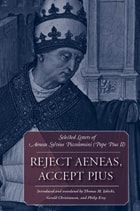
Reject Aeneas, Accept Pius
Selected Letters of Aeneas Sylvius Piccolomini (Pope Pius II)Thomas M. Pius II
Catholic University of America Press, 2006
Aeneas Sylvius Piccolomini (1405-1464, elected Pope Pius II in 1458) was an important and enigmatic figure of the Renaissance as well as one of the most prolific writers and gifted stylists ever to occupy the papacy
[more]
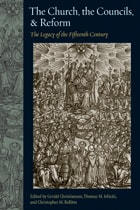
The Church, the Councils, and Reform
The Legacy of the Fifteenth CenturyGerald Christianson
Catholic University of America Press, 2008
The Church, the Councils, and Reform brings together leading authorities in the field of church history to reflect on the importance of the late medieval councils. This is the first book in English to consider the lasting significance of the period from Constance to Trent (1414-1563) when several councils met to heal the Great Schism (1378) and reform the church.
[more]