Results by title

4 books match the query 'J . Edgar Hoover'
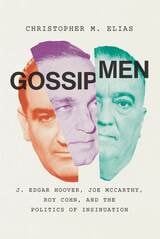
cover of Gossip Men: J. Edgar Hoover, Joe McCarthy, Roy Cohn, and the Politics of Insinuation

Gossip Men

J. Edgar Hoover, Joe McCarthy, Roy Cohn, and the Politics of Insinuation

Christopher M. Elias

University of Chicago Press, 2021

J. Edgar Hoover, Joseph McCarthy, and Roy Cohn were titanic figures in midcentury America, wielding national power in government and the legal system through intimidation and insinuation. Hoover’s FBI thrived on secrecy, threats, and illegal surveillance, while McCarthy and Cohn will forever be associated with the infamous anticommunist smear campaign of the early 1950s, which culminated in McCarthy’s public disgrace during televised Senate hearings. In Gossip Men, Christopher M. Elias takes a probing look at these tarnished figures to reveal a host of startling new connections among gender, sexuality, and national security in twentieth-century American politics. Elias illustrates how these three men solidified their power through the skillful use of deliberately misleading techniques like implication, hyperbole, and photographic manipulation. Just as provocatively, he shows that the American people of the 1950s were particularly primed to accept these coded threats because they were already familiar with such tactics from widely popular gossip magazines.

By using gossip as a lens to examine profound issues of state security and institutional power, Elias thoroughly transforms our understanding of the development of modern American political culture.
 
[more]
cover of Gossip Men: J. Edgar Hoover, Joe McCarthy, Roy Cohn, and the Politics of Insinuation

Gossip Men

J. Edgar Hoover, Joe McCarthy, Roy Cohn, and the Politics of Insinuation

Christopher M. Elias

University of Chicago Press, 2021

This is an auto-narrated audiobook edition of this book.

J. Edgar Hoover, Joseph McCarthy, and Roy Cohn were titanic figures in midcentury America, wielding national power in government and the legal system through intimidation and insinuation. Hoover’s FBI thrived on secrecy, threats, and illegal surveillance, while McCarthy and Cohn will forever be associated with the infamous anticommunist smear campaign of the early 1950s, which culminated in McCarthy’s public disgrace during televised Senate hearings. In Gossip Men, Christopher M. Elias takes a probing look at these tarnished figures to reveal a host of startling new connections among gender, sexuality, and national security in twentieth-century American politics. Elias illustrates how these three men solidified their power through the skillful use of deliberately misleading techniques like implication, hyperbole, and photographic manipulation. Just as provocatively, he shows that the American people of the 1950s were particularly primed to accept these coded threats because they were already familiar with such tactics from widely popular gossip magazines.

By using gossip as a lens to examine profound issues of state security and institutional power, Elias thoroughly transforms our understanding of the development of modern American political culture.
[more]
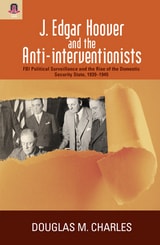
cover of J. Edgar Hoover and the Anti-interventionists: FBI Political Surveillance and the Rise of the Domestic Security State, 1939–1945

J. Edgar Hoover and the Anti-interventionists

FBI Political Surveillance and the Rise of the Domestic Security State, 1939–1945

Douglas M. Charles

The Ohio State University Press, 2007
In this very timely manuscript, Douglas M. Charles reveals how FBI Director J. Edgar Hoover catered to President Franklin D. Roosevelt’s political interests. Between 1939 and 1945, the Federal Bureau of Investigation monitored the political activities of President Roosevelt’s anti-interventionist foreign policy critics. Hoover, whose position as FBI director was tenuous within the left-of-center Roosevelt administration, catered to the president’s political and policy interests in order to preserve his position and to expand FBI authority. In his pragmatic effort to service administration political goals, Hoover employed illegal wiretaps and informers, collected derogatory information, conducted investigations that had the potential to discredit the anti-interventionists, forwarded political intelligence to administration officials, and coordinated some activity with British intelligence. This all occurred within a crisis atmosphere created with the onset of the Second World War, and it was this political dynamic that permitted Hoover to successfully cultivate his relationship with President Roosevelt. In the process, the administration's otherwise legitimate foreign policy opposition—regarded by some as subversive—had their civil liberties violated through intensive FBI scrutiny of their political dissent. Moreover, the FBI’s surveillance marks the origins of the FBI’s role in the later national security state. Among the targets examined in this book are Charles Lindbergh, the America First Committee, notable anti-interventionist senators and congressmen, the anti-interventionist press, and other prominent individuals who advocated American isolation from foreign war.
 
[more]
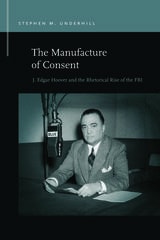
cover of The Manufacture of Consent: J. Edgar Hoover and the Rhetorical Rise of the FBI

The Manufacture of Consent

J. Edgar Hoover and the Rhetorical Rise of the FBI

Stephen M. Underhill

Michigan State University Press, 2020

The second Red Scare was a charade orchestrated by a tyrant with the express goal of undermining the New Deal—so argues Stephen M. Underhill in this hard-hitting analysis of J. Edgar Hoover’s rhetorical agency. Drawing on Classification 94, a vast trove of recently declassified records that documents the longtime FBI director’s domestic propaganda campaigns in the mid-twentieth century, Underhill shows that Hoover used the growing power of his office to subvert the presidencies of Franklin D. Roosevelt and Harry S. Truman and redirect the trajectory of U.S. culture away from social democracy toward a toxic brand of neoliberalism. He did so with help from Republicans who opposed organized labor and Southern Democrats who supported Jim Crow in what is arguably the most culturally significant documented political conspiracy in U.S. history, a wholesale domestic propaganda program that brainwashed Americans and remade their politics. Hoover also forged ties with the powerful fascist leaders of the period to promote his own political ambitions. All the while, as a love letter to Clyde Tolson still preserved in Hoover’s papers attests, he strove to pass for straight while promoting a culture that demonized same-sex love. The erosion of democratic traditions Hoover fostered continues to haunt Americans today.
[more]