Results by title
4 books match the query 'J . M Coetzee'
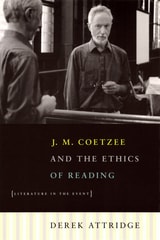
J. M. Coetzee and the Ethics of Reading
Literature in the EventDerek Attridge
University of Chicago Press, 2004
Nobel Prize-winning novelist J. M. Coetzee is one of the most widely taught contemporary writers, but also one of the most elusive. Many critics who have addressed his work have devoted themselves to rendering it more accessible and acceptable, often playing down the features that discomfort and perplex his readers.
Yet it is just these features, Derek Attridge argues, that give Coetzee's work its haunting power and offer its greatest rewards. Attridge does justice to this power and these rewards in a study that serves as an introduction for readers new to Coetzee and a stimulus for thought for those who know his work well. Without overlooking the South African dimension of his fiction, Attridge treats Coetzee as a writer who raises questions of central importance to current debates both within literary studies and more widely in the ethical arena. Implicit throughout the book is Attridge's view that literature, more than philosophy, politics, or even religion, does singular justice to our ethical impulses and acts. Attridge follows Coetzee's lead in exploring a number of issues such as interpretation and literary judgment, responsibility to the other, trust and betrayal, artistic commitment, confession, and the problematic idea of truth to the self.
Yet it is just these features, Derek Attridge argues, that give Coetzee's work its haunting power and offer its greatest rewards. Attridge does justice to this power and these rewards in a study that serves as an introduction for readers new to Coetzee and a stimulus for thought for those who know his work well. Without overlooking the South African dimension of his fiction, Attridge treats Coetzee as a writer who raises questions of central importance to current debates both within literary studies and more widely in the ethical arena. Implicit throughout the book is Attridge's view that literature, more than philosophy, politics, or even religion, does singular justice to our ethical impulses and acts. Attridge follows Coetzee's lead in exploring a number of issues such as interpretation and literary judgment, responsibility to the other, trust and betrayal, artistic commitment, confession, and the problematic idea of truth to the self.
[more]
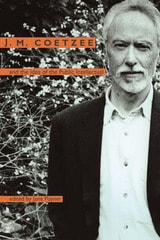
J. M. Coetzee and the Idea of the Public Intellectual
Jane Poyner
Ohio University Press, 2006
In September 2003 the South African novelist J. M. Coetzee was awarded the Nobel Prize for Literature, confirming his reputation as one of the most influential writers of our time. J. M. Coetzee and the Idea of the Public Intellectual addresses the contribution Coetzee has made to contemporary literature, not least for the contentious forays his work makes into South African political discourse and the field of postcolonial studies. Taking the author’s ethical writing as its theme, the volume is an important addition to understanding Coetzee’s fiction and critical thinking. While taking stock of Coetzee’s singular, modernist response to the apartheid and postapartheid situations in his early fiction, the volume is the first to engage at length with the later works, Disgrace, The Lives of Animals, and Elizabeth Costello. J. M. Coetzee and the Idea of the Public Intellectual explores Coetzee’s roles as a South African intellectual and a novelist; his stance on matters of allegory and his evasion of the apartheid censor; his tacit critique of South Africa’s Truth and Reconciliation Commission; his performance of public lectures of his alter ego, Elizabeth Costello; and his explorations into ecofeminism and animal rights. The essays collected here, which include an interview with the Nobel Laureate, provide new vantages from which to consider Coetzee’s writing.
[more]

The Writings of J.M. Coetzee, Volume 93
Michael Valdez Moses
Duke University Press, 0
[more]

Three Sons
Franz Kafka and the Fiction of J. M. Coetzee, Philip Roth, and W. G. SebaldDaniel L. Medin
Northwestern University Press, 2010
Franz Kafka was a self-conscious writer whose texts were highly if mysteriously autobiographical. Three giants of contemporary fiction—J. M. Coetzee, Philip Roth, and W. G. Sebald—have all acknowledged their debt to the work of Kafka, both in interviews and in their own academic essays and articles for a general readership about him. In this striking feat of literary scholarship, Daniel Medin finds that the use of Kafka by Coetzee, Roth, and Sebald is similarly self-reflexive and autobiographical. That writers from such divergent national and ethnic traditions can have such unique critical readings of Kafka, and that Kafka could exert such a powerful influence over their oeuvres, Medin contends, attests to the central place of Kafka in the contemporary literary imagination.
[more]