Results by title
5 books match the query 'Jackson'
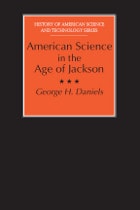
American Science in the Age of Jackson
George H. Daniels
University of Alabama Press, 1968
A foundational history of science, ideas, and professional identity in nineteenth-century America.
American Science in the Age of Jackson is a landmark study that traces the emergence of a distinctly American scientific community during one of the most transformative periods in the nation's history. Focusing on the years between 1815 and 1845, George H. Daniels examines how a loosely connected network of amateur naturalists, physicians, educators, and scientific enthusiasts evolved into a more organized and professional body of researchers united by shared goals, methods, institutions, and intellectual commitments. Through an innovative analysis of leading scientists and the scientific journals that connected them, Daniels reconstructs the foundations of American science at the moment it began to establish an independent identity.
Originally recognized as the first major effort to define an American scientific community, this influential work explores the individuals, publications, and philosophical traditions that shaped scientific inquiry in the early republic and Jacksonian era. Daniels examines the careers and writings of the most prominent American scientists of the period, demonstrating how they built professional networks, established standards of evidence and inquiry, and promoted science as an essential component of national progress. In doing so, he illuminates the institutional development of scientific societies, colleges, journals, and research programs that would lay the groundwork for the nation's later scientific achievements.
Featuring biographical sketches of leading scientists, analyses of early scientific journals, and a detailed examination of the ideas that united the nation's scientific elite, American Science in the Age of Jackson remains a foundational text for understanding the origins of scientific culture in the United States. More than a history of science, it is a history of intellectual ambition, institutional growth, and the pursuit of knowledge in a rapidly changing society. Scholars and students of American history, history of science, intellectual history, philosophy, and nineteenth-century studies will find this volume an indispensable resource for understanding how American science established the foundations of its modern identity.

Medgar Evers
Mississippi MartyrMichael Vinson Williams
University of Arkansas Press, 2011
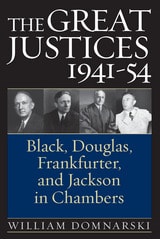
The Great Justices, 1941-54
Black, Douglas, Frankfurter, and Jackson in ChambersWilliam Domnarski
University of Michigan Press, 2006
This is rare and little-examined territory: in the public consciousness the Supreme Court is usually seen as an establishment whose main actors, the justices, remain above emotion, vitriol, and gossip, the better to interpret our nation of laws. Yet the Court's work is always an interchange of ideas and individuals, and the men and women who make up the Court, despite or because of their best intentions, are as human as the rest of us. Appreciating that human dimension helps us to discover some of the Court's secrets, and a new way to understand the Court and its role.
Comparing four brilliant but very different jurists of the Roosevelt Court-Hugo Black, William O. Douglas, Felix Frankfurter, and Robert Jackson-William Domnarski paints a startling picture of the often deeply ambiguous relationship between ideas and reality, between the law and the justices who interpret and create it. By pulling aside the veil of decorous tradition, Domnarski brings to light the personalities that shaped one of the greatest Courts of our time-one whose decisions continue to affect judicial thinking today.
William Domnarski is the author of In the Opinion of the Court (1996), a study of the history and nature of federal court judicial opinions. He holds a J.D. from the University of Connecticut and a Ph.D. in English from the University of California. Domnarski currently practices law in California, where he is also working on a forthcoming biography of legendary Hollywood lawyer Bert Fields.
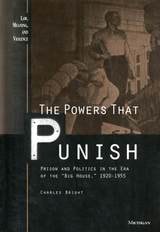
The Powers that Punish
Prison and Politics in the Era of the "Big House", 1920-1955Charles Bright
University of Michigan Press, 1996
In a pathbreaking study of a major state prison, Michigan's Jackson State Penitentiary during the middle years of this century, Charles Bright addresses several aspects of the history and theory of punishment. The study is an institutional history of an American penitentiary, concerned with how a carceral regime was organized and maintained, how prisoners were treated and involved in the creation of a regime of order and how penal practices were explained and defended in public. In addition, it is a meditation upon punishment in modern society and a critical engagement with prevailing theories of punishment coming out of liberal, Marxist and post structuralist traditions. Deploying theory critically in a historic narrative, it applies new, relational theories of power to political institutions and practices. Finally, in studying the history of the Jackson prison, Bright provides a rich account, full of villains and a few heroes, of state politics in Michigan during a period of rapid transition between the 1920s to the 1950s.
The book will be of direct relevance to criminologists and scholars of punishment, and to historians concerned with the history of punishment and prisons in the United States. It will also be useful to political scientists and historians concerned with exploring new approaches to the study of power and with the transformation of state politics in the 1930s and 1940s. Finally Bright tells a story which will fascinate students of modern Michigan history.
Charles Bright is a historian and Lecturer at the Residential College of the University of Michigan.
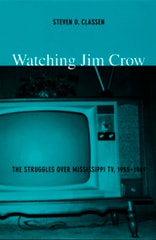
Watching Jim Crow
The Struggles over Mississippi TV, 1955–1969Steven D. Classen
Duke University Press, 2004
During the 1990s, Classen conducted extensive interviews with more than two dozen African Americans living in Jackson, several of whom, decades earlier, had fought to integrate television programming. He draws on these interviews not only to illuminate their perceptions—of the civil rights movement, what they accomplished, and the present as compared with the past—but also to reveal the inadequate representation of their viewpoints in the legal proceedings surrounding WLBT’s licensing. The story told in Watching Jim Crow has significant implications today, not least because the Telecommunications Act of 1996 effectively undid many of the hard-won reforms achieved by activists—including those whose stories Classen relates here.