Results by title
3 books match the query 'Jackson, Bruce'
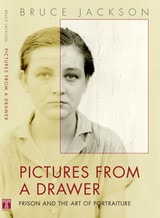
Pictures from a Drawer
Prison and the Art of PortraitureBruce Jackson
Temple University Press, 2009
The Negro and His Folklore in Nineteenth-Century Periodicals
Edited by Bruce Jackson
University of Texas Press, 1967
In the eyes of many white Americans, North and South, the Negro did not have a culture until the Emancipation Proclamation. With few exceptions, serious collecting of Negro folklore by whites did not begin until the Civil War—and it was to be another four decades before black Americans would begin to appreciate their own cultural heritage. Few of the earlier writers realized that they had observed and recorded not simply a manifestation of a particular way of life but also a product peculiarly American and specifically Negro, a synthesis of African and American styles and traditions.
The folksongs, speech, beliefs, customs, and tales of the American Negro are discussed in this anthology, originally published in 1967, of thirty-five articles, letters, and reviews from nineteenth-century periodicals. Published between 1838 and 1900 and written by authors who range from ardent abolitionist to dedicated slaveholder, these articles reflect the authors’ knowledge of, and attitudes toward, the Negro and his folklore. From the vast body of material that appeared on this subject during the nineteenth century, editor Bruce Jackson has culled fresh articles that are basic folklore and represent a wide range of material and attitudes. In addition to his introduction to the volume, Jackson has prefaced each article with a commentary. He has also supplied a supplemental bibliography on Negro folklore.
If serious collecting of Negro folklore had begun by the middle of the nineteenth century, so had exploitation of its various aspects, particularly Negro songs. By 1850 minstrelsy was a big business. Although Jackson has considered minstrelsy outside the scope of this collection, he has included several discussions of it to suggest some aspects of its peculiar relation to the traditional. The articles in the anthology—some by such well-known figures as Joel Chandler Harris, George Washington Cable, Thomas Wentworth Higginson, John Mason Brown, and Antonin Dvorak—make fascinating reading for an observer of the American scene. This additional insight into the habits of thought and behavior of a culture in transition—folklore recorded in its own context—cannot but afford the thinking reader further understanding of the turbulent race problems of later times and today.
The Story Is True
The Art and Meaning of Telling StoriesBruce Jackson
Temple University Press, 2008
Making and experiencing stories, remembering and retelling them is something we all do. We tell stories over meals, at the water cooler, and to both friends and strangers. But how do stories work? What is it about telling and listening to stories that unites us? And, more importantly, how do we change them-and how do they change us?
In The Story Is True, author, filmmaker, and photographer Bruce Jackson explores the ways we use the stories that become a central part of our public and private lives. He examines, as no one before has, how stories narrate and bring meaning to our lives, by describing and explaining how stories are made and used. The perspectives shared in this engaging book come from the tellers, writers, filmmakers, listeners, and watchers who create and consume stories.
Jackson writes about his family and friends, acquaintances and experiences, focusing on more than a dozen personal stories. From oral histories, such as conversations the author had with poet Steven Spender, to public stories, such as what happened when Bob Dylan "went electric" at the 1965 Newport Folk Festival. Jackson also investigates how "words can kill" showing how diction can be an administrator of death, as in Nazi extermination camps. And finally, he considers the way lies come to resemble truth, showing how the stories we tell, whether true or not, resemble truth to the teller.
Ultimately, The Story Is True is about the place of stories-fiction or real-and the impact they have on the lives of each one of us.