Results by title
3 books match the query 'Jackson, Jeremy B. C.'

Bryozoan Evolution
Frank K. McKinney and Jeremy B. C. Jackson
University of Chicago Press, 1991
The authors argue that the growth pattern and form of the colony in many bryozoans is an adaptive strategy rather than a stable genetic character.
"Bryozoan Evolution is profusely illustrated and has a bibliography of over 400 titles. It will find an appreciative audience of paleontologists, invertebrate zoologists, and ecologists thanks to its innovative and detailed evaluations of the roles of ecology, adaptive and functional morphology, life histories, biomechanics, developmental constraints, and chance on the evolution of the marine taxa of this speciose group."—Russel L. Zimmer, Science
"This book is an excellent source of information on the functional morphology and variety of colonial architecture in bryozoans, very well illustrated, and worth reading at least twice."-Robert L. Anstey, Paleobiology
"Even as one of the converted, I found the book a stimulating combination of paleobiology and ecology. In many ways it is a 'teaser'-the authors suggest a number of interesting hypotheses, and can test only some of them. Perhaps most important, McKinney and Jackson provide a plethora of fascinating ideas and examples that demonstrate the potential of this group of animals, and that should stimulate more work."-Michael S. Keough, TREE
"This stimulating book is sure to promote further interest in bryozoans. It will appeal to biologists and paleontologists alike."-Paul Taylor, Times Higher Education Supplement
[more]

Evolution and Environment in Tropical America
Edited by Jeremy B. C. Jackson, Ann F. Budd, and Anthony G. Coates
University of Chicago Press, 1996
How were the tropical Americas formed? This ambitious volume draws on extensive, multidisciplinary research to develop new views of the geological formation of the isthmus linking North and South America and of the major environmental changes that reshaped the Neotropics to create its present-day marine and terrestrial ecosystems.
Recent discoveries show that dramatic changes in climate and ocean circulation can occur very quickly, and that ecological communities respond just as rapidly. Abrupt changes in the composition of fossil assemblages, formerly dismissed as artifacts of a poor fossil record, now are seen as accurate records of swift changes in the composition of ocean communities.
The twenty-four contributors use current work in paleontology, geology, oceanography, anthropology, ecology, and evolution to paint this challenging portrait of rapid environmental and evolutionary change. Their conclusions argue for a revision of existing interpretations of the fossil record and the processes—including invading Eurasian peoples—that have produced it.
[more]
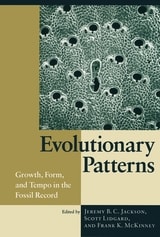
Evolutionary Patterns
Growth, Form, and Tempo in the Fossil RecordEdited by Jeremy B. C. Jackson, Scott Lidgard, and Frank K. McKinney
University of Chicago Press, 2001
With all the recent advances in molecular and evolutionary biology, one could almost wonder why we need the fossil record. Molecular sequence data can resolve taxonomic relationships, experiments with fruit flies demonstrate evolution and development in real time, and field studies of Galapagos finches have provided the strongest evidence for natural selection ever measured in the wild. What, then, can fossils teach us that living organisms cannot?
Evolutionary Patterns demonstrates the rich variety of clues to evolution that can be gleaned from the fossil record. Chief among these are the major trends and anomalies in species development revealed only by "deep time," such as periodic mass extinctions and species that remain unchanged in form for millions of years. Contributors explore modes of development, the tempo of speciation and extinction, and macroevolutionary patterns and trends. The result is an important contribution to paleobiology and evolutionary biology, and a spirited defense of the fossil record as a crucial tool for understanding evolution and development.
The contributors are Ann F. Budd, Efstathia Bura, Leo W. Buss, Mike Foote, Jörn Geister, Stephen Jay Gould, Eckart Hâkansson, Jean-Georges Harmelin, Lee-Ann C. Hayek, Jeremy B. C. Jackson, Kenneth G. Johnson, Nancy Knowlton, Scott Lidgard, Frank K. McKinney, Daniel W. McShea, Ross H. Nehm, Beth Okamura, John M. Pandolfi, Paul D. Taylor, and Erik Thomsen.
[more]